

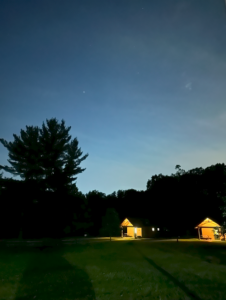
 I wish I could see in the dark.
The thought has crossed my mind many nights walking in the dark after I’ve heard an unsettling sound nearby. While the sky wasn’t too dark last week on our staff night hike, I thought of campers who might also experience heightened fear when darkness comes along.
The past two weeks I’ve been in summer staff training at the Dunes Learning Center inside the Indiana Dunes National Park. We’ve been learning the intricacies of camp while also trying out activities we’ll lead with campers. Last week we practiced the night hike we take campers on, and I was reminded how limited my sight is at night. Being a camp based in environmental education, we also learned about nocturnal animals like bats, raccoons, and owls. They all are adapted to the dark: bats use echolocation, racoons feel especially well with their paws, and owls have eyes built for the night. Each is tuned to function well in the darkness. I am not.
 This week marks my second week working with Heartland Alliance’s Refugee and Immigrant Community Services Program! As I’ve been reflecting on the start to my internship with Heartland, it seems like every day has brought new learning, new challenges, and in particular, new excitement. At the beginning, all I could think about was how nervous I was as I tried to navigate a different environment. The first challenge that I faced was driving through Chicago alone – which, up until last week, I had promised myself that I would never do. I remember setting my alarm super early on that first day, to plan in advance for the fact that I would probably miss at least 2 exits on the expressway. But even with the extra-early start, I quickly realized that Chicago traffic is way more unpredictable than I had planned for. I swear I could hear the traffic’s evil laugh as I rounded a bend in the highway and beheld an endless line of brakelights swarming the W. Lawrence Avenue exit ramp. After arriving at the office, I parked, walked across the street, and rang the doorbell to be let in. Inside the lobby, there were comfortable couches and a reception desk, where my supervisor met me before taking me on a tour of the office. As we walked through the various hallways and passed by the conference rooms and common areas, my supervisor smiled and told me, “Don’t worry if you don’t remember everything I’m going to tell you on this tour, because I know it’s a lot”. I know this statement sounds insignificant, but it helped put my mind at ease, and reminded me that it’s okay to not know how everything works right away.
After that first day, I spent the rest of the week learning more and more about the incredible work that Heartland does across the city of Chicago. As I’ve started to understand what the Refugee and Immigrant Community Services team does each week and the processes that the team goes through to take in new participants and place them into jobs, I’ve found myself becoming increasingly excited for what the rest of my internship will hold. I’ve also been really enjoying learning about refugee policies and the rights that refugees and asylees have when they come to the US. Prior to this internship, I had never done research on or looked into refugee rights before, and I’ve found it to be really interesting – especially in the present-day, with many of these topics taking center stage with the current political climate. While thinking about my calling and purpose throughout the CAPS program so far, I’ve been considering how these subjects of interest might play a role in my vocation in the future. Since starting college, my attention has consistently been drawn to refugee/immigration issues and policies – so with this internship focusing on those things in a non-profit setting, I’m curious to see where that might lead me in my search for calling and purpose.
Nora Fisher, Heartland Alliance

Throughout this summer, I will be updating the membership database by reaching out to members
through calls and emails. I am excited to speak with a variety of people and hear why they love and support
Save the Dunes. I will also be continuing the process of inventorying our archives and picking out the gems.
In my first few days, I spent a lot of time learning about Save the Dunes’ history and getting myself
acclimated. On May 28th, I had the privilege of attending a tour of some Grand Calumet River Areas of
Concern (AOC). The event was put on by the Nature Conservancy. They have spent a lot of time remediating
these sites back to what they once were. The area consists of a unique ecosystem called dune and swale. It
features alternating sandy ridges and low wet areas that repeat. From an aerial view, it looks like corduroy.
caught my attention was the location. These areas were sandwiched between steel mills and refineries. I
asked myself how such beauty could exist among the pollution and industry. This day in particular, I was
really struggling with my purpose. It was my first full week at Save the Dunes, and I was struggling with what
I was there for and if I was worthy of the position. Oddly enough, seeing these properties was comforting.
Knowing that, with some love, care, and patience, this land was able to thrive under the pressure from the
industry surrounding it gave me some reassurance that I would be ok. Much like the sites, I just needed a
little time and attention to find my footing.
I can now say confidently, after two weeks, that there is immense beauty in the in-between. I may
only be there for the summer, but my work is important and needs to be done. I have found meaning and
purpose in the work that I am doing while discovering skills and interests that I never knew I was capable of. I
may not know everything, and sometimes I will doubt myself. But, if I have learned anything these past two
weeks, it’s to give myself grace and find the beauty within the moment.
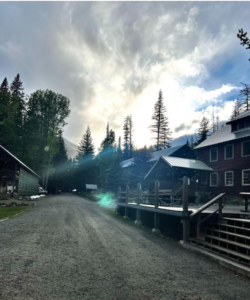 From the ecstatic moment a person arrives at Holden Village, an iconic retreat center located in the heart of Washington’s North Cascades Mountains that offers visitors a unique opportunity to step into the wilderness they are greeted with a “Hosti”. This person designs a sign with your name on it to welcome you to the village and answer any questions you may have. From the moment the school bus with Holden Village written on the side was in sight of the village entrance all the way to the time I stepped off said bus I was greeted by most, if not all, of the village waving at me and cheering for my arrival. Before even getting to the village I was required to complete a Child Safety Training which is crucial to the safety, comfort, and well-being of the children that reside in Holden Village.
I realized that I’ve been saying Holden Village a few times now and some people might not know anything about it. First I want to acknowledge the original people living on this land. We live and gather upon the homelands of the Chelan, the Entiat, the P’Squosa, the Wenatchi-Colville and the Wenatchi-Yakama Tribal Nations. And we commit to resisting erasure of Indigenous people and stories, following Native leadership, and centering tribal voices. Here is some more info on the history of Indigenous people in the area of Holden Village. The official organization “Holden Village” started as a copper mining town. Here is a little bit about that copper mining history.
Everyone’s travel choice is different when coming to Holden but my journey getting here was very elaborate. My mom and I drove two hours to the airport with stops. We took a 4 hour plane ride from Chicago to Seattle. Then we drove another 4 hours to Chelan, Washington where we stayed in a hotel for the night to then get on at a different boat landing than originally planned. The boat ride was about 45 minutes and then we got on a 45 minute school bus ride to Holden Village.
After finally, arriving at Holden my first thought was, is this a commune? But I later came to learn and humbly understood that it is simply a very rustic, community oriented place where everyone plays a role in the village. After 10+ hours of travel it was overwhelming but comforting to arrive to a warm welcome. I started at Holden around mid-May and I have been working as an Education Assistant where I have accomplished: making flyers to promote the incoming presenters(“teaching faculty”) and guest musicians for each week, setting up housing accommodations for teaching faculty and their guests for each of the 12 weeks of the summer, and setting up info about each faculty session/program per week. Soon I will move to working in “Narnia” the Village school where I will be working with the youth program coordinator. There I will be helping create curriculums and helping out with youth programming.
Esai Hernandez, Holden Village
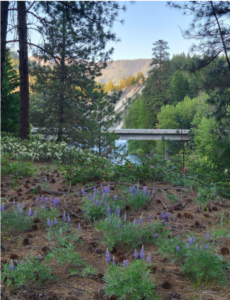 It’s now been almost a week that I’ve been at the Grunewald Guild here in the mountains of Washington state, and I’m thoroughly excited for the months ahead. I’m staying in what’s called the Riverhouse, as it directly overlooks the river flowing 50 feet away from the back porch. This porch is one of my favourite places so far to sit and enjoy the area, as it’s fully screened in to keep the bugs away (mosquitos remain my arch-nemesis) and is beautifully lit with string lights in the evenings. The quiet rush of the flowing water is a constant and peaceful sound, and a wide range of birds fill the trees and air with their calls too. (There’s one critter that makes a fascinating little clicking sound sometimes and I can never find it, but it intrigues me.) I was surprised by how windy it gets here in the side of the valley given the mountains on either side and the tall pines packed pretty densely around us, but the breeze is nonetheless refreshing and gives the sense that the forest itself is breathing. There’s really just so much about the space here that I love, everything seems so contentedly alive and welcoming – the bright purple and red-orange flowers, the neon lime green moss, and the spiders weaving intricate lace across the corners of the porch.
Most of the projects I’ve been helping with so far have been focused on organizing and cleaning up some of the studio spaces in preparation for the start of summer programming, but today I helped ‘turn’ a bunch of the bedrooms, larger shared spaces, and outdoor landscaping to get them ready for when more guests come in a couple weeks. With the help of 3 other full-time staff members and a resident artist, we cleaned bedrooms, bathrooms, and studio and living spaces in four different buildings. Making beds and preparing bedding bundles were some of my favourite tasks, as well as wiping down all the surfaces and cleaning mirrors. We also walked quick loops around the buildings to check for wasp and other pest nests, and made sure all supply cabinets were stocked, whether with linens or a wide range of art supplies.
When I’m not helping organize and prepare spaces though, the staff here are really supportive and encourage me to explore my creativity and express the inspiration I experience. The campus is beautifully curated to inspire this sort of reflection and thoughtful consideration of the surroundings and one’s place within them, and that’s one theme I’ve been pondering more recently. The experience I’ve already had here in the mountains of Washington has been overwhelmingly one of intimate connection and intentional relationships both with the natural environment, and with the staff, volunteers, and guests here at the Guild. I’ve been trying to develop a better understanding of my relationships with the communities around me, and the time I’m spending here is definitely a helpful stepping stone in crossing that river.
Bianca Olfert, Grunewald Guild
On a basement bookshelf of my home sits a framed photograph I’d forgotten about until recently. In that picture, I’m beaming in cap and gown, flanked on either side by my smiling parents as we stand in the backyard garden of a former landlord’s property. That day was muggy and hot (not surprising for May in South Carolina), and I remember my nervous anticipation on that celebratory afternoon–the kind of feeling where you’re not sure if your stomach is buoyed with breathless excitement or clenched in apprehension…or, more likely, both. Either way, you’re holding your breath a bit more than usual.
While milestone moments can seem cliched to focus on, they do often define real junctures, and mine that afternoon certainly did.
I had made all sorts of plans, convinced that I needed to map things out in particular ways. Some of those plans would take dramatic turns I could not yet imagine and most assuredly would not have signed up for. Other parts would morph and unfold far more powerfully and beautifully than I could have sketched out on that May afternoon.
Among the many adventures that I was about to embark on: beginning a graduate program in literature and learning “officially” to teach through pedagogy coursework and through the mother of all learning–critical, sometimes painful experience. All of 22 years old and only a handful of months removed from my own college graduation, I would don blazers and heels to feel more authoritative in those Texas university classrooms as a graduate instructor.
My anxiety to underscore my competence (while understandable) belied the potent force behind transformative teaching and learning: generous reciprocity. I needed–and eventually would come to appreciate–a necessary shift in posture, an openness to being shaped, challenged, and strengthened by the community around me (which I could not control or even fully plan for). Balancing an evolving awareness of and gratitude for self and world is no easy matter; indeed, it proves a fragile, precious thing vital to our own development.
Early in his stunning, slim volume Let Your Life Speak, Parker Palmer writes:
With twenty-one words, carefully chosen and artfully woven, May Sarton evokes the quest for vocation–at least, my quest for vocation–with candor and precision:
Now I become myself.
It’s taken time, many years and places.
I have been dissolved and shaken,
Worn other people’s faces…
What a long time it can take to become the person one has always been! How often in the process we mask ourselves in faces that are not our own. How much dissolving and shaking of ego we must endure before we discover our deep identity–the true self within every human being that is the seed of authentic vocation.
Later in the same chapter, Palmer hints that this process of “authentic” self-discovery is never one of rugged individualism (certain US cultural narratives be damned), but rather something inextricable from the relationships and communal ecosystem surrounding us. We discover and respond to both this sense of self and world, growing and evolving in an always ongoing journey of life-giving reciprocity.
I’ve been thinking more about Palmer lately, in part because of some other work I’m involved in and in part because I’m daily reminded of impending graduations. Our soon-to-be alumni are making the rounds to say goodbye, to share life updates, and to tend to the many details that accompany a leavetaking and life “threshold” moment. These graduates have insight into the delicate balance of “self” and “world” in ways I find admirable and inspiring. They are preparing to lead and especially to serve with grace, humility, and honesty.
In two days’ time, this Friday, May 9th, at 5pm you have the opportunity to see what I mean. Graduating seniors Kuda Chikonyora, Noemi Vela, and Natalya Reister will speak at Baccalaureate–a ceremony preceding Saturday’s commencement programs and one that literally comes full circle from graduates’ convocation four short years ago. Gathering in the Chapel of the Resurrection, standing before the mosaic of sacred stories pieced together in stunning stained glass, each will offer their own story as they reflect on their time at Valpo and the myriad ways they have been shaped by and come to understand the value of community and service.
Kuda heralds this gift as ubuntu, noting the reciprocal showing up and supportive learning animated in robust communities. For Noemi, cultivating one’s self-knowledge and respect engenders honest engagement with the wider world, nurturing boundaries that revitalize relationships. Natalya reflects that ‘service,’ properly understood, is not so much a way of doing as a way of being–something that radiates outward to reinforce in a million small ways what ultimately adds up to both an inheritance and a legacy.
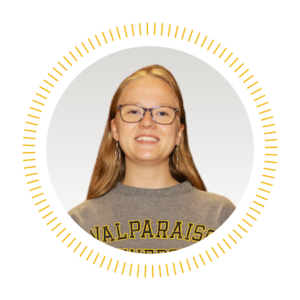
Natalya Reister

Kuda Chikonyora

Noemi Vela
Would that we all remember and honor these charges from our eloquent student speakers. We discover ourselves and our calling in service–the deep, honest, reciprocal engagement with the community and world around us. It is a gift we imperfectly proffer, and in so doing must also gracefully receive.
– Dr. Anna Stewart, Director of the Institute for Leadership and Service
The Institute for Leadership and Service is dedicated to preparing students for lives of leadership and service—lives shaped by a sense of calling, equipped for thoughtful reflection, engaged in the larger world, and responsive to its deepest challenges.
The unflinching memorist Dorothy Allison writes, “Two or three things I know for sure, and one of them is that telling a story all the way through is an act of love.” A thorough and full accounting is indeed an act of love, and even an act of service.
Following a meaningful spring break service trip in northwest Indiana several weeks ago, I might amend Allison’s formulation a bit further: telling a story all the way through is an act of love and service…and so is attending to that story–listening compassionately, for understanding, and then figuring out what it means to hold and carry that story forward.
In a week spent criss-crossing northwest Indiana and south-southwest Chicagoland, we (Anna and Kat from the Institute for Leadership and Service) joined eight Valpo students on a journey to hear story after story–some ecology, some art, some history, some activism, some sociology – while participating in hands-on service projects related to our region’s grappling with environmental justice.
We visited National Parks, local museums, green spaces in Chicago, an urban garden in Gary, land preserved in trust in Valparaiso and Hammond, and a local farm while we interrogated questions of land access and power imbalances, the pros and cons of industrial development, food deserts and the burgeoning urban garden movement, local agriculture, and native and invasive species in conservation work.
Again and again, we witnessed this region’s beauty, potential, and fragility. It is a place of interlocking species and stories, held together by shared earth, water, and air–a place intimately shaped by the forces of nature as well as the people within it.
In last week’s CSL newsletter, Pastor Kate reflected on the profound “gift of hearing a community’s story [during a spring break service trip]–bearing witness to their tragedies and their triumphs.” We felt similarly humbled by that opportunity here in Indiana, as we learned and served alongside people doing all manner of good work in this corner of the world–from park rangers and “guerilla gardeners” to community artists and activists. In the spirit of valuing stories and perspectives, we offer below the reflective takeaways from some of the students we were fortunate enough to accompany on our early March trip.
Melanie
The regional service trip highlighted the importance of understanding stories both personal and historical. Every place we went to had its own background story, shaped by its people, environment, and history. Understanding these stories helped us connect with the land around us, fostering empathy, respect, and a deeper appreciation for diverse cultures and experiences. By learning about the challenges of the communities we visited, I better understand the broader issues they face and how we can contribute to positive change. Stories help us see the bigger picture and find meaning in the actions we take.
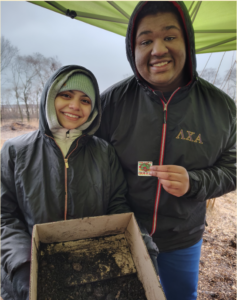
Student Leaders Melanie and Adam help with seed planting for this year’s Juneteenth celebration at Nichol’s Park in Midtown Gary.
Adam
Having this regional trip helped me to continue seeing the world in a different light. Doing hands-on service is nice, but it’s always harder to bring the lessons of a roof repair or hurricane relief work to NW Indiana. However, listening to stories about families within and just beyond VU’s walls resonated with me more easily, and also made me feel that I was having an impact in my community. It’s too easy for us to say “this is a problem, but it’s not happening where I’m from”, but this trip forced us to confront these questions in our own backyards.
Abby
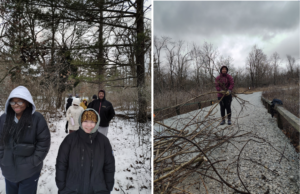
Abby and other students explore the Indiana Dunes National Park and help remove invasive species to make space for an upcoming stream monitoring project.
This service trip really made me understand our environment in a different way, both culturally and naturally. I have always thought that gardening was hard to accomplish in Indiana, and that you need the perfect land to do so, but through learning about sustainable gardening, and the different ways you can re-plant food, I have been proven wrong. It was really interesting to participate in this kind of service trip, one that combined our current understanding of service, with one that sees service as learning, giving time instead of giving physical labor. Doing both helped me broaden my worldview, and I will take that forward to work that I do in my church and community.
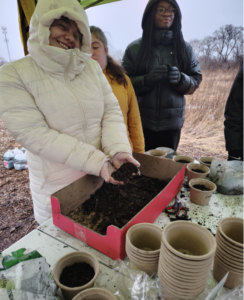
Ximena gets her hands dirty while practicing winter sowing for the Juneteenth plant giveaway.
Ximena
As a first year student, I was anxious as to what my first service trip would be. I had never done outdoor service and it honestly scared me. However, this trip helped me see many ways one can do service. We started our trip by learning about our environment and history from not only Indiana but Illinois as well. Our group worked on looking past the “front cover” of cities and looking at its inside work. We learned about different viewpoints and how a community can overcome its struggles. Through this service trip, although we did do some physical labor, we learned to listen and carry the stories we learned and how that is also an act of service.
Dallas
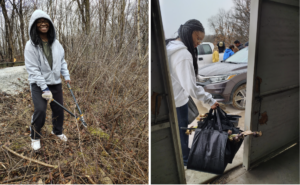
Dallas helps with invasive plant removal and with packing totes full of locally grown produce for new moms in the WIC program.
Our Spring Break Service Trip was a very unique experience for me that helped to deepen my personal understanding of how different communities come together. Throughout the duration of our trip we learned about some of the business decisions that caused some of the largest environmental and social issues in Northwest Indiana and Chicago. Personally, I’m still amazed at how much damage can be done to one community in such a short period of time. Every area we visited challenged me to strengthen the value of listening to help learn from those we want to serve. It was truly moving to see how much it meant to them that we simply took the time to listen and understand their situation.
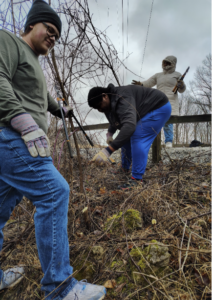
Jake helps with invasive plant removal at the Shirley Heinze Land Trust Meadowbrook Nature Preserve.
Jake
Coming from someone who isn’t from the area, there was a lot of learning to do on this trip. Our service trip focused on learning a lot. Each day left me with a greater understanding of the places we visited, because we took the time to learn about where we were, and the communities present. Learning about the unique geography of Northwest Indiana served us well, but it’s something that would benefit all service trips. Similarly, getting to connect with the people we were helping first rather than simply getting to work immediately enabled us to further understand the impact of our efforts. I strongly believe understanding and service go strongly together hand in hand after this; understanding the context behind the need for the service is just as important as the service itself.
Carolyn
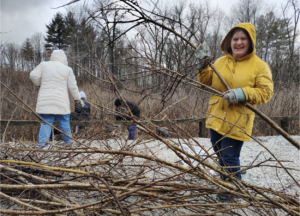
Carolyn helps with plant removal to make way for an upcoming stream monitoring project.
It’s impossible to truly be of service without understanding the communities you’re serving and why you’re doing it. Without knowing the background behind the struggles a given community is experiencing, it’s impossible to address them effectively. During this trip, we were intentional about educating ourselves on the background behind the environmental issues northwest Indiana and Chicago are facing, and how they have historically impacted our area. It’s only in light of this knowledge that we were able to truly understand the context and importance of the current work that organizations are doing in our communities. By understanding why they’re responding the way they are, we were able to work with these organizations rather than simply for them to genuinely meet their needs.
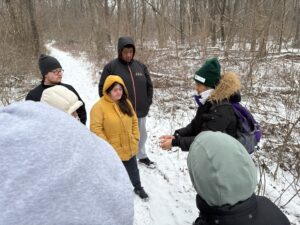
Dunes Learning Center Fellow Lisa explains native and invasive species in the Indiana Dunes National Park, on our way to the Maple Sugar Time Festival at Chellberg Farm.
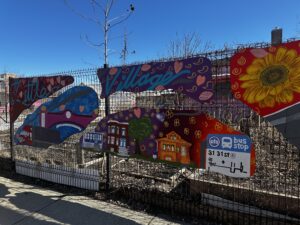
Murals created by local youth and families at the La Villita Park community garden in Little Village, Chicago.
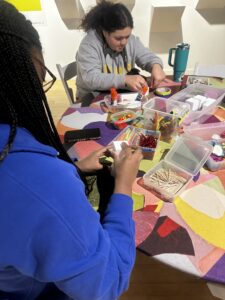
Dallas and Jazzy create their own art as part of the Ordinary Wonders exhibit at the Lubeznik Center for the Arts in Michigan City.
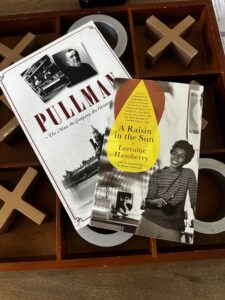
Two ways to think about land, power, race, and industry in our area: the Pullman National Monument, and Lorraine Hansberry’s “Raisin in the Sun.” We experienced both live and in person this Spring Break.
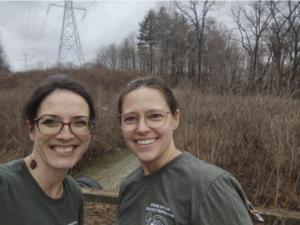
ILAS Director, Anna Stewart, and Assistant Director, Kat Peters. We both feel so fortunate to have been on this trip with an amazing group of thoughtful, talented, and engaged students.
As a young toddler–bright-eyed and babbling happily–I loved few things more than a good story. I was known to pad into a room, book in tow, while clamoring for what I cheerfully called a “once-a ponce-a.” So many children’s books and fairy tales, after all, take narrative flight with the well-worn opening line, “Once upon a time…” Hence, my half-comprehending shorthand. Slightly older and intent to share (force?) my love of story on my younger sister, I would solemnly intone the beginning for her the same way (to the doubtless mirth of any nearby adult). Nevertheless, “once-a ponce-a” rapidly became a family expression.
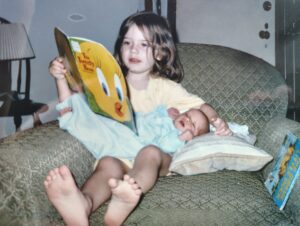
Perhaps I could channel this tale from childhood into destiny, invariably paving the way to my status as a justified book nerd with a doctorate in literature. A little tidy, but not without some merit.
Actually, though, this early anecdote has been on my mind recently for another reason: as a testament to the enduring power of story; a reminder of the propulsive force of narratives as avenues to deeper truths sometimes difficult to recognize in our workaday lives. As humans, we make sense of the world and the people around us through the stories we tell ourselves and others. Whether we pause to acknowledge this instinctual process or not, our story-making still wields tremendous power for how we show up and move through the world.
Knowing this, we can lean into the power of stories as a way of making sense of complex experiences and realities in our adult lives. By being more self-conscious in this process, perhaps we can also tell each other and ourselves truer stories to counteract the dishonesty that pervades our current culture.
Moreover, narrative agency is crucial to our vocational discernment and our educational journeys, and lately I’ve been particularly delighted to find deeper, common cause around this idea with friends and colleagues from a variety of disciplines and perspectives doing some amazing work on our campus. Dr. Reva Johnson in the College of Engineering has been training in, and drawing on, “story-driven learning” to help students more intentionally scaffold connections between scientific and narrative modes of understanding, between their personal and professional experiences and identities. In newly reimagined VUE courses, students’ topics of study meet active, experiential learning in fieldwork–whether they might be gardening, or volunteering with a local non-profit, or cooking, or exploring historic campus spaces, or observing peer-led organizations as sites of learning-in-action. Their reflections around these experiences can become avenues into deeper self-awareness about the ways they show up in the world, exploring the nuance of leadership and service. Meanwhile, in the honors college, Dr. Amanda Ruud marshals lively ideas from deep discussion about justice, community, and “the good life” to facilitate first-years’ inspiring creation of an original piece of musical theatre–a dramatic account of the conversations and ideas they’ve been wrestling with, making sense of the complex in story and song. It’s all really quite remarkable, and these are but a few potent examples of intentional story-making as avenues to deeper understanding and work in the world happening right here at Valpo.
At the risk of completely nerding out on everyone reading this reflection (sorry, not sorry), some of the most influential work around narrative identity and agency coming out of the social sciences hailed from none other than a Valpo alum, Dr. Dan McAdams ‘76 (Psychology and Humanities, CC Scholar), now professor emeritus at Northwestern University. McAdams pioneered a field urging scholarly study of our own narrative constructions and their power to shape who we are and who we become. (You can read more about his work here.)
Our story-telling matters, and it does real work, both in the world and in the ways we understand our own showing up and agency in that beautiful, broken, ever-evolving world. As a former colleague regularly reminded me–citing novelist Tim O’Brien’s powerful and true line: “Stories can save us.” Of course they can. One need look no further than the New Testament parables.
Less than a week ago, I had the privilege to observe this power anew as current Valpo senior Natalya Reister offered a poignant reflection at Morning Prayer, bearing witness to the ways our stories to ourselves can make and save us. (If you didn’t get a chance to be there in person, I would urge you to check out her moving remarks here on the Valpo Chapel YouTube channel.) Natalya recounts the overwhelm so many of us can attest to at the start of a new chapter in our lives, recalling herself as a first-year student huddled in the Lankenau chapel unable to see the bigger story she is part of and sometimes slowly, painfully helping to write. In her reflection, she casts herself back to this time, addressing a younger version of herself with tenderness and a deeper sensibility of things coming together in ways she cannot at that time see but must learn to implicitly trust:
“[R]ight now, you’re sitting in the Lankenau chapel, and you feel alone. And that’s okay too. It is a part of your journey and God isn’t going to give up on you. Our lives are a mural of experiences and stories. At the moment, though, you are living and focusing on just a small little corner. You don’t yet see the artistry in the narratives God is painting. So take a breath and slow down. The sorrows and the hurts are real, but they are not the end of the story.”
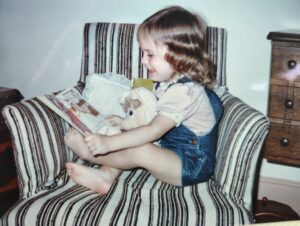
Would that we all would take that sort of tender care, choosing to narrate gently and truthfully from our own empowered voices… while also never forgetting that we are not, blessedly, the end of the story. We offer our “once-a ponce-a,” now and always, in a transcendent narrative frame.
–Dr. Anna Stewart, Director of the Institute for Leadership and Service
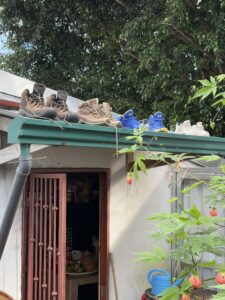
It turns out the roof is a great place to dry boots and shoes in Costa Rica.
The tap, tap, tap on the metal roof turned into pitter-patter-pitter-patter, and my mother-in-law and I looked at each other with an expression of urgency. The clothes we had hung outside on the line the day before hadn’t dried, and for fear of night-time rain we had brought them in, damp in their hamper near the back door. On this particular morning we had optimistically re-clipped them to the metal wire spanning the entire yard from the neighbors’ wall to the side of the house. It had dawned clear over the mountains, but seemingly out of nowhere the clouds had rolled in, and it was now raining in what should have been the first days of the dry season in Costa Rica.
In looking at our clothes and shoes and hiking boots in the backyard, it struck me that clothes-drying is a kind of microcosm for understanding vocation. Discerning vocation asks us to consider how we respond to a particular moment, within specific limitations and parameters. Our lives, routines, and identities start getting built around the ways we repeatedly respond to particular moments, with particular details, opportunities, limitations, and parameters. How do we respond when we depend on sunshine to dry our clothes, and it is now raining? We drop everything and run outside.
What other limitations and parameters do you notice that determine your daily vocations? Perhaps the cry of a baby or small child gets you out of bed each morning. Perhaps aches and pains determine the way you use stairs or inform an exercise and stretching schedule, or a larger illness forces you into an early retirement. How about other larger vocations? Perhaps housing prices influence your decision of whether to buy or sell. Or perhaps a particular injustice inspires you to work for societal change as a career or as a “side hustle.”
Middle class United States culture is pretty determined to prevent and mitigate as many limitations as possible. We purchase appliances to save time, program our smartphones to anticipate and complete tasks, and engage in as many “life hacks” as possible to maximize productivity. Our scientists look for ways to prolong life and increase crop yields, and our engineers seek out ways to get more mileage and battery life out of our technology.
And it’s true – some limitations are not fair or acceptable. As I was struggling to get my clothes dry this past rainy December, there were women in many countries of the world struggling to dry the rags they use to manage their menstruation. Overcoming such a limitation can mean the ability to finish school or find a job for millions of women and girls around the world.
Injustices and exploitation place unfair limits on the lives of so many: those without access to even public transportation, let alone an electric vehicle; those who live in food deserts, unable to access healthy food that sustains a healthy life; those who cannot access even basic health care and suffer from illnesses that many of us don’t think twice about. We as a society need to fix these limitations.
And yet, what happens when those of us who are allergic to limitations begin to embrace a few, or understand the opportunity that our limitations represent? On one of the mornings I spent rehanging damp clothes in Costa Rica, I heard the cacophony of screeching parakeets that gather in the trees of local parks in the city. The sound kept getting louder and louder as I clipped clothing to the line, and soon I saw huge clouds of perhaps one thousand parakeets in all flying across the blue sky, west to east, their screeches and silhouettes calling out the start of the day. A sight I would not have seen if not for my need to greet the sunny morning with clotheshanging. I exhaled, and felt a deep gratitude for such a day settle deep into my chest.
In a recent podcast of the Ezra Klein Show, Klein interviewed Oliver Burkeman, author of “Meditations for Mortals: Four Weeks to Embrace Your Limitations and Make Time for What Counts.”
In their conversation, Klein shared a meditation that he practices that reminds him of his finite nature, and Burkeman’s response concurred:
“So many of the things that we call “self-improvement” can be best understood as a structure of emotional avoidance so that we don’t have to feel how uncomfortable and claustrophobic it is to actually be who we are as finite individuals.
“…I think the point is that when you really begin to let it permeate you that we are of the nature to be finite, you get to exhale. You get to let your shoulders drop. Not in order to veg out but precisely to move forward to do the most meaningful things with your day. It’s a refocusing.”
What limitation have you been fighting in your life? What possibilities may open up if you embrace this limitation? What new gratitude, what new path, might become available to you? What unjust limitations can you become aware of, even as you seek to embrace your own finite nature?
Read more about our total dependence on the sun for food and energy on the Living Connected blog, written by Lutheran Deaconess and environmental engineer Katrina Martich, and engage in reflective practice on the gifts of creation.
- Deaconess Kat Peters, M.Ed., M.A., Assistant Director of the Institute for Leadership and Service
The Institute for Leadership and Service is dedicated to preparing students for lives of leadership and service—lives shaped by a sense of calling, equipped for thoughtful reflection, engaged in the larger world, and responsive to its deepest challenges.