

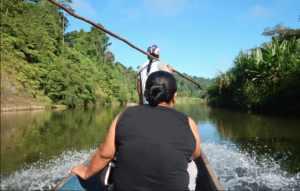
Members of the community of Yorkin, on a canoe of the STIBRAWPA association. Photo used with permission from https://enstibrawpayorkin.wordpress.com/images/
I have seen a saying around campus in the past few weeks, in the Student Life Administration window, in the Valparaiso University Center for the Arts Box Office: “Fall is proof that change is beautiful.” It’s true, fall is beautiful. However, I was thinking that perhaps we need the reminder by way of a catchy saying because we don’t often feel that change is beautiful. In fact, it can be downright scary.
Everywhere I turn, people are reflecting on change. The Institute’s Listening for Purpose podcast Season 2 Episode 2, an interview with Valpo senior Reahlyn Bryce (which was released on November 12, 2024), is all about change and beauty in inspiring songs. Reahlyn and Listening for Purpose host, senior Simeon Klepac, discuss the impending transition facing seniors as they finish out their time at Valpo and make plans for the future.
Whenever I attend higher education conferences, colleagues discuss changes on their campuses that make the future uncertain and require adaptation. A change in national administration always brings uncertainty, and many people from all sides of the political spectrum expect the upcoming administrative change to be paradigmatic.
How do we discern our calling and vocation in such times of change and uncertainty? How will our calling change in the impending future? Does impending change bring us hope? Fear? Is the change one that we wanted, or one that was forced on us? Does it bring us deep happiness, or is it full of sadness and regret?
For many people, the question of vocational transition is not merely intellectual or emotional, but real and material to their lives.
During the height of the Covid-19 pandemic, I wrote about women that I know in Costa Rica and Northwest Indiana who responded to uncertainty and crisis with creativity and grit that opened up new possibilities for their families and communities, despite great hardship. The loss of tourism income, the decline of fish populations for island dwellers, the need to take a step back from college – all were setbacks, but the vocational resilience of these women made survival possible for their families.
I want to sit with the stories of so many who have gone before us, who have passed through intense and frightening times, and who survived, even when many others didn’t. From American Indians in my home state of South Dakota that survived boarding schools and are still here today, to refugees who passed through the Darien Gap after leaving behind everything they once knew; from Black Americans who migrated to the North during the Great Migration to escape Jim Crow, to individuals with health diagnoses that set them on vocational paths they would never have chosen for themselves. All of these folks lived a vocation of survival and resilience in the face of change, and forged paths forward.
When economic and political systems are in upheaval, changes and uncertainty affect us all, and we are called to consider how our vocations meet the specific moments we find ourselves in. Big changes mean that our vocations are going to shift, and we may or may not find deep happiness in that transition. Deirdre Egan-Ryan, Professor of English and Director of faculty development at St. Norbert College recently wrote for the Network on Vocation in Undergraduate Education blog: “Even if we don’t want to admit it, we can all feel some degree of fear as our vocations shift. It’s natural for transitions to be times of uncertainty, sometimes so intensively that we fear losing our very sense of self in the process. This is especially acute when changes are ones that we did not choose and that feel out of our control.”
Despite the fear that can come with change, new vocations are also opportunities. In the ILAS student staff read this year, Your Calling Here and Now by Gordon T. Smith, the author encourages us to face questions of change and vocational discernment with an intentional thoughtfulness. Smith describes this thoughtfulness as “critical, confident, creative, and compassionate” (p. 82): we see past the hype (critical), we speak for ourselves (confident), we are capable of adaptability (creative), and we have empathy for others (compassionate). These are postures that we can intentionally practice in moments of uncertainty, and will help us to move forward.
In her podcast interview Reahlyn Bryce reminds us that change and transition are a part of life, as fearful as uncertainty might make us. She reminds us that we will not be able to accept the gifts of a new future if we cling too tightly to the past. May we all, in times of change, embrace the vocation of moving forward.
The Institute for Leadership and Service, we are currently accepting applications to our summer fellowship program called the Calling and Purpose in Society (CAPS) Fellows Program. This is an opportunity to live out a calling in the moment, but also to practice the steps of discernment and deep listening, to learn about situations in the world that require attention and response. The experience will prepare students to approach future issues of calling and purpose with tools of reflection, community, and a responsive attitude.
If you or someone you know are interested in the CAPS Program, you can find more information on our website (www.valpo.edu/ilas), or write to us at lead.serve@valpo.edu.
-by Deaconess Kat Peters, M.Ed., M.A., Assistant Director of the Institute for Leadership and Service
Twenty-one Octobers ago, I was a college student hovering over one of life’s many threshold moments, poised between what seemed at the time like teenager-hood on one side…and the yawning gap of “adulting” beyond. It was fall of my junior year at the University of South Carolina (yes, Go Gamecocks and especially their women’s basketball team, but I digress).
Beginning my fifth semester of college, I found myself right at that halfway moment in college where things start to seem more real and people begin to ask you a little more about what you might actually do after graduation. And I….I did not feel like myself at all. I felt like I was trudging through molasses. Everything seemed foggy and gray, as though I was peering through a grimy, smudged window at other people, who cheerfully and purposefully strode through sunlit spaces, while I remained ineluctably apart, unable to access them or the bright clarity they so appeared to possess.
In hindsight, I know I was struggling with a depressive episode, but I didn’t have language for that at the time because I’d never walked through that before. So it just felt like something had gone terribly wrong. Tired and unmotivated, I abruptly pulled out of the many extracurricular activities I had been industriously undertaking–from our version of an ambassador in admissions (including being one of six who helped host fancy gatherings at the university president’s house) to a res hall council member and community volunteer. I decided that I needed to pull back on my ambitious coursework as well. As an honors student double-majoring in English and Spanish, I hoped to possibly attend graduate school for literature one day, and so I determined that I needed a breather. Maybe, I mused, I could scale back on a course or two that wasn’t as essential for my still-developing doctoral plans.
That term I was enrolled in a fascinating honors seminar on pre-1800s African history, a subject about which I knew embarrassingly little. I didn’t fully appreciate how fascinating this class was, however, because at that moment I lacked the capacity for true awe or wonder. To this day, I can still vividly recall the course’s kindly and erudite professor who, prior to his Peace Corps service in Uganda and graduate work, had graduated from Kalamazoo College. As a twenty year-old South Carolinian, I had no idea where Kalamazoo was; it sounded as faraway to me as the many centuries-removed history I was attempting to puzzle out.
I visited Dr. Atkinson’s office hours because I had resolved to switch from the honors seminar version of this class to a lecture-based version, with less intensive reading assignments and less corresponding projects. I would still learn the material, I reasoned, but without as many additional requirements. Stepping into his office out of polite obligation (in my estimation anyway), I certainly didn’t want him to think I didn’t like his course. I thought it my duty to inform him of my change in plans so he would not be surprised when I moved from one roster to another on his teaching schedule.
I still remember how he peered at me through his glasses as I dutifully stood before him, reciting my plan. He smiled softly and asked me to sit down. How was I doing? What did I think about the book we’d been reading? What else was I taking that semester, and why had I chosen his class in the first place?
It all came tumbling out. Or, at least, some of it did.
Gently and with the care of a seasoned mentor, Dr. Atkinson encouraged me to stay–and not, I should hasten to add, because I needed to prove myself as some sort of exceptional college student or as someone who could not slow down and take a breath. (As a former academic advisor now myself, let me just reiterate: quadruple-majoring remains a bad idea! You do not need to do ALL. THE. THINGS.)
All these years later, I better recognize what he was up to that day. I think he intuited that what I actually, desperately needed was to relax my death-grip on the idea of who I was supposed to be–someone who never made less than an A, a perfectionist with a logical plan for academic and career success.
Drawing me out in conversation, Dr. Atkinson encouraged me to stay in the class, not because I should but because it would be an opportunity to lean into curiosity. Indeed, the same sort of curiosity that propelled me toward exploring and analyzing themes and patterns in literature could find an outlet in these ancient primary documents. What patterns might I discover in the cultural traces of these historical texts? What stories were they telling beneath the lineages and lists? Why did it matter?
Ultimately, this proved (almost) invitation enough. Truth be told, I’m sure some part of my decision to stick it out in his seminar was rooted in a fear of disappointing him. But another part of my decision stemmed from his ability to see through my facade to the heart of the matter. What I needed wasn’t a plan to open up my schedule…so that I could probably push myself that much harder in literature seminars. What I needed was a release, a reminder of why any of this complex humanities work spoke to me and resonated so powerfully in the first place. I needed to reconnect with creativity and curiosity, and, perhaps slowly, with myself and a world blessedly bigger than me.
I’m sharing this story today after giving a version of it several weeks ago for Morning Prayer. I am so grateful to Pastor Jim and my colleagues in Calling & Spiritual Life for settling on this year’s Monday Morning Prayer theme as “That Time I Asked for Help.” On the surface, it seems like a strange theme–certainly not the sort I remember my pastors growing up might have organized a sermon series around–but it makes a lot of sense on our college campus, where we’re all (whether students or not) learning and growing and challenging ourselves and falling short and getting back up and reflecting and learning anew.
That’s the essential work of education after all, but it’s also the essential work of being human. We just need reminders from time to time, and sometimes those reminders are grace-filled encounters when we admit we need someone else’s perspective or guidance. Other times (and often in my own experience), someone else perceives the heart of the matter, gently offering up the support you didn’t realize, let alone begin to articulate, that you needed.
That is grace, and that is a gift, if we can only be wise enough to humbly receive it.
–Dr. Anna Stewart, Director of the Institute for Leadership and Service
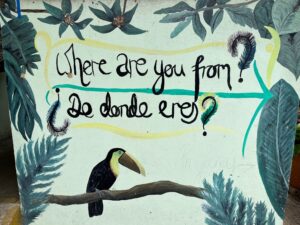 I would like to invite you into a journaling activity this week. We at the Institute for Leadership and Service like to promote reflection. We think of it as a muscle we can exercise. You know, how strong muscles are just kind of “nice to have” until one day when you need to move a couch or pick up a child, and then those muscles become absolutely necessary. Similarly, reflection may seem superfluous, until the day we kind of just need to know what we think about a subject.
OK, the reflection activity. Get out a writing instrument and your journal, or a piece of paper, or the back of a napkin.
First, write down where you are from. You decide if that means, city, state, country, etc, but I mean a geographical place.
Next, think of something about that place that is meaningful to you. Spend a little time describing it in writing. Is it a place in your hometown? The waterfall? Is it the public pool? Is it the weather? The way the sunset in August looks? What does this element of home look like? Feel like? Smell like?
Finally, write down why it is meaningful to you.
Now stop. Did you do it? Even if you’re not writing, imagine in your mind’s eye before you continue reading.
Mine is a ponderosa pine tree (smells like vanilla) next to the family cabin in the Black Hills of South Dakota. More specifically, the day I was contemplating the age of the trees and the mountains, and spotted a rose-breasted grosbeak bird perched on one of the branches.
OK, now let’s think about our calling for a minute, our vocation(s). One set of questions for thinking about calling is: “Who am I, and how do I show up in the world?” Or, “How do I understand the world around me, and my place in it?”
Sometimes we think of these vocational questions as very metaphorical or philosophical questions. I want to take a step back and make sure that we ground our philosophical/theological questions in the actual material world for a minute:
How do I survive? Where does my food come from? Where does my water and energy come from? What is the soil under my feet and the land use capacity of this area? What temperate zone are we in?
Or, who are the elected officials and civic organizations in my town/state/country this term? What do they care about and work on? What happened 100 years ago in this town that still influences our reality today? Is being “me” different, depending on if I’m living in Indiana, or South Dakota, or Costa Rica? If so, how? If not, why not?
Together with our student staff, this year we at ILAS are reading “Your Calling Here and Now,” by Gordon T. Smith. In this book, Smith reminds us that our vocation or calling is not theoretical – it is real, it is specific, and it is grounded in actual reality:
“Vocation is always particular: this person, at this time, and in this place. Vocation is never discerned in a historical vacuum; it is always in the specifics of the world in which we live. It is always about the here and now – and, as needs to be stressed, it is the here and now as it comes to us, as it presents itself, not as we wish it to be. We get beyond wishful thinking, and we name reality and discern calling in the light of and in the midst of this time and this place – this situation.”
The “here and now” of our present situation is specific, and it’s daunting. Our global situation is full of war and conflict. Our national situation is a time of divisiveness and uncertainty. The current U.S. Surgeon General’s Advisories in place have to do with mental health, loneliness, and gun violence. Our economies and environments feel precarious.
We can wish those things away, but Smith reminds us that our calling is not to live in a dream world, but to address our time and place as they are, with the tools at our disposal given our formation.
To end this activity, I invite you to look back at what you wrote about where you are from. What about that place makes you who you are? And what about who you are, has something to offer to the place and time where you live now, and to the people in that place?
To my ponderosa pine, I bring my learning from a geomorphology class that taught me that the ground that pine is standing on is an ancient volcanic batholith. To the cabin, I bring my realization that my white family came into this land after violence, conflict, and betrayal whose legacy lives on. And to the grosbeak comes my experience of finding another grosbeak (is there any way it could have been the same one??) perched in a branch near my home in Costa Rica, years after this original siting.
My place brings me awe, it brings me deep and complex questions, and it brings me evidence that we all are connected.
What does your place bring you?
And if you are in doubt, or despairing, I invite you to return to your (former or current) place – there will be direction there for you. What flower is blooming? What bird flits by your window? What person that you encounter in your daily routine brings a smile or an encouraging word? What deep historical truth about your place can help you to know what the next right step is, in this time and this place?
-Kat Peters is the Assistant Director of the Institute for Leadership and Service, housed in the Division of Calling and Spiritual Life at Valparaiso University
 The longer I’m at Valpo, the more I’ve come to appreciate the rituals that bookend our academic year. (Twenty year-old me would not have predicted this.) I enjoy donning those odd, medieval robes, hood, and tam to line up and process down the magnificently long aisle of the Chapel in August, organ music swelling the usually thick, humid air as we welcome new students and the return of the academic calendar’s cycle. This year the cool weather granted us all a reprieve at Convocation–merciful when you’re attired in a polyester and velvet concoction.
As much as I appreciate the Convocation’s music, addresses, and honors of scholarship and service, though, my favorite part of the ceremony is its closing–when we file out singing to form two multi-colored lines curving out from the Chapel and campanile toward the West Lawn. As Valpo’s new students emerge from the narthex, faculty and staff break into applause, cheering and clapping them through our path and into their shared journeys here. It’s a powerful moment of community and welcome, establishing that we are joined together in our pursuit of knowledge, service, faith, and wisdom.
It’s also joyful.
Indeed, Arts & Sciences Associate Dean Richard Severe and Dean Bagel Johnson offered a boisterous example this year of radical welcome. Dr. Severe exuberantly high-fived every single student passing his way, insisting on celebration and gathering the rest of us in his wake. Dr. Johnson called out (as only he could), “Welcome! You’re all wonderful human beings…but do go to class!” His bellowed, good-natured advice drew grins and nods as students filed past.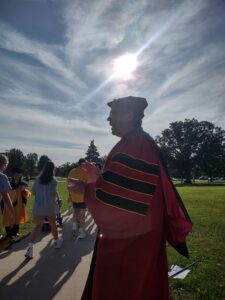
After all, rituals–even well-meaning ones–can quickly tip into feeling artificial or, at worse, silly. To participate fully you need to feel something of the meaning and power that fueled the ritual in the first place. This might be especially challenging for students new to Valpo. It probably seems a little awkward to recite an honor code en masse, to witness a procession of strangely robed professors, and to subsequently pass through their ranks–sometimes painfully slowly because the students ahead of you are bottlenecked so you have to pause, self-consciously wondering if you should make small talk with those waiting around you. The only way such a ceremony “works” at all is for those of us not new to its rhythms to whole-heartedly lead the way and, in so doing, to reinforce the communal bonds these rituals perform.
Drs. Johnson and Severe did that for me that late Tuesday afternoon. I know their high-fives and shouts weren’t intended for me, but their ebullience also buoyed my spirits, reminding me of what makes Valpo the remarkable place that it is. It’s the people, the relationships, the community…the way we show up for one another doing a strange, hard, beautiful thing: formative education. Such insistent showing up is a gift in this place we share, even and perhaps especially when it isn’t easy.
A communal mindset is always crucial, but I believe it’s especially so in spaces of education and formation. In these spaces we’re more consciously attuned to how we purposefully engage in a process of becoming. In reality, this happens throughout our entire lives, but it feels more palpable in the transition years and threshold moments of college. Our decisions can loom critically, implying the false logic of an “either/or” and paralyzing us with uncertainty. That, at least, was how it felt to me two decades ago as an undergraduate and how I sometimes hear this period described by current students. I remember thinking that my college self needed to determine everything right in that moment, because this was my chance to jump-start the rest of my life. (No pressure, right?) And even if I knew, intellectually, that this wasn’t wholly true, it certainly felt true at the time.
With all this in mind, how do we ground ourselves in the larger arc of our still-evolving stories? How do we engage deeply in the education and discernment that might very well help guide our decisions, while not rushing and assuming that every choice must fix us on some path?
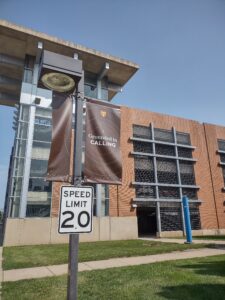
I would suggest that we need reminders to slow down and take our time, to savor the relationships of our community and the ways these bonds form and strengthen us. I observed an unwitting reminder of this while walking campus a few weeks ago with my colleague and friend Kat Peters. On the north side of campus, tucked behind Alumni Hall and the adjacent parking ramp, I noticed one of the new “Grounded” branding flags. “Grounded in Calling,” it proclaimed, scrolled out just above a 20 mile-per-hour speed limit sign. I began to chuckle to myself, but then it dawned on me that this was actually a fairly apt juxtaposition. 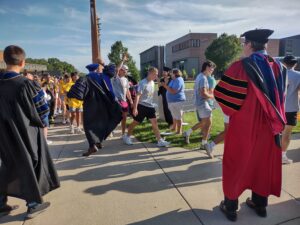
Discerning our purpose–discerning to what we are called in life–cannot be pursued at breakneck speed or even a hurried rush. Rather, it requires our deliberate slowing down, pacing ourselves to pay attention to our experiences, our contexts, and the rich community around us. That community can reflect truth back to us, helping to guide us on our way and perhaps offering a jolt of good humor to spur us onward.
As we begin a new academic year, I am grateful for the many people who shape and re-form our community anew at Valpo–those who have been here many years as well as those who’ve just joined us. In the coming weeks, the Division of Calling & Spiritual Life wants to begin recognizing and lifting up people who distinctly promote belonging and community on our campus. Be on the lookout for more information, and thank you for your contributions to shared journeys and collective goods.
–Dr. Anna Stewart, Director of the Institute for Leadership and Service (ILAS)
 Over the course of this summer and my internship at Erie House, one thing has became ever more clear to me each time I wake up and head to work: any number of individually insignificant factors can decide whether or not it’ll feel like a good day. For example, it could be cloudy but not raining, my bus is on time, and I have an extra minute to grab coffee before I clock in. That’s already a good day. Just as much, if it’s raining without an umbrella, both of my bus rides get delayed, and I have to show up twenty minutes late, that’s kind of a rough start.
Any one of those single elements shouldn’t be enough to make or break a day, but taken together, they pile up quickly. And, of course, that’s just the first hour or two of your standard weekday. If you’re in the habit of noticing things, there will be more of these little factors than a reasonable person would even try to count. So, that begs the question: What do you do when every single part of your otherwise normal day seems to be going wrong?
I suppose you just have to do your best. There’s not much else that can be done.
Whatever you have to do that day, just try to do it well. Enjoy the help of who’s with you. If you’re going solo, just focus on your surroundings, thinking as much as you can about whatever catches your eye (if it’s not something good, keep looking). Eventually, the object of your frustration will only become a smaller part of an otherwise normal day. Maybe something better or worse will happen later, but that’s not happening in the moment.
- by Lucas Lennen, Erie Neighborhood House
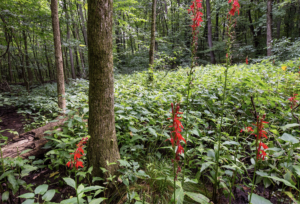
Photo credit: Shirley Heinze Land Trust
As my internship continues, I continue looking for a purpose big enough to dominate my life. I’ve always loved reading and since childhood, narratives of grand proportions filled my head, so much so that I’ve come to expect my purpose to be similar to the same characters that had
populated my life. Frequently I find myself looking for a purpose big enough to dominate my own life or appear on some metaphorical horizon. I had expected to see something like a summer thunderhead marching across the sky, or maybe something far away but with a promise of grandeur like the Chicago skyline as seen from the Indiana Dunes National Park.
This summer, and especially the CAPS internship has set my mind on a future that I am
typically happy to ignore. My previous blog post mainly talked about my refusal to truly think
about vocation in a real sense, but I’ve realized that I have been expecting a lot out of myself
unconsciously. That looming purpose, I now realize, was meant to be just that, looming and out
of reach. An imposing storm front that would never rain, and a city that would always be
shrouded in mist. A thing that is always there to look at and admire, but I could never touch the
clouds, or wander the far away city. To be honest, I’m a little disappointed in myself as I have
always left the infinite to others, and to the realm of impossibility for me.
As I considered the issue more, I realized that I associate that huge imposing cloud with works
and people who I admire the most, but don’t personally know and probably do not entirely
understand. Things and people who have pointed to or embodied something bigger than myself.
Therefore, I cannot or will not attempt to reach it. Unfortunately, the irony of this situation was
lost to me until I relatively recently. By separating myself from these big things I’ve also made
myself relatively isolated, and less able to connect with the immediate things which populate my
life. I’ve also denied myself the opportunity to grow or stretch beyond my perceived limitations.
Recently, I have been reading Ted Kooser’s Kindest Regards and the author’s focus on the
beauty of locality has steered in another direction. With the help of Kooser, it has become more
apparent to me that those little kernels of meaning and beauty that can be found anywhere
contain storm clouds, and the seemingly small things will swell to the size of hurricanes if given
the chance.
To be honest, I’m not sure what to do with this realization. I certainly don’t have all the answers
right now, but I am part excited, and part nervous about what my life may look like going
forward. In the meantime, I’ll make sure to be more aware of the kernels which keep piling up.
As for a concise and satisfying conclusion? I’ll leave that for the next internship which is only a
short Junior year away.
-Korbin Opfer, Shirley Heinze Land Trust Intern
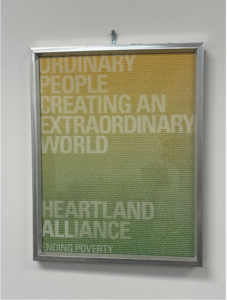 Today is my last day of my CAPS summer fellowship at Heartland Alliance. I look around the office. It’s quiet, a normal Friday morning as people mostly elect to work remotely before the weekend. Regardless, while everyone goes about their day, I sit here reflecting on some of the things I have learned this summer about both the work I have gotten to be a part of in refugee resettlement and as part of a non-profit at large in Chicago, IL.
I once asked my supervisor the question, “how does Heartland approach the problems it wants to solve?”, and she gave me an answer I did not expect. For those that may not be familiar, Heartland Alliance’s mission is to resettle newly arrived refugees and immigrants in Chicagoland with the goal of helping them to become self-sufficient. My question about its “approach” could have yielded a number of answers.
Her answer to me was that Heartland takes a “strength-based approach”, something that helps each person newly arrived to the country to center, at least for a moment, on what things they bring to the table as a citizen in their community. Getting them to “feel confident in their skills, but also to feel confident that they are human beings who are here to contribute to society,” is the ultimate goal, something that can transcend any single service Heartland provides.
When we look at the broader implications of the strength-based approach that Heartland takes, it certainly places the refugees and immigrants in a position of accountability, or at least more accountability than one might think refugees should have. In fact, this is often a misconception: both from the outside world, and from inside Heartland (and organizations similar to it). When I asked my supervisor about common misconceptions she hears about her work, she spoke directly to this issue. “We are not here to save people”, she told me. “We are here to support. People save themselves, but they need our support to do it.” Sometimes staff and even newly arrived refugees see Heartland as an organization that can solve everything, which can affect the effectiveness of such a non-profit with limited resources. To be effective, it takes the newly arrived refugees to recognize that even in a new and often-times intimidating home, that they are still capable as human beings in society. They have to see themselves in the equation, and all of the autonomy, but responsibility that comes with it.
As I think about what I have learned this summer working in a non-profit, that may be the most important lesson. At Heartland, we are not here to save people; we can only support them in saving themselves. The best way to support them is to help them see not just their own strengths, but to see themselves as citizens in their community. Avoiding “mission drift”, where an organization loses sight of its goal (in this case supporting, not saving) is hard in refugee resettlement, a line of work that faces you with real people and consequences. But as an organization, Heartland does not have the means to address the root of the core challenges that refugees face in Chicago and the United States. However, it can support people, one by one, in facing those challenges, and give them the disposition to continue to overcome them long after we are supporting them with tangible means. Maybe in the future Heartland can exercise more influence on some of those core challenges. For now, it needs to focus on its strengths: supporting refugees with personalized services, all in the name of allowing them to create a better world for themselves. 
“Problem-posing education affirms men and women as beings in the process of becoming.” Paulo Freire, Pedagogy of the Oppressed
- by Aidan Obermueller, Heartland Alliance
 ‘I don’t know.’: the response that never feels good enough. Whether it is an answer to what you want, why you started, or what you plan for the future, few leave a conversation satisfied when you say ‘I don’t know’. But I, personally, don’t know a lot of things. I am a very indecisive person; I like to do a lot of things, and I don’t mind doing a lot of things, so, while some people might call me a people pleaser, I would say I’m just really adaptable. I want what others want because I would be content with either.
Being so flexible is great a lot of the time; I’m reliable, understanding, good at sharing, good at listening, good at conflict resolution, and the list goes on. But that also means, I have a hard time setting boundaries, and don’t always receive the same grace I give others. While it can frustrate me in the moment, it’s not something I like to focus on and often just brush off.
But there was one day where this flexibility made me feel like Elastigirl, being pulled in all different directions, and I felt as if everything was out of control. I had just finished putting out a fire with one set of kids, when I see Willow and Zack (names have been changed to protect privacy) start shoving each other, so I rush over and say, “Uh-uh-uh, keep your hands to yourself; we do not solve our problems with violence” to which Willow responded with “Then make him to stop.” Willow did not like that Zack knew all the lyrics to the song we were playing and was singing it.
As I explained to Willow that Zack had every right to sing and that sharing a classroom with other students meant sometimes we had to hear and do things we find boring or don’t necessarily want to do, she interrupted to tell me how mean and horrible of a teacher I was, which I took. I let her finish and then said, “Okay, well just because you think that does not mean you can shove Zack. So it’s either you go color or play but no more shoving.” She rolled her eyes and went to hug me and I cringed inside because one of my biggest pet peeves (which I did not know I had until this summer) is getting a hug after an argument or disagreement where there was clearly no resolution. I stopped her and said, “No, you don’t get to hug me after telling me how horrible of a person I am without apologizing. I am not mad at you and I respect that you feel that way about me but I do not want a hug, because you hurt my feelings.”
Willow’s face went blank. She was so confused and awkwardly walked back to her table. We went the rest of the day like nothing happened and I wished the kids a good day and reminded everyone to be safe like I did every day.
But, as I took a deep breath as the last child left, it really hit me. I said ‘No’ to a hug. In general, I feel bad rejecting any physical touch because I recognize we need touch and it is important for a lot of people to receive that from others. Because of that, there were so many days I went home upset after I allowed a hug from my coworkers and students after getting an earful from them that was negative. It felt like a slap in the face.
A few weeks prior, as I was giving a friend the rundown of my day and mentioned feelings this way my friend said, “Why do they get to feel good after making you feel bad?” Roasted, I truly was. Because any behavior you allow, you endorse.
- by Noemi Vela, By the Hand
As a result of my time ending at Jacob’s Ladder, I have been given a chance to shift my focus from getting the most out of my experience to reflecting on everything that I’ve learned and what it means. Throughout my summer at Jacob’s Ladder, I had the pleasure of learning many lessons, though the ones that stick out the most to me are the ability to walk into new experiences with an open mind and heart and not to put too much emphasis on my expectations.
I believe that it’s completely normal to have expectations and a mental checklist of things that we want to accomplish when entering a new environment or experience. It’s a way to hold ourselves accountable and a way to maximize what we’re learning. Even though having expectations is essentially inevitable, I have come to realize that expectations can limit us and put us in a box. If we’re constantly thinking about an imagined quota or very specific experience, it can result in being very disappointed and sad that it didn’t work out the way we planned. When in reality, the expectation that we didn’t experience wasn’t meant for us, and the one that we were able to experience, can lead to us learning more about ourselves and others.
It can be unrealistic and daunting to say “Don’t have expectations”. We all have goals and ambitions (personally, professionally, academically), so it can feel weird to say “I’m going to walk into the experience with no expectations.” However, my time at Jacob’s Ladder taught me that schedules and plans can change. It’s completely normal. As a result of schedules and plans changing, it’s vital that we are flexible and aren’t attached to our perceived realities. If we can let go of the imagined reality where all of our expectations are met, it can be freeing and lead us to learn things that we wouldn’t have learned otherwise. I highly doubt that I will completely stop walking into new situations with zero expectations. However. I will be flexible with my expectations and open to them changing.
Since I have learned that my expectations do not equal my reality and that is okay, I have felt much more accepting and comfortable with what happened compared to what I thought would happen. I believe that this mindset switch is very helpful as I am getting closer and closer to my career since the workplace can be unexpected and is prone to going through changes. With an open mind and heart, it helps the always-changing and unpredictable conditions of the workplace feel a bit more manageable and that what is meant to be, will be.
- Natalie Ensor, Jacob’s Ladder Pediatric Rehab
 A lot of people think that I am a shy person. But really, I am just an anxious person, and that results in me thinking and rethinking through any possible implications and consequences of any actions or words before doing or saying them. And when I do not pre-think through them, I will post-think through them afterwards. Or both, which can really slow an interaction. Shockingly enough, that kind of hesitation comes across as shy.
As I have gotten older and worked on it, this pattern of thinking and hesitation have been steadily decreasing. And this summer specifically, I have gotten to practice a new mentality surrounding social interaction that has really helped.
It started at the beginning of the summer. On maybe my second day, one of my supervisors took me to a meeting with her where she was planning an awareness event with a few other representatives of youth organizations over coffee. While I was only there to shadow, walking into a meeting like that on only my first week, I felt woefully underqualified to be there. Talk about having to think through a social interaction. I was introduced to all of the people there, who were all very nice, and they began the meeting. As they planned, I heard a bit about how each of them came into their fields, and I thought about what an odd set of circumstances that these people would wind up at the table together. An odd set of circumstances, I realized, just like the set of circumstances that brought me to the table. I started thinking, what would be so different about me that my circumstances were any less valid when I too, had the same goals? Not much. I was reminded of a phrase that I had started telling myself last semester: I belong in every room that I am in. But now, I actually had to put it into practice.
Little did I know just how many opportunities I would have to put this thought process into practice this summer. My supervisors have brought me to tag along with them to nearly all of their meetings this summer, just so I can get a feel of how Girls on the Run operates. So, in addition to learning a lot about the organization that I am working for, I have met many people and had several intensely social interactions. Each time, reminding myself of my new mantra, it gets easier to walk in thinking about why I am there rather than how I got there. And now, at the end of the summer, I have realized just how much weight this takes off of an interaction.
At the most recent meeting I went to, my supervisor took me to a luncheon packed full of people, many of whom were invited because they head up nonprofits. Walking in, though I felt significantly better than I did at the first meeting, I was still a bit uncomfortable, because confidence is a skill, not an epiphany. And this big, formal room of leaders felt like the confidence Olympics. So, I was following around my supervisor, not saying much, until we walked up to two people who were talking, and my supervisor got into a conversation with one of them, leaving me to talk to the other person. At first, the conversation was a bit strained, I was extremely conscious of being at least a decade younger than everyone else in the room, and I could not even focus the conversation on the purpose of the luncheon… because I was completely unaware of it. I could not stop thinking about the formality, and the fact that everyone was shaking hands in dresses and button-ups. But then, after my conversation partner and I had awkwardly interrupted each other by accident a few times in attempts to initiate a conversation, I glanced down and noticed that he was wearing flip-flops. For whatever reason, this immediately snapped me out of my hesitation. We both belong in this room, no matter the formality. I physically felt my shoulders relax. I apologized for interrupting to bring attention back to the conversation and I started talking and talking before my mind even gave my lips permission. Apparently, the person I was talking to was a professor, and if I enjoy talking about one thing, it is definitely school. As it turns out, so did he. Then, when the lunch part started, Professor Flip-Flops asked me if he could sit with us, and settled on my answer before he even asked my supervisor. He told her he was joining because I was “fun”.
I was floored. Never before have I been one to bring new people into a social group, and certainly never before has my first impression on someone been that I am a “fun” person… usually not even my third impression. This made me realize that the practice that I have been doing this summer has really helped: I went from being intimidated by a small coffee-get-together to hyping myself up during a large luncheon. This skill is still, obviously, a work-in-progress. One does not go from being nervous in a one-on-one social interaction to being comfortable in any social interaction in one summer. But I am a little better at it than before, and I have found that my new reminder is very helpful for me.
- By Katherine Naylor, Girls on the Run