
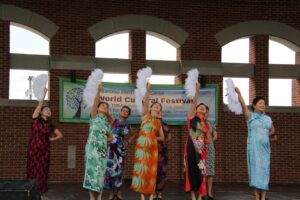
“Jasmine Dancers”: This image from last year’s World Cultural Festival features the Jasmine Dancers traditional Chinese dance group and hints at the wonderful performances this year’s festival has in store.
As a child, I loved attending a certain small festival in a downtown Valparaiso parking lot that sold trinkets from around the world. Maybe there were a couple performers singing melodies from other countries, or a food tent or two. What I didn’t know was that, years later, I would be working to put on that same festival, now celebrating its 15th anniversary and expecting to host 2,500 – 3,000 attendees in a unified celebration of international cultures. With the CAPS Fellows Program, I am interning with the Valparaiso International Center (VIC) in preparation for its annual World Cultural Festival, where I have already learned so much about event planning and the importance of relationships in community work.
I believe the most eye-opening technical aspect of my internship so far has been realizing the sheer mountain of details that goes into planning an event. Focusing on just one area of festival preparation, I’ve come to see that, no matter how amazing the day-of setup is, nothing matters without marketing. After all, if people don’t know about the event, they won’t come. VIC founder Duane Davison explained to me that we need to meet people in every place that they exist in the community.
So I’ve worked with a professional graphic designer to put an ad in a magazine, and we will soon release our festival’s poster design to be posted in cafés, stores, libraries, and even VU’s campus. I am also putting together a social media plan, and the VIC is including billboard ads for the first time in their marketing. By far, my favorite way we plan to get the public involved is having our first-ever float in Valparaiso’s Popcorn Festival Parade. Helping design one of the larger-than-life popcorn floats I’ve loved seeing all my childhood is truly a full-circle moment.
Working with the VIC has also shown me the importance of understanding relationships in the community. Nothing happens in a vacuum, and putting on this event has required participation from everyone from the Chamber of Commerce to the local library to Menards. I’ve met with individuals of all sorts of backgrounds and personalities, and I’ve been surprised by how much I’ve enjoyed this in-person work. I believe this internship has nudged me in the direction of looking for a career that includes lots of social interaction. I’ve also learned to look for the humanity and beauty in the “non-efficient” parts of workday interactions, whether they be meandering topics of conversation during a meeting or attending non-work events with fellow VIC members.
I remember in particular one evening when I drove out to our warehouse with others from the VIC team to take inventory of and clean our festival banners. However, we ended up spending an hour weeding an adjacent garden and talking about family, travel, and all sorts of topics. Looking back, I deeply valued this evening in the sunset garden as an authentic human blip in an otherwise work-driven world. Taking time for conversation is healing for the soul, and I hope to take this value of relationship-building with me into any future profession.
My elementary school self would have never guessed that, one day, I would be helping put on the World Cultural Festival I loved going to every year. Now, I find it hard to believe how fast the summer is flying by, and how every day uncovers a new aspect of this community I thought I had all figured out.
Come join the VIC for our World Cultural Festival on Sunday, September 15, 2024, from 12pm-5pm in Valparaiso’s Central Park Plaza!
- Lucia Otten, Valparaiso International Center
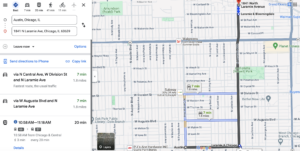 The easiest way to get to 1841 North Laramie Ave from Austin, Chicago by 10 AM every weekday without a car is to take the Green Line at Austin via Ashland/63rd, get off at Laramie & Lake, then take bus 57 towards Grand/Latrobe and get off at Laramie & Bloomingdale. In theory, this journey should only take about 33 minutes: a 5-minute walk to the station, a 12-minute train ride to Laramie & Lake, a 14-minute bus ride to Laramie & Bloomingdale, and a 2-minute walk north towards the building, meaning I could leave my house at 9:20 AM.
Public transportation in Chicago is a rite of passage for newcomers. Despite its numerous benefits
over private car usage, it can be difficult to navigate. I had visited Chicago a few times and only used the trains, which are easy to navigate with clear stations, platforms for delay and inactive train updates, and CTA personnel available for inquiries. This time, however, I had to learn how to use the bus system, which was unfamiliar but could cut up to 20 minutes off my transit time. In other words, I missed at least one bus every day during the first week and boarded the wrong bus going in the wrong direction three times that same week. It was humbling.
At first, I was really annoyed with myself, wondering, “Why am I struggling with this? If I’ve triple-checked everything and still get on the wrong bus, what am I missing? Should I just Uber it?” Then, I became frustrated with the people around me who, despite hearing my struggle, offered no new
information on how to navigate the system. My frustration stemmed from insecurity. What is wrong with me that I can’t figure out how to use the system efficiently when so many others just seem to know?
While it didn’t overwhelm me, by the end of the week and the start of the next, I accepted that my
commute would be extra long until I could see the patterns in the system.
And I did. By the end of the second week, I knew everything: which buses to take, which ones
ran on time, which ones rarely showed up, and what time specific lines stopped running. It was liberating.
This experience with public transportation, however, is not uncommon. On the contrary, it is a shared
experience among those who aren’t Chicago natives. While I didn’t receive great advice the first week, I
did hear many stories of people having similar experiences and recounting the ridiculous adjustments they had to make when using the system.
As I recapped the week with my mom, it hit me. Every time I get a glimpse of what my calling
could be, insecurities chase me, and I find myself lost in the confusion and uncertainty, often aborting
missions. I prefer to take the Uber rather than figure out a system that could take 3, 4, or even 5 shortcuts to reach my destination. Realizing this, I started to be more aware of what I was avoiding at my internship and recognized that I haven’t been as open as I thought I was to this new and unfamiliar space. It was eye-opening but motivating.
Long story short, if I leave my house by 8:55 AM to catch the 9:06 AM train via Cottage Grove at
Austin Station—which goes in the same direction as Ashland/63rd and runs approximately every 6
minutes—I can transfer to bus 57 towards Grand/Latrobe at 9:25 AM. This bus always arrives on time,
unlike the 9:32 AM or 9:42 AM buses, which have spottier arrival times and more delays. Getting off at
Laramie & Bloomingdale, I’ll arrive at the office with 15 to 20 minutes to spare. During those spare
minutes, I take the time to prepare and create a list of goals for the day, reminding myself of what I want to achieve from this experience and how I will need to go about it, allowing the process to flow naturally.
-Noemi Vela, By the Hand
 For my second blog in two weeks, I was really struggling to find an experience that I did not touch on the week before this. As I was reflecting on my summer, already at the halfway point of this experience with Jacob’s Ladder and the CAPS Fellowship, I was thinking about what is a lesson I have learned.
I feel that the biggest takeaway I have had is how much better of an experience is gained when you simply are present in the moment. In our world today, there are a million things that can distract you when you are bored or to pass the time. When I first started at Jacob’s Ladder, I often found my
mind wandering or thinking about how much time till lunch, or when I get to go home. It
was not that I was not enjoying the work, I was just distracted. I was really struggling
with this when I thought back to the key part of the CAPS Fellowship, reflection.
As I was reflecting on my first couple days, I knew I needed to figure out a way to be less distracted. I decided no matter what, I was gonna just throw myself at all the work I could possibly do and really focus. By week 2, I felt I was already improving. I noticed when I was doing administrational paperwork and doing therapy sessions with the patients at Jacob’s Ladder. I realized if I just focus on fully immersing myself in the work, time flies quickly and you end up enjoying the work even more.
This focus on being in the moment became key when we had a big deadline this past week for an important grant for our company. The deadline for the grant writing that myself, and another one of
the interns had to do, got moved up and we were in a time crunch. I felt stressed at first, but then I realized with what I had been practicing, it would be okay. By using the reflective portion of CAPS and just the need to improve, Natalie and I were able to get the grant done in plenty of time and we submitted it the next day.
CAPS has really improved my work habits and just understanding of myself through reflection, and how important being in the moment is.
- Colin Graves, Jacob’s Ladder Pediatric Rehab
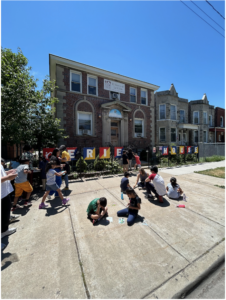
They say that those who can’t do, teach. That’s never made much sense to me. How is someone supposed to teach something they’ve never experienced? I mean, you have to at least know the knowledge if you’re trying to pass it on. On the other hand, teaching is just another form of communication, so having a receptive audience does make a huge difference. Luckily for me, the first- through third-grade students enrolled in the Little Village READS summer program at Erie Neighborhood House are definitely there to learn.
Having never worked with children before (or even taught groups in a formal setting, for that matter), I’d been pretty anxious before starting my internship at Erie House. For the week before the students started, my time was occupied by emails, lesson plans, supply checks, book shelving, and everything else I could think of doing to prepare and make sure that the summer would get off to a smooth start; frankly, it had me kind of worried. Not knowing exactly what to expect, I could only fear the worst: brainrotted Gen-Alphas who wouldn’t be able to sit still and focus on anything for more than thirty seconds if it wasn’t plugged into the Internet.
Come Monday, I realized that I couldn’t have been more wrong. As the kids trickled in from drop-off, I did my best to introduce myself and welcome them to what will essentially be their summer school, thinking that they’d be dreading every additional minute in a classroom past the regular academic year’s last bell. Instead, they were immediately finding ways to entertain themselves, looking through our bookshelves, drawing, solving puzzles, and eagerly chatting away with their friends as soon as they walked in the door. Not a screen in sight. One of the boys even asked me if he could go outside to check on the garden and water the vegetables; I was more than happy to oblige him. In that moment, I felt better about the next generation than I ever thought was reasonable.
As the day went on, I got to know the students and see how they learn; not a one of them is without curiosity. Whether it’s from the books they choose for free reading, the way they participate in lessons and projects, or the wide-ranging questions that pop out their heads (what’s the sun made of, where do cicadas come from, Messi or Ronaldo for GOAT, etc.), there is a constant reminder that people really do crave a sort of understanding for the world around them. That shared sense of wonder is precisely why I applied for CAPS in the first place. Teaching or learning, it’s all part of what gives purpose to being human, no matter how old you are. In terms of vocation, personally, I’m just grateful for the opportunity to be a part of that wonder.
- Lucas Lennen, Erie Neighborhood House

This summer I have been working at Jacob’s Ladder, a pediatric rehabilitation clinic in Chesterton, Indiana. I have thoroughly enjoyed my first 3 weeks working there. I am majoring in Healthcare Leadership and am struggling to find what path I want to go into in Healthcare.
Before I started my job, I was excited to work in a clinical setting to really find out, or at least point me in the right direction of a path in my profession. I was also looking forward to using the resources and guidance CAPS provides to reflect on my experiences daily. One thing I realized immediately was that my work was going to take patience and a lot of effort.
A lot of the time, I am doing research for grants, for my organization and organizing the reopening of providing aqua therapy sessions. This is long hours researching equipment, set up, location, and other key aspects for information for grants and aquatherapy.
The other part of my job is shadowing physical therapists during their sessions with children and helping out at some of their camps, especially the wheelchair wars camp, every Friday morning. This is one of my favorite parts of every week and I always look forward to it. I have created a great relationship with one of the campers, Maverick. He is a 6 year old, with trouble walking. I really enjoy my time, working through obstacles and trying, failing, and succeeding. I am only with him for 2 hours every week, but I am always in a great mood after every Friday when I finish working with him. His persistence and positive attitude is infectious and has really helped me reflect on my own actions and decisions, which is a big part of CAPS experience.
As I see Maverick, and the other children, with physical and mental challenges, come to sessions everyday, and continually work to improve and get stronger, I think back to myself, and times I have been ungrateful or taken opportunities for granted. CAPS has pushed me to be more thankful and reflective, everyday that I take time to reflect on both administrative work and therapy. I have been blessed with opportunities in sports and academics my whole life, and I feel that it is easy to often take it for granted, complain, and not give it my all. My experience so far at Jacob’s Ladder, especially with Maverick, has really helped me grow and realize how important it is to be thankful for every opportunity in life, and give it my all, just as Maverick does.
–by Colin Graves, Jacob’s Ladder
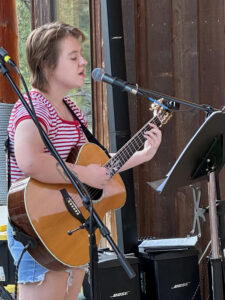
In a small town tucked away and hidden by Washington state’s Cascade Mountains, there resides a non-profit organization called Grünewald Guild. This organization offers a wide assortment of community-oriented classes based upon artistic mediums ranging from songwriting, weaving, watercolor, and many others. Due to the absolutely scenic location of the guild, there is a larger influx of students during the summer programs compared to the rest of the year, and the title of this year’s summer program is Waymaking. You may be wondering, “What does waymaking mean?” and this terminology refers to the ability that one has over their unique ways of implementing a personal touch within all of their endeavors. The Guild’s wonderful Executive Director, Sarah Sprouse, is incredibly fascinated with the manner in which rivers are able to consistently adapt and change their path depending on the season or circumstance. The tides of the tenacious rivers always persist, and they make a profound and visible impact on the environment in which they reside. A river forging its own path is a prime example of what it means to be a waymaker, but this metaphor can be easily applied to the journey that all artists pursue. Progress is almost never linear and the journey that every artist pursues demonstrates their commitment to positively impacting themselves and the world around them through their creations. Through the gentle guidance of the guest artists, the guild hopes to aid their students in their goals and objectives within their craft of choice.
Through the CAPS Fellows Program, I have the privilege of working as one of the Communication Interns at Grünewald Guild during their busy Waymaking Summer 2024 program. Through my role as a Communications Intern, I specialize in designing newsletters, writing blog posts, and creating social media guidelines to promote the guild’s core values of art, faith, and community to prospective and returning students. Accompanying this role, I also partake in programming efforts to ensure the general upkeep of the campus. I have been working at the Guild for exactly a month and my experience has been delightful and incredibly enriching; however, there was one aspect of my work experience that I did not expect to encounter.
I feel as though the way that time progresses while at the guild is quite strange to say the least. I have always had an extremely Type A personality and, since I was born and raised on the East Coast, I have always functioned under the jurisdiction of a New York minute. The mentality that was instilled in me since birth was that every task I would undertake must be done perfectly in the most timely manner possible so that I can move quickly onto my next task. I have found that this ideology has become less regional over the years and, unfortunately, has become an almost universal modus operandi. Under these conditions, the importance of art is often overlooked and swept under the rug, but the mission of Grünewald Guild actively combats this utilitarian perspective.
The Type B approach that Grünewald Guild has to their organizational climate has been a culture shock to me but it is something truly novel. I am encouraged to practice mindfulness and to literally stop and smell the flowers, more specifically the scarlet trumpets, during my time here. The more I have tried to conceptualize the Guild’s peculiar progression of time, the more my mind associates it with the highly remarkable poetry of T.S. Eliot. I am an avid fan of Eliot’s poetry and the piece of literature that began my infatuation with his work was his collection Four Quartets. In this prose, Eliot focuses on the concept of timeless moments and uses vivid imagery to symbolize that time is a series of gray areas. When I first read Four Quartets, I found it difficult to conceptualize the phenomenon of timeless moments that Eliot was illustrating but, through working at the Guild, I realized that the past, present, and future are not wrapped into neat and tidy categories that are to be easily consumed. These three categories are deeply intertwined and inherently dependent on one another, and the most fascinating nuance of this is how casually the connection manifests. I drink water from a mug that was created by Richard Caemmerer, co-founder of Grünewald Guild and former art professor at Valparaiso University, and I breathe in oxygen from trees planted by Liz Caemmerer, co-founder of Grünewald Guild. Richard and Liz Caemmerer paved the way for the success of Grünewald Guild’s pedagogy and this tutelage is rooted in their ideas from the past, intricately preserved in the small joys of the present, and will ultimately transcend into the future.
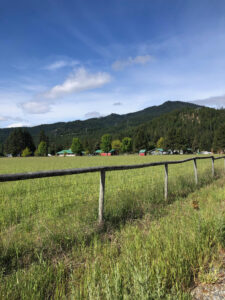
As a rising senior at Valparaiso University, one thing that has been weighing heavily on my mind recently is how I would like to indulge in my vocation post-graduation. Through my fascination with the style in which time preserves traditions and philosophies, I have begun looking into opportunities for librarianship and archival work so that I can play an active role in that conservation process. More precisely, I would like to work with music scholarship, collections, and archives in order to safeguard the unbridled power that music holds. As part of my compensation for my work at Grünewald Guild, I was able to take one of their classes completely free of charge and I chose to take the class The Muse, Your Dues, The Fuse: Songwriting with the spectacular singer-songwriter Jan Krist. During the first day of class, Krist said a phrase that has bounced in my head throughout the entire duration of that class. She said that others have described her music as “Hope in a minor key,” and that wording stuck with me due to the sheer complexity of the sentiment. The stories that people hold fall on a spectrum of emotions and, though it is cliché, it is only fitting that art should imitate life. From my scrapped lyrics written in my messy handwriting to the songs of my classmates that I constantly hum, I now carry artifacts of a timeless moment that began with the vision of Richard and Liz Caemmerer back in 1980.
— Jasmine Collins, Communications Intern at Grünewald Guild
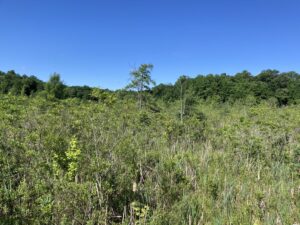
If I leave this Internship with nothing else, it will be the memories of people swept up by purpose. Seeing interns, project managers, and conservation stewards alike inspires me continuously. In my position, the opportunity to see the inner workings of a nonprofit, and the complex world of grants, partners, and funding has presented itself. Additionally, I get to take an inside look at the research, water quality monitoring, and long-term conservation goals of Shirley Heinze Land Trust.
Despite all these good things, I’ve come across an unsettling issue. The possibility of having a vocation has truly presented itself, and I could find myself swept up by a calling at any time. Vocation is an idea I had never seriously entertained. After all, I am easily contented and have always found happiness in my circumstances.
If you had asked me at any other point in my life about vocation, I might not have had a clear answer. Both of my parents are teachers and are deeply involved in their careers, which provide a significant and emotionally rewarding part of their lives. But for me? I had ruled out the possibility, but I always planned on finding a career and turning it into a calling, rather than being drawn to a path. I reassured myself that my passions and interests would remain, but they would be confined to my own time.
I expected to “learn to love” my job as if it was inevitable that I would work an unfulfilling job. But what if my vocation does exist, and I am drawn towards a path that I cannot pursue for whatever reason? After reflection, I discovered that my thought process had been the following. Never knowing I could have a vocation would be preferable to finding one that’s out of my reach.
I had assumed that if I were not on the watch for vocation, or allowing myself to feel called to a line of work, I might never be given one. Is that silly, or prudent? In any case, it is certainly not brave, and I realize now that it has been a mechanism for preventing potential dissatisfaction later in life. I had thought I was surrendering when in reality I had taken life into my own hands. The truth is I refused to let myself be vulnerable, and ultimately I may have been dismissing the masks of God for fear of hardship.
Korbin Opfer,
Shirley Heinze Land Trust Intern
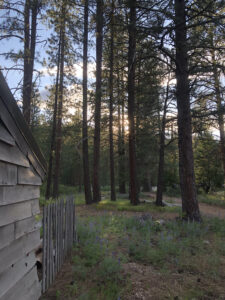
From the moment I stepped off the Amtrak train in Leavenworth, WA I have been in awe of the landscape around me. The air is fresher, everything is green and taller than any building. The mountains rise up in every direction, completely surrounding us in the plain little valley where the Grünewald Guild is located. We’ve been here three weeks now and I still can’t get over the scenery. The mountains aren’t new to me, I grew up near the Sierra Nevadas, but this feels so much more impressive and wild. They seemed almost too surreal at first. Everywhere I turn it looks like I’m looking at award-winning photos of landscape, it’s hard to believe how extensively beautiful Washington is.
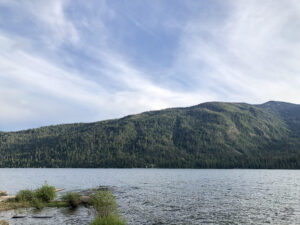
While my main goal for this summer was to form new community relationships through service (and I have absolutely done that), my second goal was to explore and learn. I’m in a new environment, and it’s definitely different from Valparaiso. When going out to the woods in the mountains for the summer with the goal of exploring in mind, you tend to think of outdoor activities like hiking, backpacking, camping, swimming, etc. things that put you out in the thick of the outdoors to find a meaningful experience. Friends from home have constantly been asking me if I’ve found any good hiking spots nearby. I have, but I’ve found my own way of exploring the world around me. I wander around the campus with my binoculars to spy on birds, squirrels and the occasional deer. On top of a boulder overlooking the Wenatchee River is my favorite spot for meditation and time to let my mind wander. I’ve learned that not all exploring has to happen in the way you expect though, sometimes the little adventures find you instead of you having to look for them. You can explore through old art pieces stored up in the attic and start to learn the history of the artists who’ve lived and taught here over the decades. Even sitting quietly on the front porch of a cabin can teach you so much. You notice the rain in the bright sunshine that only lasts for five minutes, you hear the birds chirping as they move about in the rustling trees, you meet new people who bike past or stop by for a visit.
The mountains have given me a very interesting lesson. The world can seem too big for us to handle sometimes, it can feel like we’re very small and not able to get very far or like we won’t measure up to the highest peaks. But, taking each day and task slowly and calmly, we can slowly build up ourselves and others. Exploring and learning bit by bit has allowed me to feel more connected to my space here and offered me time for honest, peaceful reflection.
Building up,
Gabby Unzicker
Grünewald Guild Intern
As I walked into my first staff training and orientation session of my placement, I immediately noticed the passion and drive that the leadership of Camp Lakeside (and by extension Opportunity Enterprises) have for their work. I was excited to join a team that truly cared about the work that they do, as well as the service that they are providing to the community. That being said, the camp environment is one that can be hectic and overwhelming, which was evident even in the orientation process weeks before the wild ride officially started. Camp Lakeside’s main objective is to bridge the gap between typically developing children and peers that aren’t. Simply put, the goal is to create an environment where people of all abilities can come and enjoy the camp experience. With this, I was able to come in as a fresh face with a position that will be able to help aid and create more meaningful experiences.
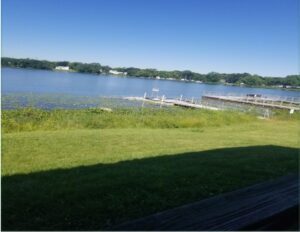 While the camp season has only just begun, I have had many different opportunities to fulfill my duties of collecting the necessary data for the camp. One of the biggest skills that I have used in the short time that I have been here is the art of creative productivity. In my position of direct observational research, that often means spending a lot of my day, directly or indirectly, interacting with campers. This has meant that, on multiple occasions throughout my week, I am often jumping in on games of “duck, duck, goose”, hanging out at the archery range, or even taking an afternoon boat ride around the lake.
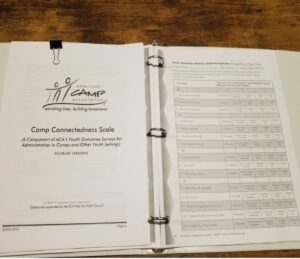
Two other impactful skills that I have learned and used so far in my time at my internship are time management and communication. While most of my duties during the week are typically pretty laid back and casual, there are certain days, typically Thursdays and Fridays, where my job becomes much more fast paced. On these days, I (along with other camp staff) am tasked with conducting surveys of the campers that are on sight for that given week. Conducting these surveys can take some time, especially with the population that I am working with and that the camp serves. With the support of my supervisors Nichole and Walter (affectionately known at camp as “Chief” and “Bullseye”), I have learned to better communicate and explain what it is that I am assessing, and what it means for the future of the camp that comes as a result.
While it is still very early on in my internship and the work that I am doing, I hope that as time passes throughout the summer that I continue to find deeper appreciation for what it is that I am doing on behalf of Opportunity Enterprises at Camp Lakeside. Much of the work that I get the chance to do will inevitably impact so many families in positive ways, even if I may not get to directly see the fruits of my, and others, labor in the short time that I am here.
Representing Opportunity Enterprises and Camp Lakeside,
Rasheed Jibriel
My office is tucked on the second floor of 444 Barker Road, just a stone’s throw away from Lake Michigan. My desk had been haphazardly dragged in front of the room’s only window, and upon my arrival only had one singular occupant, a snake plant that was practically begging for some water. And honestly, three weeks later it doesn’t look much different. A flyer s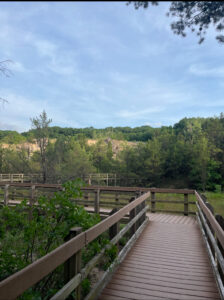 hoved in a drawer, a hair tie that had been long abandoned, maybe a water bottle that had been forgotten during a quick departure. It is apparent to anyone who works in the Barker House that I don’t usually sit at my desk, and that’s something that I’m quite proud of. Let me explain.
My arrival 3 weeks ago was followed by a whirlwind of activity. First there was orientation, then an introduction to my coworkers, which in turn was quickly followed by my first staff meeting. I was given project after project, leaving my head whirling and my laptop full of fragmented notes. It became quite clear that the staff at Save The Dunes wore many hats, and worked passionately to keep this non-profit relevant, flourishing, and dependable. And for some odd reason, this shocked me. Not to any fault of their own, but simply because I had forgotten it was possible to work in alignment with your passions. In my mind, my future career and profession (whatever that would end up being) had long been labeled as something that would merely provide me a source of income and perhaps multiple cups of lukewarm break room coffee a day. I didn’t quite dread what was coming, but I certainly wasn’t looking forward to it either. This brought around a question that I had scribbled in my CAPS journal a couple weeks before; where did passions belong in a profession, and vice versa, could a profession truly align to a person’s passions?
And to be honest, I’m still working on an answer. But seeing my coworkers love the environment enough to advocate for it every day sparked a little bit of hope that maybe one day I’ll work in a place like that too. Where I wake up in the morning (or at least most of them) and I’m actually EXCITED to drive to the office and try to make a difference that the average person can see. And you know what? Maybe one person can change just a tiny piece of the world.
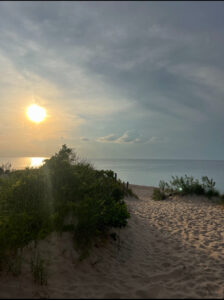
I don’t intentionally avoid my desk, or leave my desk to get away from my coworkers. It’s just simply that since the very beginning the entire house on 444 Barker Rd has felt like home. The warm, cushioned chair on the sunlit covered porch, the elegant conference room, and the cheery yellow tiles of the kitchen always give me somewhere new and unique to work. My coworkers laughing on the porch or sitting on the couches of the living room are the best company (And truly now feel like family) and the group hikes often leave me content and sunburnt. Why in the world would I ever sit at my desk when there’s so much to learn everywhere else?
Wishing the weeks would go by slower,
Heather Elwood,
PROUD Save the Dunes Intern