

I entered my internship with the American Red Cross without expectations, mostly because I didn’t know fully what to expect and what I would be working on. I felt excited to try something new and branch out beyond my area of study and my typical skill set, something I had mentioned during the CAPS application process that I wanted to focus on and grow in. So far, I believe that the work I’ve been able to do through the American Red Cross has helped me to see myself and my calling as something greater than one niche thing. I have my hands in many different places, and it’s been refreshing to exercise different skills and ‘muscles’ of my brain to assist with various projects.

Specifically, I have been working with my wonderful supervisor, Colleen, on various projects relating to the alliance between the American Red Cross of Indiana and Indiana University Health. I am updating the volunteer information packet for the new volunteers from IU Health. I am adding updated information to the packet and also improving the design. Additionally, I am putting together the summer edition of the quarterly newsletter, which involves designing the newspaper and interviewing nurse volunteers to highlight in the newsletter.
Something I am learning, especially having a remote internship, is that just because I don’t see a direct impact of the work I’m doing doesn’t mean that my work isn’t impactful or important. While I may not be able to directly interact with a lot of the volunteers or know who will read the packet and the newsletter, I understand that those resources that I am working on will benefit the network of Red Cross volunteers in one capacity or another. As someone who normally craves instant feedback and honestly, gratification, learning to trust the long-term impact of something I’m creating is a major growth area in these first couple weeks of my internship.
Another growth area from the first few weeks of my internship has been building a practice of discipline. Working remotely means that I need to create a schedule each day, and keep myself on track for certain tasks and projects I need to complete. I have learned a lot about myself, how I work best, and how I can keep myself motivated, especially on the days when I am not as eager to work on things. Having the end goal of completing three hundred hours in the back of my mind has been especially helpful. I even made a paper tracker to cross off the hours I complete, which has been a fun reward at the end of each workday. Keeping myself on track for completing the hours has led to a practice of being more intentional with how I spend my time and a new focus on the importance of routine and prioritization, skills that I can continue to apply throughout the rest of my professional and personal life.
All in all, the past few weeks interning with the American Red Cross have been rich in learning opportunities and moments of growth. I am looking forward to what the rest of the summer will bring!
- Grace Roberts, American Red Cross
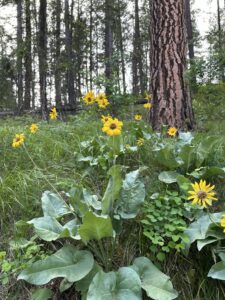
I am going to go out on a limb and say that the summertime brings joy to many people. A balanced mixture of sunshine and warm weather has always been the driving factor for my love for summer. Luckily for me, this summer I have the amazing opportunity to enjoy the wonderful joys of summer at Grunewald Guild located in Leavenworth, WA.
During my time as an undergrad at Valpo I have used the summers away from school as a time of self-reflection and intend to do the same this summer. My method of daily self-reflection usually entails asking myself, “What is one memorable thing that has happened today?” Sometimes I can easily pinpoint a moment that stood out to me, but sometimes it takes more time to find a significant moment each day. Whenever I struggle to immediately pinpoint a memorable moment, I am forced to replay the day’s events in my head, often highlighting the little moments that go overlooked in the moment. And now that I am officially beginning my summer at the Guild, I would like to share some of the little moments that I found on my journey out here.
My summer adventure started off with a connecting train ride into the windy city of Chicago. This initial train ride was my first time on a train and was an excellent precursor to the long 42-hour train ride headed out west. During the ride, I tried to soak in the sights and memories of Northwest Indiana because I wouldn’t see cornfields again for at least a few months. The sight of the fields reminded me of my family and friends that I was leaving behind for the summer. Something as simple as a cornfield helped me reflect about my loved ones and it helped ease the nerves of traveling across the country.
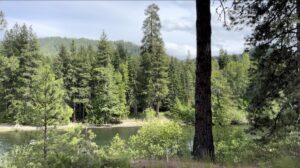
As the train continued its tracks towards the coast, the passengers were instructed that the train was stopping for a weather delay in Wisconsin Dells, WI. What was initially a 45-minute delay turned into a 2-hour long conversation with other passengers, including another CAPS Fellow. At first the weather delay seemed to put a damper on the trip but turned out to be quite the opposite. It got passengers talking and cracking jokes to one another to pass the time. Through the mutual connection of being stuck on the train and the less-than-ideal weather, many bonds were created through passengers. Some of these bonds lasted for the remainder of the trip in the form of having a buddy to talk to during maintenance stops along the route. Again, something that many may see as insignificant or even detrimental ended up being one of the highlights of the journey.
While my journey out west has concluded for the time being I will continue to make every day memorable. Whether it is a fun conversation or taking a few extra moments to look at flowers, there will be no moment overlooked – no matter how little they seem.
- Corey McClure, Grunewald Guild

Yellow Thighed Finch, Costa Rica
As we explore questions of leadership and service at Valpo, we talk a lot about leadership in times of complexity and challenge, or serving the world’s deep needs. While it is valuable and necessary to think about how we can change things for the better, our leadership and service must also be marked by a humility that understands that “we” might not have the right answers, or the tools necessary to “fix,” and that we might actually need to change something about ourselves, rather than about the world.
More to the point, what happens when we see the world as good as we lead and serve? What happens when we see those we seek to serve as having assets, resources and capital that we ourselves might not have? Does anything change?
In my capacity as a Lutheran Deaconess, I was recently invited to share with students of the Lutheran Diaconal Association at Valparaiso University on the topic of one of our diaconal hallmarks: Prophetic Voice. This powerful hallmark reads:
“Individually and as a community, the diaconate points to God’s vision of shalom (peace, wholeness, and salvation) for the whole creation. Through action and word, the diaconate raises a prophetic voice, calling and recalling the church to its diaconal task, advocating with those whose voices have not yet been heard, exposing injustice and oppression and reminding all God’s people that in God’s realm the least is the greatest. Lest they lose sight of God’s vision of shalom, members of the diaconate also remain open to the prophetic voice of others, especially those on the margins, who challenge them to remain faithful to their diaconal call.”
Specifically, the diaconal students were looking at this point in the hallmark: “A Deaconess/Deacon identifies personal power and cultural privilege, using these as opportunities to lift up those caught in cycles of powerlessness and oppression.”
Susan L Maros points out in her book, Calling in Context, that it’s often harder to see our own power, and easier to see where we feel our power is lacking. In situations where we are the ones with personal power and cultural privilege, how do we learn to identify this and to listen to the abundance present in the world, to the voices of those who have assets and resources we have never considered?
Rabbi Abraham Heschel, an inspiration and mentor for Dr. Martin Luther King, Jr, writes in the introduction to his book on the Prophets that the key attitude to cultivating a prophetic stance is to be “sensitive to God’s spirit” and to “know what we see rather than see what we know.”
What does this mean, knowing what we see rather than seeing what we know? I am reminded of the time that I was bird watching in a Costa Rican cloud forest, practicing my binocular skills with some US university students. I saw a gray bird in a cypress tree, looking quite unremarkable. I almost walked right by. Then I used my binoculars and saw that the bird actually had bright yellow “pants,” feathers along its legs that are a delightful surprise. This aptly-named Yellow Thighed Finch is endemic to Costa Rica and Panama, and thus by identifying it upon closer inspection I was able to see a bird that very few people in the world actually get to see.
How many times have we assumed we knew what we were looking at, whether it be a bird, or a political question, or a conversation with our partner or other relative? How often do we take the time for a closer look? How often do we stick with it long enough to be surprised?
The particular challenge of the diaconal hallmark comes when we are asked to identify personal power and cultural privilege. Those of us with a lot of power and privilege don’t get our assumptions questioned very often. It can be easy to run roughshod over others through simple “privilege inertia” that allows us to plow forward even if what we are doing is nonsensical, or at worst, harmful to others. When we come from a position of personal privilege and cultural power, standing for God’s shalom means problematizing our own position, and practicing humility and justice.
Can we with power and privilege come to know better what we see, and be humbled by the bright yellow feathers on the seemingly simple, gray bird? And when we notice and understand the strength held by others, how does this change our behavior?
A friend recently pointed out that people who speak two languages are not often credited with the unique strength that is being bilingual. Bilingualism brings with it many more benefits than simply being able to speak two languages. The US Department of Education points out that bilingual people have better critical thinking skills, are better at remembering information, have an easier time with math and logic, and can more easily understand and learn more languages. They can code switch between cultures, understand divergent viewpoints, and even identify more emotions and ideas due to the fact that they have a larger vocabulary overall. And yet, in our society students with a first language other than English are seen as “behind” in school, Deaf people are losing access to ASL in school, and high-stakes standardized tests are built for monolingual English speakers, failing to showcase the strengths of bilingual people.
What other areas have you noticed where characteristics that are largely seen as deficits might actually be assets? How does changing our mind about these characteristics open us to promoting God’s shalom in our communities?
-by Deaconess Kat Peters, M.Ed, M.A, Assistant Director of the Institute for Leadership and Service
Photo credit: By Cephas – Own work, CC BY-SA 4.0, https://commons.wikimedia.org/w/index.php?curid=34218026
Last week, I had the privilege of conversing with Dr. Kevin Gary’s CORE 115 students, who are exploring “Vocation and the Good Life” through their reading, discussion, and writing this semester. College can be such a rich space for delving into these questions, particularly at Valpo, and I was deeply curious. What were they mulling over? What did they think it might mean to live well? How were they seeking to understand and discern a sense of vocation or purpose? What sort of conversation were they having, with writers and with each other, to get at such questions in earnest?
In our discussion, students brainstormed, teasing out the defining elements of “vocation” and a “good life” from their previous reading and reflection. They highlighted the importance of intentionality and humility in cultivating a deeper sense of joy or contentment (as opposed to chasing happiness). They mentioned how crucial self-reflection and awareness are, and how we must lean into growth (and sometimes discomfort) to discern and live well. We also reflected on role models and communities that anchor and orient us, the ways we are called outside of ourselves, and how–for many–faith underpins even trying to frame these questions at all. Suffice it to say, they were pondering and synthesizing an impressive range of potent ideas–ideas that suggested more fulfilling ways of being in the world, ways of leading and serving with intention.
Exploring such questions and concepts isn’t tidy and easily determined. Indeed, it’s not something you can assume you’ll have fully figured out at twenty two, or even thirty five or seventy for that matter (see “humility” above). But then again, exploring questions that continue to yield nuance and new insights across your life should be part of the point of college. We invite these questions in many places on this campus. It’s happening through informal conversations, advising meetings, student org groups, and cafeteria lunches, as well as in classrooms. I’m grateful that we as a campus community can cultivate space for that reflective work in all sorts of environments and contexts. Because, as most of us already know, that sort of deeper engagement can be hard to find time for elsewhere.
In a recent book project, Meghan Sullivan and Paul Blaschko compellingly differentiate between the approach to what they label the “surveyed life” versus one rooted in reflection and examination, suggesting that there is a persistent pull to skate on the surface rather than probe the depths of messier complexities:
“This survey approach is everywhere in our lives right now. And in the right doses, it can be healthy. Although the constant data collection and behavioral management can get a bit intrusive, there’s a reason we let our phones count our steps, monitor our heart rates, remind us to meditate, and organize reports in easy-to-digest diagrams. . . . Still, the survey approach is radically insufficient to address the bigger questions. A well-lived life is integrated and thoughtful; it doesn’t consist in robotically conforming our lives to whatever the data suggests at the moment…” (9-10).
To put this another way, as much as we might wish or pretend otherwise, we can’t life-hack our way to purpose. Information is not the same as insight. There isn’t “one weird trick” that can magically transport us to a good life.
Rather, we’re called to something more interesting and complicated: an iterative process of discovery and engagement, experiences of reflection and practice that move us beyond ourselves. I know I’m still figuring it out, in community and with the gift of good conversation partners–among them, first-year students raising thoughtful points about vocation on a recent Tuesday morning.
–Dr. Anna Stewart, ILAS Director
 When I was a Valpo student, vocation was often discussed in my circles as being the place where one’s “deep gladness and the world’s deep hunger meet.” This is a classic statement from Frederick Buechner. It’s shorthand, while also holding important meaning. In fact, Buechner helpfully gives some practice examples of this, suggesting that writing cigarette ads might be fun but probably not helpful, and that being a doctor in a leper colony is very helpful, but if it drains your joy then may not be your best-fit vocation.
The image that this formula always brings to my mind is that of a cross-hairs: two straight lines that find a center, a bullseye. The world’s need on the x-axis, my gladness on the y-axis. In this image, as an undergraduate, I found a target with a point system, like the archery targets I used to practice on at summer camp. Miss the mark, lose the game. If I cannot find my center, my purpose, will my life be worth living?
In my work in development studies, we confront the same problem – how to define development, how to measure it? One key problem to the idea of development is that it necessitates the existence of “underdeveloped” places and people, those who need to be brought into alignment with a “better” way of life. There is a target, and you can hit the mark, or miss it.
This may not be Buechner’s intent, and a charitable reading will give him the benefit of the doubt. Hopefully everyone can find themselves at this crossroads. But images bring with them connotations, and this image of the axes connotes targets, success, failures. What if a different image were a little more helpful?
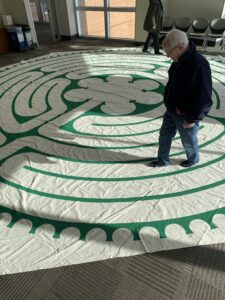
Valpo is also home to several labyrinths. There are two outdoor labyrinths, one located on the east side of the Chapel of the Resurrection, and one at the Lutheran Diaconal Association center. There is also an indoor, portable canvas labyrinth, which was used at a session for MLK Day in January on spiritual resources for action and contemplation.
As Travis Scholl (‘96), the author of Walking the Labyrinth: A Place to Pray and Seek God and the presenter at the MLK Day session, eloquently points out, a labyrinth is the opposite of a straight line. In fact, the center of the labyrinth is not located at the crosshairs, and the way to the center takes the longest and most circuitous route possible within the space. Moreover, the center of the labyrinth is not a dot, but an empty place.
What does this mean for our journey of understanding our purpose and calling? As many of us can attest, years or decades after college graduation, life does not play out in a series of straight lines. If we find a magical “bullseye” where we feel fulfilled, glad, and useful, this feeling may not last or it may not be present every day.
Scholl tells us that the empty center of the labyrinth demonstrates the emptiness of our clichés and our pieties, and calls us to understand that all we can do in our search for purpose is to find ourselves in the present moment. In that moment we find ourselves face to face not with our definitions, aspirations, or accomplishments, but with our Creator, who tells us that we were created for just this moment, that we are enough. No instructions beyond that. That simple, and that difficult.
Where our previous ideas told us we fell short, that we are lacking, in the center of the labyrinth all that we have walked before comes to fruition in the moment, and meets the moment, if only we can trust.
And then, rather than congratulating ourselves for hitting the target, we walk the long and winding path back out into the world to live and act in the present moment, having experienced the center.
- by Kat Peters, Assistant Director of the Institute for Leadership and Service
- Photo credit Pastor Kate Museus
The Division of Calling and Spiritual Life (ILAS and the Chapel) is working with campus partners this Lent and this spring to bring the canvas labyrinth to different corners of the university. We invite you to watch for this labyrinth, or to visit the outdoor labyrinths east of the Chapel and in the garden of the Lutheran Diaconal Association Center. We invite you to take the first step, to take one step at a time, to reach the center of your life.
It’s that time of year—in the calendar and in the rhythm of college life—when we instinctively look ahead. Perhaps we declare a resolution to those around us, or search out an app to download that will help us track and manage our habits. (Our consumption culture has just finished a season of encouraging us to indulge, after all, and now we’re exhorted to take control so that adds some pressure, too.)
On college campuses, soon-to-be graduating seniors are often peering more earnestly into the future, as well—perhaps finalizing applications or awaiting graduate school decisions; seeking to network and interview for positions that are still coming into focus; wondering with a mix of excitement and uncertainty about a position that they may have already secured; navigating relational commitments and how best to live into them in this next period; recalibrating as plans shift.
In all this, possibilities beckon, sometimes pulling in quite different directions.
I often think of these as “threshold moments” (a term I’m not alone in embracing but one whose genesis is unclear to me). This metaphor implies a rich backstory with any number of experiences that have formed and shaped us, and we’re about to walk into a new space, still connected to what came before but also distinctly its own. In my personal experience, thresholds stir up all sorts of emotions because I’m more keenly aware of being poised between past and future, moving forward and looking back. If I’m being honest, my life is a series of these thresholds, and not just at the big milestone markers like graduation. Thresholds always seem to loom larger, though, when accompanied with extra signposting and expectation.
Lately, I’ve been privileged to share thoughtful, searching conversations with several seniors approaching graduation as they weigh options and an abiding desire to live fully and meaningfully into their values while embracing a sense of purpose. Even if they are still discovering more about themselves everyday (as we all are), they can eloquently describe what they care about, what they are good at, and what is life-giving for them as individuals and as community members engaged in broader concerns…but how precisely do you fit those pieces together? What shape does it make? How do you choose this shape over that one?
I can hear my own deliberations echoed in these questions, and even though I recognize it as a fallacy, I feel the pull of single, simple answers. We seek clarity and certainty. It must be this…just one clear thing, please.
It is both fortunate and frustrating that our purpose is more complex and more multi-faceted, that it can’t be neatly winnowed down to one role, that it resists the bounds of being defined by just position or career. This is actually life-giving news (even if it doesn’t always feel that way). It translates into the abundance of “both/and” possibilities, eschewing the logic of “either/or.”
In my conversations with college students, it seems to me that they often perceive their threshold as a front door as they leave the relatively safe confines of home or college life for a wide and somewhat unfamiliar world. In these sorts of moments, we are called to the present, to paying attention and responding as we discern and take the best next step. But that step doesn’t have to be perfect or permanently defining. One of the lessons that I personally take away from Christianity and the Lutheran heritage of this particular place is that we are not fully defined by where we find ourselves. There is a God who travels beyond all thresholds—there in our spaces of home and comfort, there on the open road, always with us and holding us.
For me, the words from what our family calls the Holden Prayer ring true at the threshold. We are called to “ventures of which we cannot see the ending, by paths as yet untrodden.” We are invited to a next step on still unfolding journeys.
–by Dr. Anna Stewart, Director of the Institute for Leadership & Service
Why are we here? What is my purpose in life? Who am I and how do I show up in the world? These are a few of the very big questions that we ask around here, in the Division of Calling and Spiritual Life, at Valparaiso University, at the Institute for Leadership and Service, in the church.

I admit, there are days when these questions are a little too big for me, to the point of being incomprehensible or illogical. In fact, the older I get, the less I profess to know, as Anne Lamott points out in her recent essay on knowing less and less every year.
What to do when we look around at society? What are we supposed to do with a refugee crisis that is sending thousands of people into our cities and towns every day? What are we supposed to do with wars that find their way to our streets and campuses? What purpose can we find in climatic events that destroy homes, livelihoods, and political stability?
Does the concept of Christian vocation stand up to these deep challenges?
Jennifer Grant Haworth provides helpful direction in her chapter entitled “Discerning God’s Call,” in the volume On Our Way: Christian Practices for Living a Whole Life, edited by Dorothy C. Bass and Susan R. Briehl. Haworth does not suppose that living into our callings, or vocations, will somehow solve all of the world’s problems, or tell us which path to choose after graduation. Rather, she describes vocation as a “call from God to love and grow in love – with self, others, and God” (p. 37).
We can do this through a centuries-old Christian practice known as discernment. Here is how Haworth describes the practice:
“Through individual reflection and conversation with others, the Christian practice of discernment invites us (1) to pay attention to our daily experience and what it stirs in us; (2) to reflect on what we notice there, sorting and sifting in order to understand what is leading to greater life and love and what is not; and (3) to take loving action on what we have learned” (p. 41).
Susan L. Maros, for her part in her book Calling and Context, reminds us that this process of discernment has to do with work that God is already doing in the world. We are listening for this transforming work, and looking for how our own experience and formation equips us to be a part of God’s work.
It turns out that this process of vocational discernment is not so much future-oriented as it is a practice of being in the present moment, of paying attention, reflecting, and then acting when the Spirit urges. We also consider our past formation, understanding that God is preparing and equipping us all along to meet the present moment.
Recently, a group of Lutheran Christians in Valparaiso that I know discerned that they will support a Venezuelan refugee family who is trying to make their way to the United States. For now, this support meant lending two names to a document of “US Contact Persons.” While sitting in the meeting where this was decided, I was struck by how the group relied on their past experiences, knowledge, and formation, and how they carefully listened to God’s voice in the wider situation and in each other, telling them that they are ready to take on this challenge.
A different group, with a different past, would not come to the same conclusion. Yet this group has had past formation through helping other refugee families, through visiting Central America and hearing refugee stories firsthand, through their connections with agencies and individuals in Valparaiso who know how to help make things happen for folks in need.
This group had prayed for a chance to serve in their own community, and had prayed for a chance to help refugees, and God provided the opportunity. They still don’t know when or even if the family will be able to make it to the United States, but they are living out their calling in the moment, responding to promptings of the Spirit, making the next small step in faith toward an unknown future.
Sometimes (most times!) those big and lofty questions of calling and vocation point us to exactly where we are, to some unexpected and yet usually obvious (in hindsight) answer of where God is already acting. Much like the song by Will Todd sung by the Valparaiso University Chorale at Christmas at Valpo this past weekend:
“Shepherds, called by angels,
Called by love and angels;
No place but a stable.
My Lord has come.
Sages, searching for stars
Searching for love in heaven;
No place for them but a stable.
My Lord has come.
His love will hold me,
His love will cherish me,
Love will cradle me.
Lead me, lead me to see him,
Sages and shepherds and angels;
No place for me but a stable.
My Lord has come.”
In our Division of Calling and Spiritual Life, we are currently accepting applications to our summer fellowship program called the Calling and Purpose in Society (CAPS) Fellows Program. This is an opportunity to live out a calling in the moment, but also to practice the steps of discernment and deep listening, to learn about situations in the world that require attention and response. The experience will prepare students to approach future issues of calling and purpose with tools of reflection, community, and a responsive attitude.
If you or someone you know are interested in the CAPS Program, you can find more information on our website, or write to us at lead.serve@valpo.edu.
-by Deaconess Kat Peters, M.Ed., M.A., Assistant Director of the Institute for Leadership and Service
Lately, I’ve been stopping to admire the light a lot. The way autumnal light, beaming lower on the horizon, bathes the crimsons, ambers, and golds of trees this time of year. Earlier dusks painting the sky in clear, breathless beauty as I walk to my car under increasingly bare tree limbs. The warmth of a single candle flickering by the sofa – one among many antidotes to those fast-darkening evenings and the chilly mornings when I rise. The pastel hues of my daughter’s miniature lava lamp, casting patterns across her ceiling at bedtime to ward off unwelcome shadows.
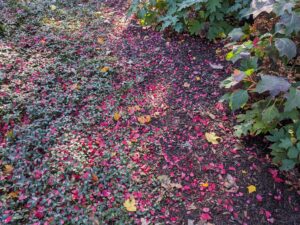
These may be small details, observations half-formed in a midday or mid-evening moment, but for me they are also potent reminders – calling me to pay attention to the world around me, to the sacred and the small, to the reverence such details and moments can invite.
In An Altar in the World: A Geography of Faith, writer Barbara Brown Taylor delves lyrically into how being intentional, purposeful, and fully present not only grounds us as human beings but points us toward God and deeper meaning. In one of the book’s chapters, “The Practice of Paying Attention,” she describes the virtue of cultivating reverence, a practice she now recognizes that she encountered early in her childhood:
“From [my father] I learned by example that reverence was the proper attitude of a small and curious human being in a vast and fascinating world of experience. This world included people and places as well as things. Full appreciation of it required frequent adventures, grand projects, honed skills, and feats of daring. Above all, it required close attention to the way things worked, including one’s own participation in their working or not working.” [19]
Brown Taylor draws on philosopher Simone Weil (among other writers and thinkers), braiding together considerations from several religious traditions as she ponders how truly paying attention – or with a nod to my own English-major desire for verbs with flair! – lavishing attention on the people, places, and things around us can open us up to reverence. Those seemingly small details just might contain multitudes.
In other words, what might at first blush seem like pausing to consider the trivial in fact becomes a path to something far bigger.
Paraphrasing another philosopher, Brown Taylor muses that reverence (borne out of a kind of sustained attention) is ultimately “the recognition of something greater than the self – something that is beyond human creation or control, that transcends full human understanding.” Reverence, she writes, “stands in awe of something – something that dwarfs the self, that allows human beings to sense the full extent of our limits – so that we can begin to see one another more reverently as well.” [21]
As a lifelong lover of literature and a longtime teacher, I found additional appreciation for this cycle of attention and reverence, walking students through complex texts and guiding them through the practices of close reading. Carefully attending to details, small moments, nuance, and texture – truly lavishing attention, even between the covers of a novel–can open us up to one another. Reading narratives this way can help us to also read the world, inviting us into one another’s stories. These practices of close reading, in books and in life, help us reckon with our limits even as we also celebrate our part in a human story far greater than our own.
A little over two weeks ago, I was preparing a brief homily for Monday Morning Prayer. Drawing on the Division of Calling and Spiritual Life’s “Reset/Refresh” theme as well as the year’s morning prayer series “This is How I Sabbath (or Try To),” I decided to reflect on how Sabbath-time can summon us toward this sort of lavish attention.
The scripture for the morning, Psalm 104, delights in the reverent details. The psalmist imagines:
“the sea, vast and spacious,
teeming with creatures beyond number–
living things both large and small.
The ships go to and fro…”
Even a sea-monster appears, “frolicking” in the expansive ocean.
The psalm offers a beautiful meditation on how lavishing attention can reorient us, pulling us into reverence. I found myself pondering and grappling with this anew when, the day before the scheduled Monday Morning Prayer homily, our campus community learned that one of our students had been violently attacked and rushed to a hospital across the state for critical care.
Tomorrow we will gather as a campus to remember Varun Raj Pucha, who tragically died of those injuries, and to lift up his life. I did not have the privilege of knowing Varun, but I have been grateful for glimpses of him carried through the words of his family, friends, and professors. The pieces of his story and others’ memories of him do not constitute his life, all that he was, or all that he was in the process of becoming. But they can offer us a chance to attend, to revere even as we say goodbye, to gather around a few powerful reminders of a beautiful story that was still being written and of a reverence that beckons us all.
-by Dr. Anna Stewart, ILAS Director
Photo credit: Amy Smessaert, Lutheran Diaconal Association
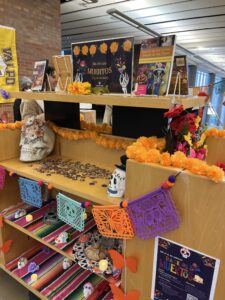 Students and faculty will gather at several locations across campus this week to celebrate Día de los Muertos, a Hispanic cultural tradition honoring loved ones who have passed away. The kick-off event will be an evening of crafting and pozole, a traditional Mexican soup, from 6-8 p.m. on Oct. 30. The Valpo community also had the opportunity to submit photos of their loved ones to be displayed on commemorative ofrendas, Spanish for offerings, on the second floor of the Christopher Center Library, Harre Union, Loke Hall and the Gloria Christi Chapel Nov. 2-8.
Sonia Morales, Assistant Director of OMP (Office of Multicultural Programs), and Kat Peters, Assistant Director of the Institute for Leadership and Service (within the Division of Calling and Spiritual Life), have been instrumental in fostering the collaboration that makes these events possible. This year, the celebrations have expanded to other facilities, in part to accommodate students who wouldn’t usually find themselves in the Chapel.
“So, it was a project that was a collaboration between OMP and Calling and Spiritual Life. We wanted to continue working on that, and this year, we wanted to make it bigger,” Morales said. “We wanted to include the library and the Union because [they] are the places where the students are more willing to go.”
Both Morales and Peters are enthusiastic about the opportunities that these partnerships present to reach a wider segment of the Valpo community, and welcome the contributions that other facilities and organizations can contribute.
“It’s really neat, because it does seem like it’s growing. It’s a campus-wide collaboration, which is something that is really important to us here at the Helge [Center] and in Calling and Spiritual Life. [We are] partnering with many places so that we can do projects together,” Peters said.
Morales too expressed the importance of embracing the opportunity to learn from their collaborators and improve their programming by doing so. She hopes that these collaborations will continue to evolve and flourish in the future.
“Something that has been really important is to understand what are things that everyone could bring to the table … We are also learning a lot about the departments that are working with us and we’re thinking [about how] they could keep working with us in different ways,” Morales said.
For Peters, this is an expression of the commitment to holistic education and embracing opportunities that characterize both the university’s mission and the Lutheran faith.
“I think there are some really neat statements out about the university’s calling … For example, it talks about symbols of faith [are] core to our mission, and Lutheran tradition calls us to serve our neighbors, embrace our differences and work to make quality education accessible to all who seek it,” Peters said.
Morales noted the similarities between Día de los Muertos and Christian traditions such as All Saints’ Day. She views the parallels between them as an opportunity for meaningful connection, and a way to come together to process the grief the community has experienced.
“Valpo celebrates All Saints’ Day where we read the names of all who have passed in the previous year … So it’s like we’ve always been doing this. But here’s another specific cultural way we can celebrate and remember, and so we can do this all together,” Peters said. “This is an important part in the healing process. I think with everything going on in the world and coming out of COVID, I don’t think that we’ve processed all of our grief about everything … which is a really healthy thing to do.”
Peters emphasized the mutual benefit of interacting with different cultural traditions, but also believes that Día de los Muertos has an impact that transcends culture. She hopes to continue this in the years to come.
“It’d be great to just keep adding … We are a family and we all get to work together even across cultural differences or bringing different traditions together. And that’s something that’s going to benefit everyone,” Peters said. “So it’s not just a cultural event, it has spiritual and emotional significance that we hope makes a difference in people’s lives.”
Students interested in participating in Día de los Muertos programming can consult the relevant flyers around campus or contact omp@valpo.edu or chapel@valpo.edu for more information.
– Carolyn Dilbeck ’25
Dear Valpo Community,
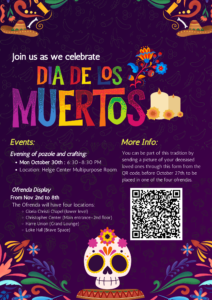
Valparaiso University has a long-held tradition of celebrating All Saints Day, in which we remember those who have passed away in the last year. Names are read on All Saints Sunday (November 5, 2023), including the names of those who have died from our university community, whose photos are displayed all year on the third floor of the Christopher Center Library. Día de los Muertos (Day of the Dead) is a Latin American tradition to honor and commemorate the lives of the loved ones who are no longer with us, and to welcome acknowledging their continuing presence in our lives. The main part of this cultural-spiritual tradition is the ofrenda, an ornamental space dedicated to honoring our relatives. This year, Valpo wants to bring this important tradition to four key locations on campus to celebrate Dia de los Muertos in the university community.
We want to invite you to join us in celebrating that death does not separate us from our loved ones. You can be part of this tradition by sending a picture of your deceased loved ones through this form before October 27th, to be placed in one of the four ofrendas. We will print and frame your pictures to be placed on the ofrenda of your choice.
Consider joining us Monday evening, October 30th, in the Helge Center Multipurpose Room at 6:30 PM, to eat pozole and prepare elements of the ofrendas.This cultural tradition brings communities together. We hope that all Valpo Families can gather together to spend time sharing stories from their ancestors. The Ofrenda will be displayed in the Gloria Christi Chapel (lower level), the Christopher Center (2nd floor), the Harre Union (Grand Lounge), and Loke Hall (Brave Space) from November 1st to November 8th. The Chapel will be open until 10:00 pm During this time, please use the Gloria Christi Chapel entrance (east side of the Chapel) during concerts and events.
Blessings,
Calling and Spiritual Life/Institute for Leadership and Service, Office of Multicultural Programs, Department of World Languages and Cultures, Christopher Center for Library and Information Resources, Student Life