
I’ve been thinking a lot lately about the book The Bean Trees by Barbara Kingsolver. This has been one of my favorite books since I first read it when I was 13. The novel follows protagonist Taylor, who, realizing that she needs to escape her small hometown in rural Kentucky, buys a VW Bug and vows to drive until it breaks down. She ends up in Tucson, Arizona, and through a strange series of events finds herself caring for a three-year-old girl who she calls Turtle. There are a lot of reasons this book could be on my mind lately – besides the Southwestern aesthetic that characterizes both Tucson and Austin (my home for the summer), it touches on perennial themes like immigration rights, environmental responsibility, and coming of age. But most of all, it is a book about building a new home in a foreign place.
Taylor draws together eccentric characters: anxiety-prone fellow single mom Lou Ann and her son Dwayne Ray, undocumented Guatemalan immigrants Estevan and Esperanza, used tire store/refugee sanctuary owner and activist Mattie, and grumbling neighbors Virgie and Edna, to name a few. Little by little, Taylor builds herself a home and a family in the “foreign” land that is the southwest, and eventually feels that she belongs there more than she ever did in Pittman County, Kentucky.
I don’t necessarily identify with Taylor’s need to escape her hometown. The opposite, actually: I am a homebody at heart. There is nowhere in the world I like more than the old red armchair in my living room at home, curled up with a book and a cup of coffee, listening to my family rustling through the house around me. But in the past few years I’ve found myself drawn farther and farther away from home, not pushed by a desire to leave but pulled towards the unknown. I’ve spent my recent months first studying in Spain, then traveling to Uganda with Water to Thrive and living in Austin as a CAPS fellow. By the time I move back in at Valpo for my senior year, I will have been home for a grand total of 8 days in the past 8 months. And though I miss my home, my family, my friends, and that red armchair, I’ve been learning to take a page out of Taylor’s book and build a new home through my community here.
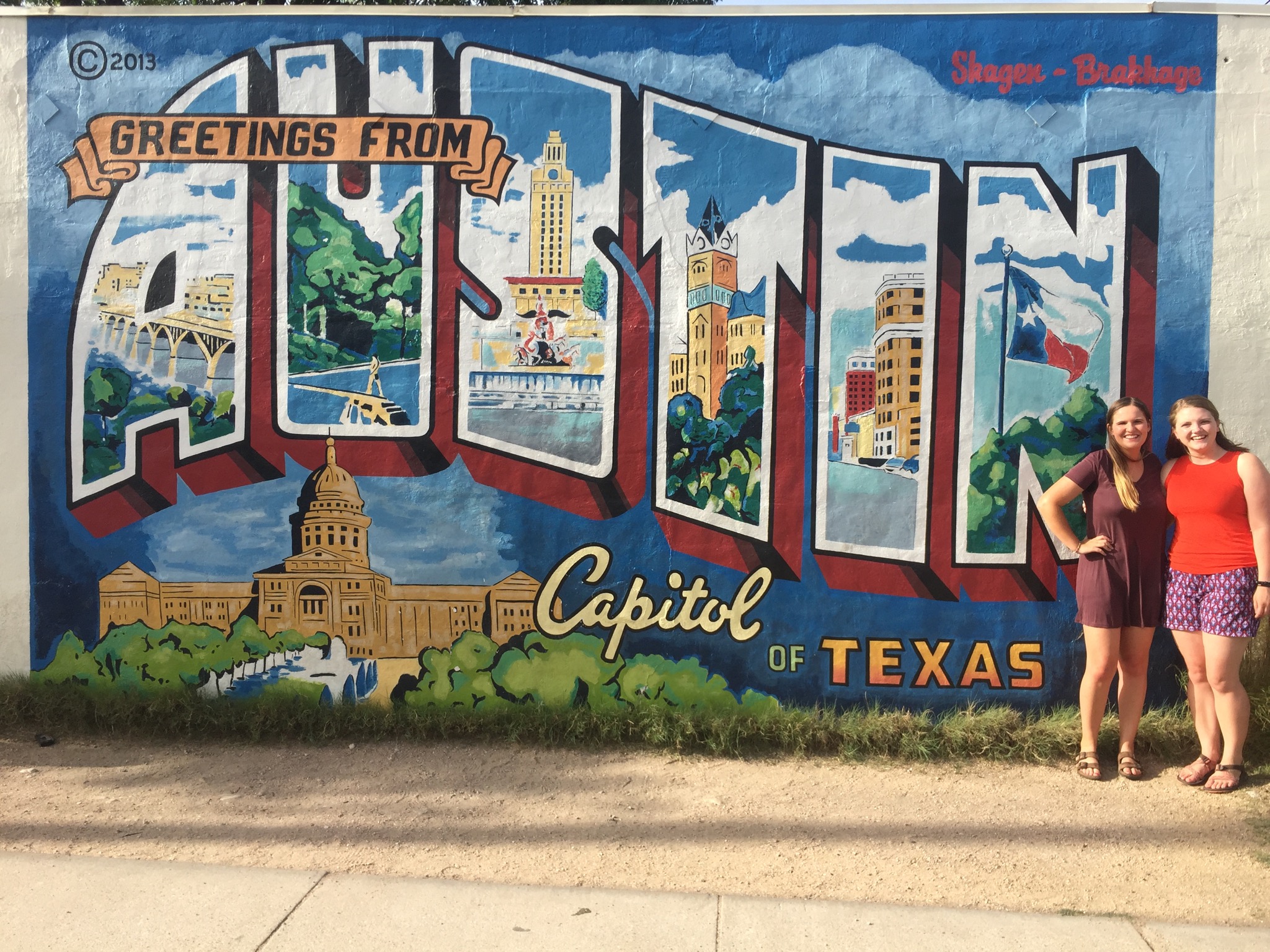
Exploring Austin with Grace!
As happens when you move somewhere new, distant networks have become friends. In addition to Grace, my wonderful fellow CAPS intern, I’ve found strange connections that have slowly built this city into a home: like friends of friends who are visiting Austin for the weekend, old acquaintances I was vaguely friends with in high school who have since moved to Austin, or my CAPS assigned alumni mentor, who had me over to her house for dinner. I spent the evening talking with her and her husband, who met in the Peace Corps and encouraged me to pursue this dream, and, after playing outside with her three-year-old son, sent me home with raspberry bars and an open invitation to stay with them any time I find myself back in Austin.
Last weekend, I drove down to San Antonio to visit Elanore, a donor who was on my Water to Thrive trip to Uganda. She is a 65-year-old former Navy Commander. On paper, we have very little in common. But we quickly bonded in Uganda, sharing snacks and motion sickness medicine and stories on long, bumpy van rides, and so I spent the weekend staying with her and her husband. We spent one day shopping and going to museums and eating tacos on the San Antonio Riverwalk. People kept asking us if we were related, assuming she was my mother or grandmother, to which one of us would reply, “No – we’re friends.”
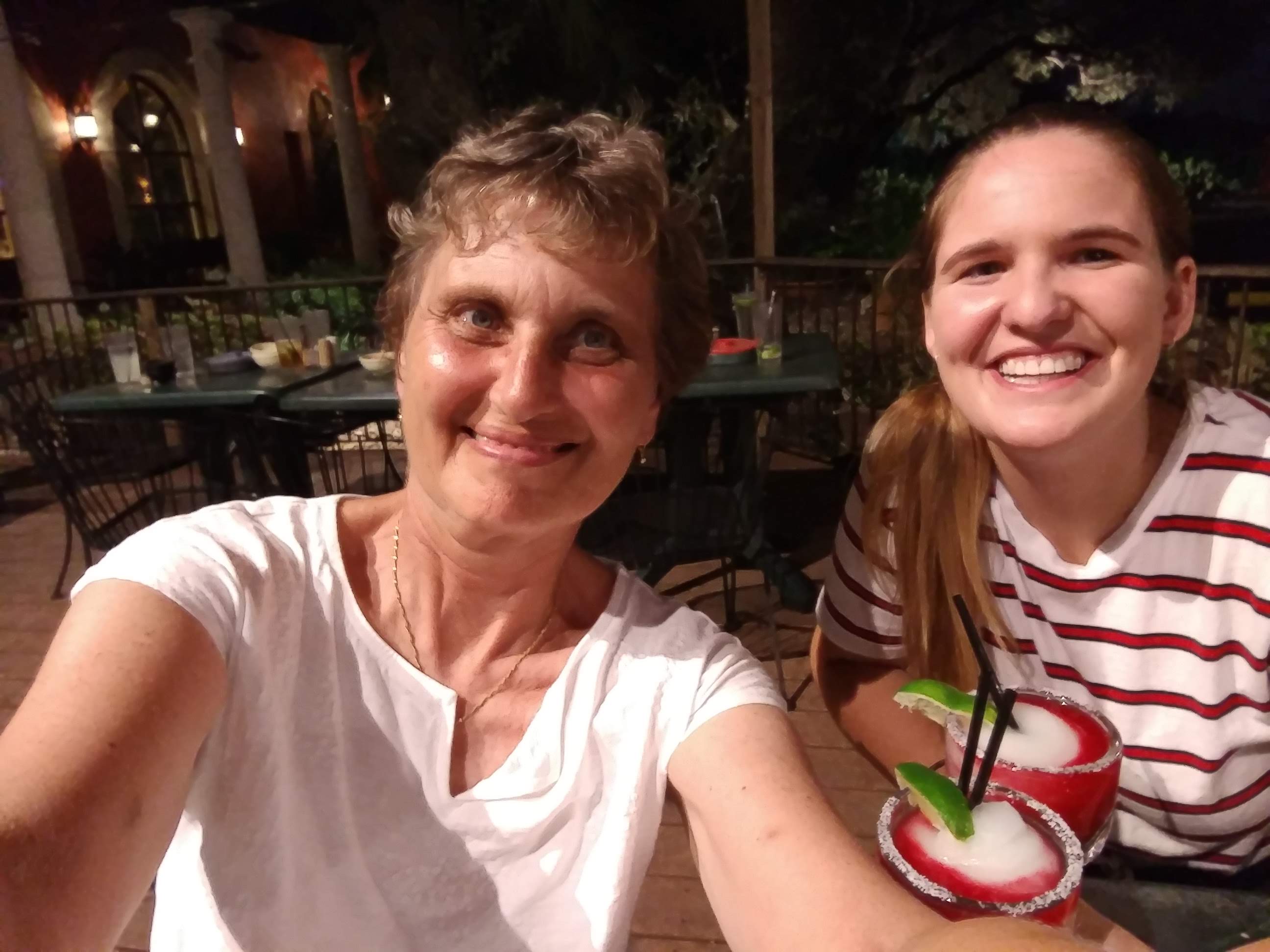
Visiting Elanore in San Antonio.
My community has turned this city into a home, made up of eccentric and unexpected characters. As my time here in Austin ends, I find myself reflecting on not just the exciting travel and meaningful work I have been lucky enough to be a part of, but also the community and home I’ve built in each new place I go.
My internship with the Harrison Center has held countless surprises, lessons, and memories. Looking back on all of it (the good and the not-so-good), I wouldn’t change how any of it played out– mostly because everything I’ve learned has been one more puzzle piece I can add to my unknown, post-graduation future. One of my most unexpected epiphanies didn’t make itself known until my last couple of weeks in Indy but it greatly affected that span of time.
I didn’t anticipate becoming apathetic to writing– blog writing that is. I know it’s a bit meta and ironic with this being a blog post but between the Harrison Center and the freelance writing I do for an addiction recovery center, this reliable use of my Creative Writing degree has grown less appetizing. Upon reflection, I think what’s deflated my love for blog-writing-as-a-career, has been the way it has zapped my energy and interest in independently writing creatively; the original intent behind my business and sales writing was to give me enough financial stability to be able to pursue my personal writing endeavors.
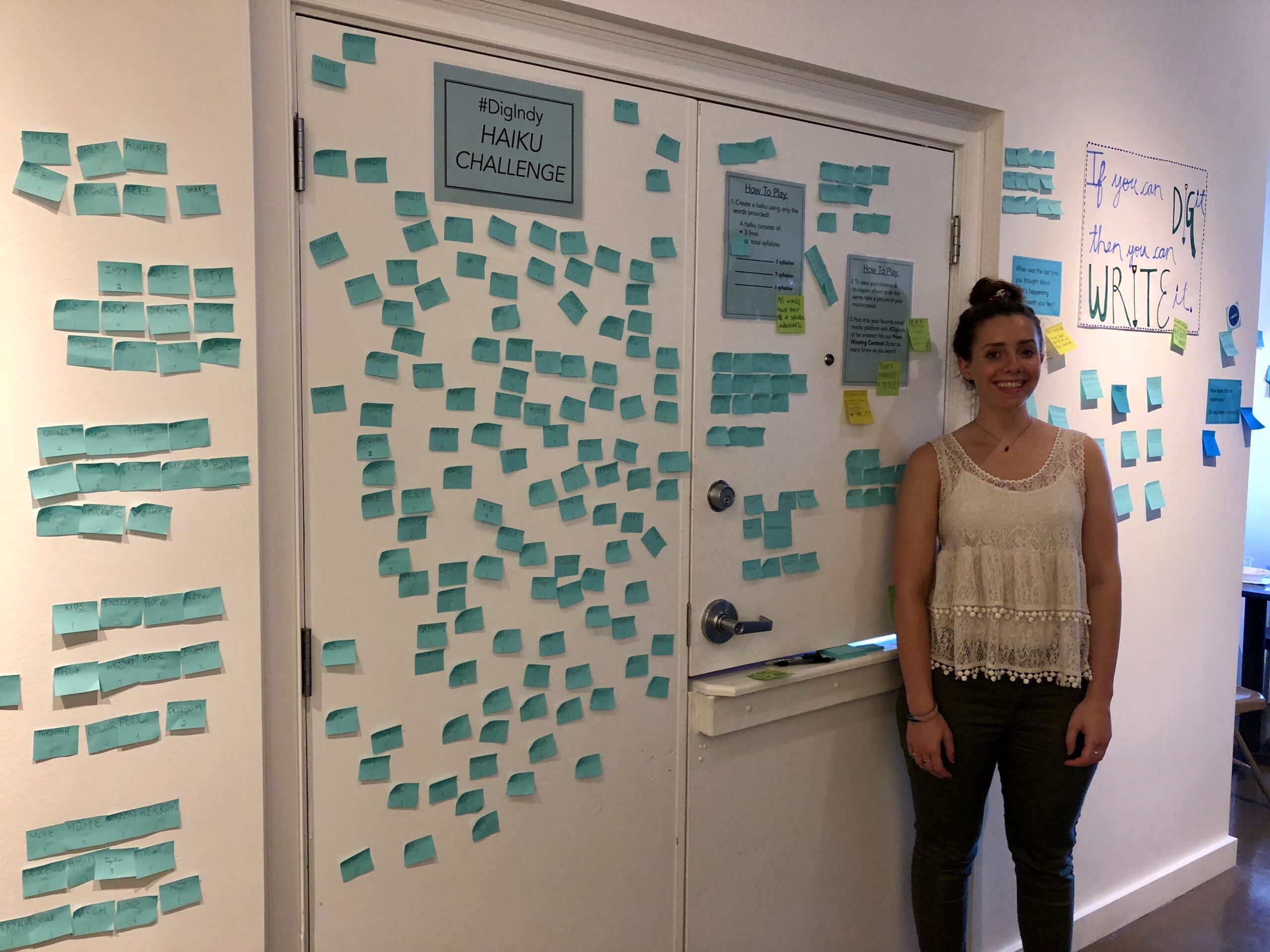
A non-blog-writing project I initiated this summer!
I know that there are many other financially-plausible options that my Creative Writing degree could open up for me (e.g., editing and proofreading, layout and design, ghostwriting, graduate school, etc.) but I’d always kind of banked on freelance content and sales writing since I’ve already gotten my foot or at least a few toes into that door.
From a big picture perspective, I know that I would end up feeling lethargic about any task that took up 40+ hours of my week or really anything mentally-demanding by the end of the summer– but I’d be lying if I said this apathy hasn’t been slightly alarming. Granted, I know I have a tendency to get too caught up in the spiraling tale of “what ifs” but as I explained in my previous CAPS blog post, it is okay because that’s just a part of my process.
At my first meeting with my amazing mentor, Lindsay Bledsoe, she imparted upon me some advice that she herself had recently received and benefited from. In regards to pursuing a creative career, she said that “sometimes you have to make art and sometimes you have to make money.” While this was initially a bit of a buzzkill to my barely 3-weeks of interning honeymoon phase, it’s stuck with me and resurfaced as relevant many times throughout this summer.
I had already had some experience with this hard lesson, as I struggled the past school year to release from my freelance writing the high expectations I put on all of my personal and academic endeavors. But I had underestimated how much more difficult it would be to establish a routine and mindset that would allow me to evenly ration out my writing energy. I know that as someone looking to make a career out of my creativity, it will be an ongoing search to find that balance between upholding my artistic standards, self-fulfillment, and making money.
These amazing friends have kept me inspired and sane this summer!
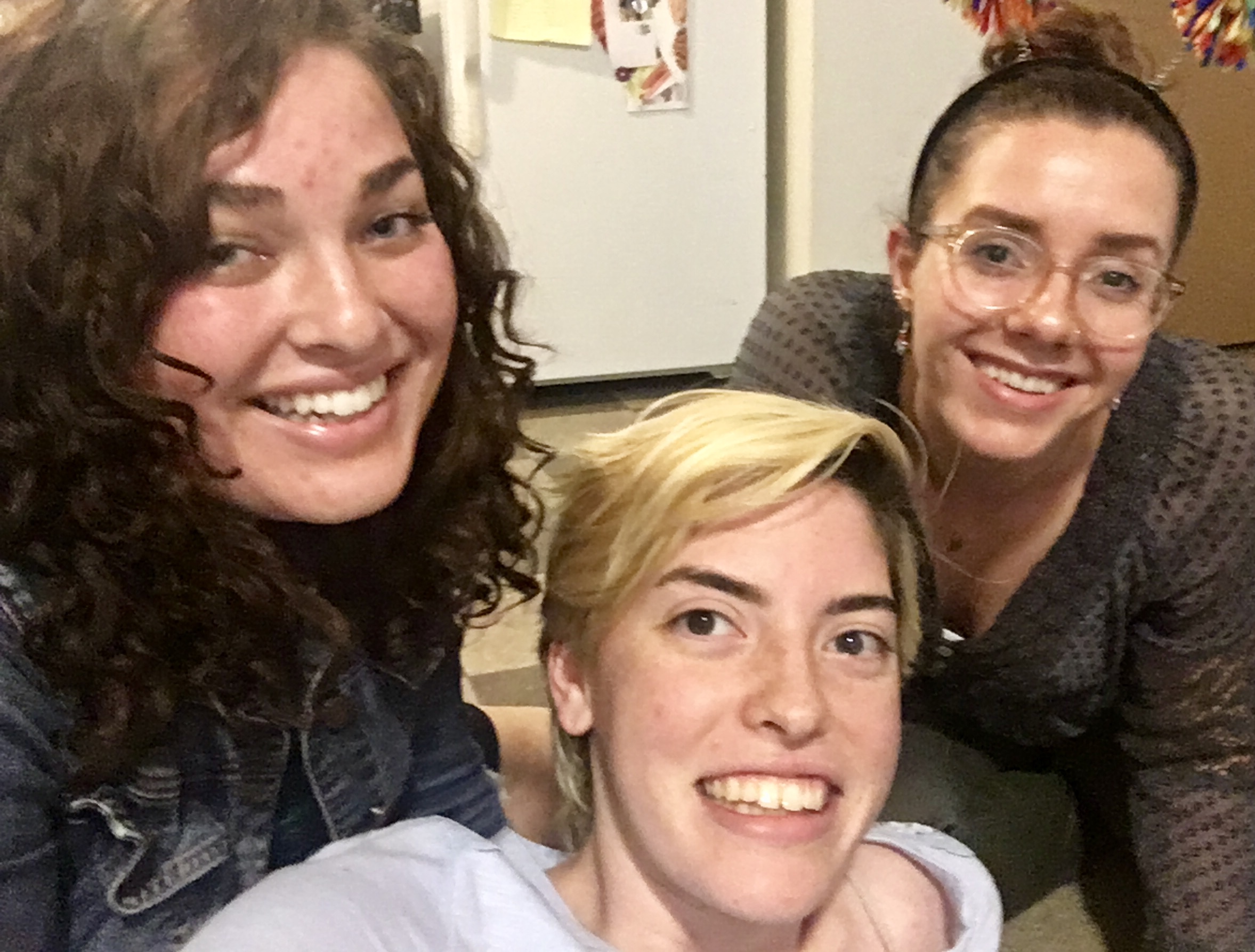
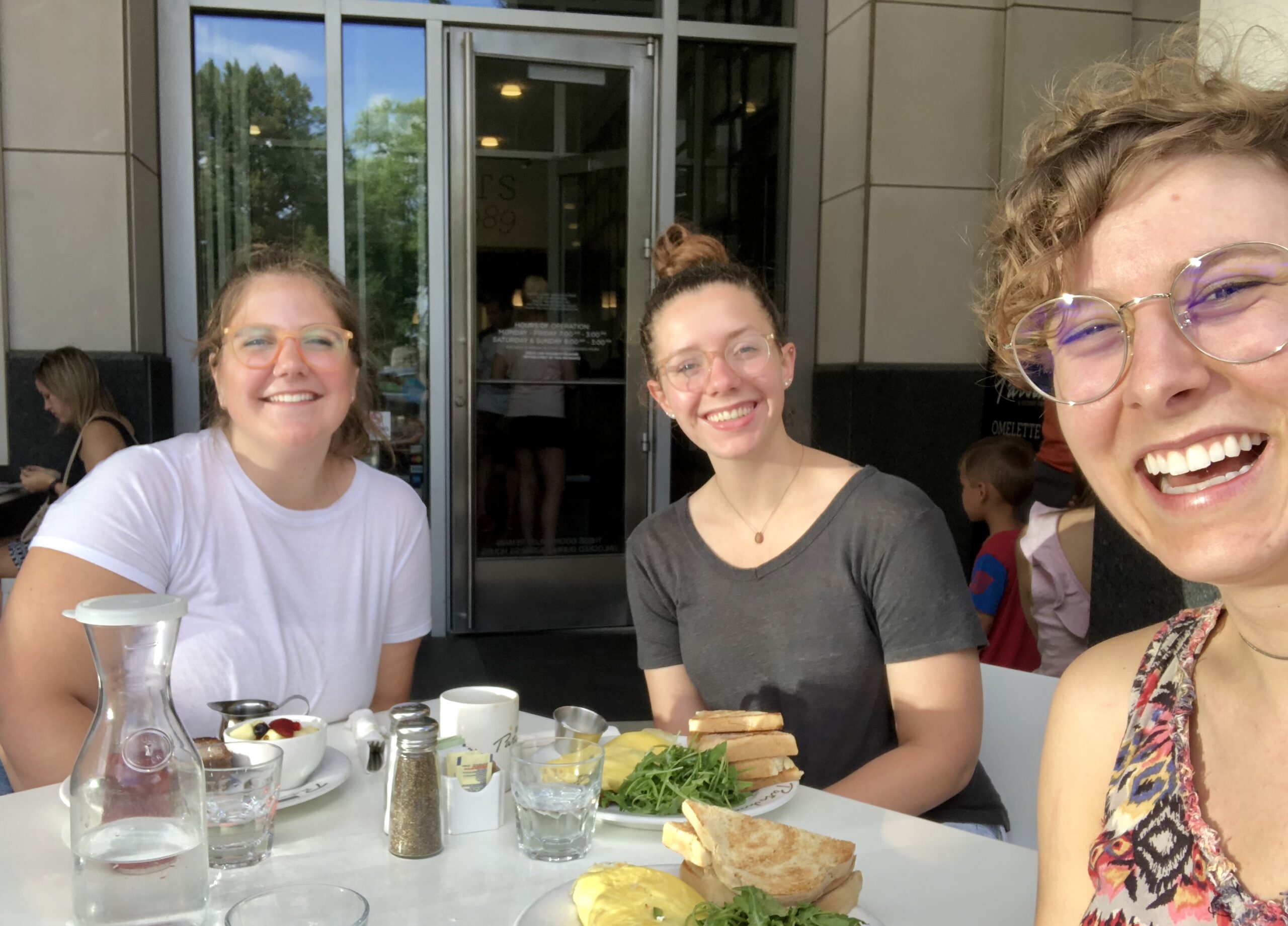
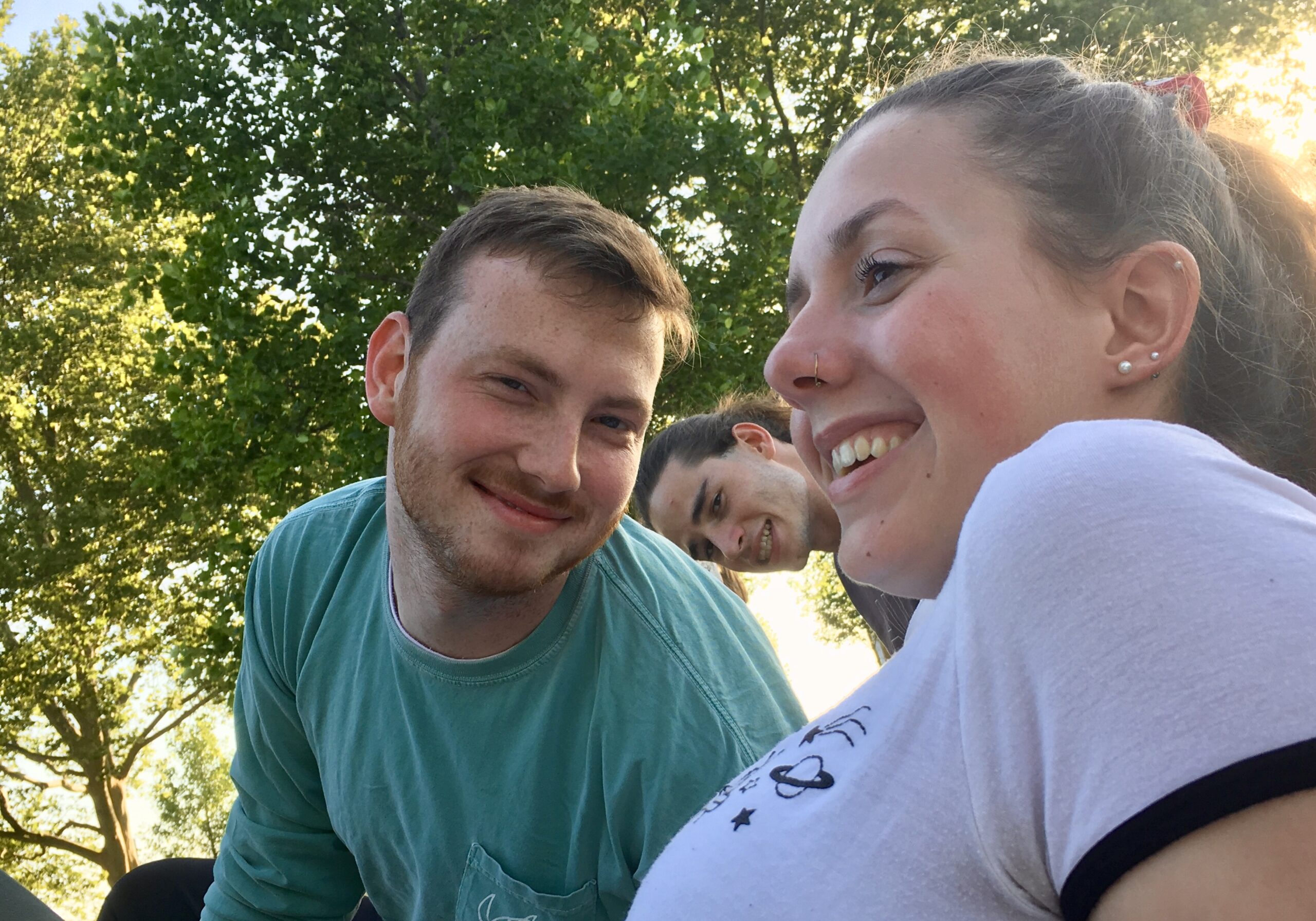
This blog post comes to you in two parts. Firstly, one of the most awkward friendship-based situations, in my opinion, is listening to friends talk about inside jokes without being in on it. It’s fun for a couple seconds, of course, because there’s excitement and laughter, but then again, there’s accidental exclusion. So to prevent that possible feeling, I would love to share some of the jokes and lessons from this summer.
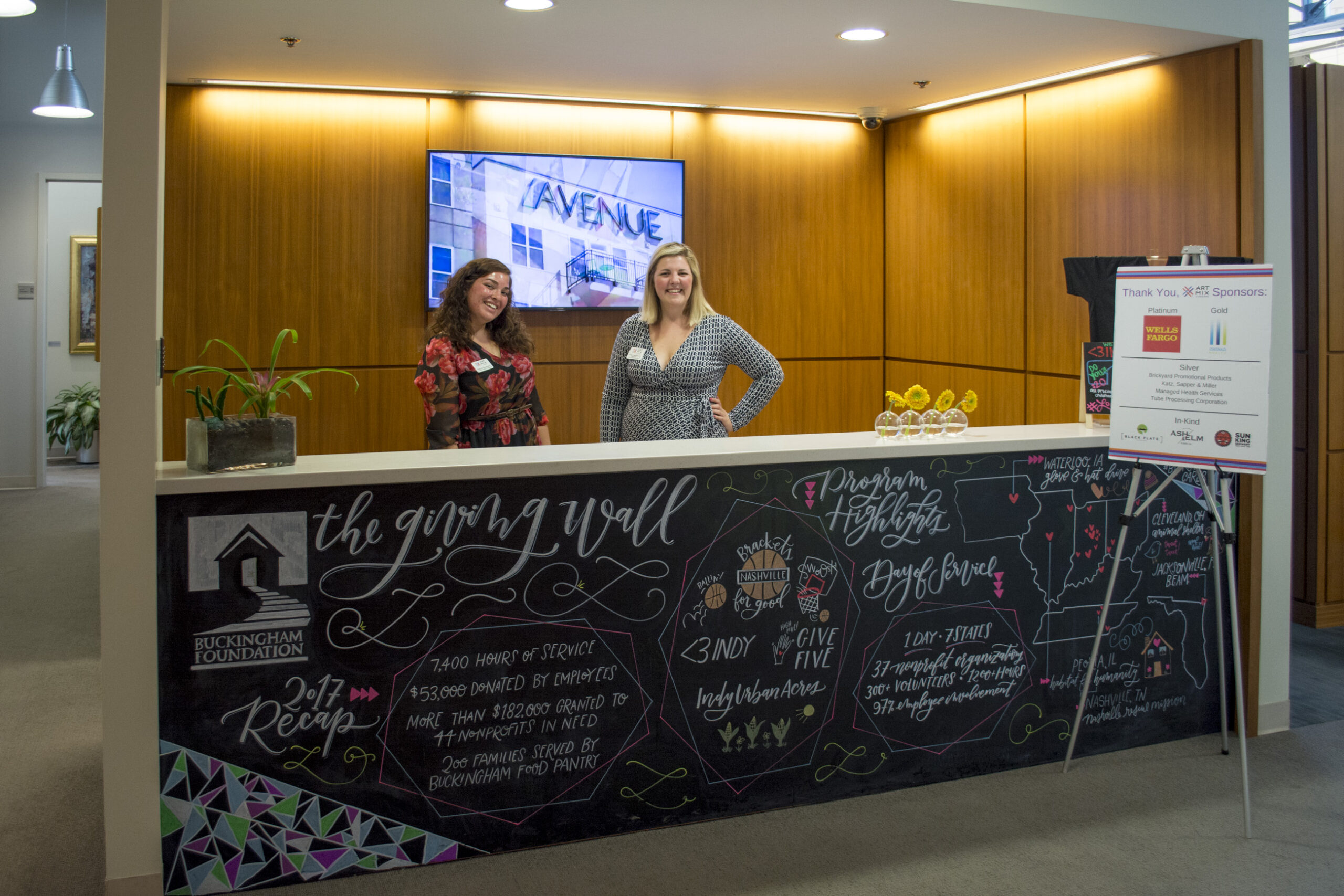
Me and Katy, a previous CAPS Fellow who now works at ArtMix, welcoming guests to the Art and Home Tour.
1. The Byrd Family
Though the Indy CAPS Fellows grew closer day by day through dinner time, there was some general, low-key disconnect due to everyone knowing one another to varying degrees. One day, one Fellow showed up late to dinner and the light-hearted dramatics that ensued afterward centered around a husband showing up late to a wife’s home cooking (stereotypical scenario definitely noted). From this moment, each CAPS Fellow took a role in the family, namely a father, mother, fraternity son, hipster daughter, and an outspoken aunt. Sure, we were acting and having fun, but thinking more about it, I think friendship includes things like how we could easily adapt, make light of a mistake, and use our imagination. At the end of the day, friendship should be a relief and a joy, and these qualities helped make it that.
2. Cowboy and Roller Derby Names
Have you ever thought of what your cowboy or roller derby name would be? Well, my cowboy “God-given name” is Wilhelmina “Willie” Buford (named after an Ugly Betty character and a Forrest Gump character). Again, this is another silly, imaginative game of sorts, but these names and other answers stemmed from out-of-the-box questions that sparked dialogue… and a good time. Questions, whether they’re serious or not, are much better at growing friendship than back-and-forth statements. While this should be a given, questions really helped us bond and reflect more about ourselves and other topics.
3. Hive Mind
Over the course of the summer, as my suitemates and I spent more time together, we noticed a trend where we would say things in unison (“…we finish each other’s sandwiches”, “that’s what I was gonna say”). Let me just say that this is one, a super awesome phenomenon, but also two, a really neat indicator of closeness. It wasn’t that we were getting predictable, but more so that we simply spent enough time together to “get” one another. Time, I’ve found, is a precious thing. Usually, I think about the time around New Years, the end of the semester, my birthday, and even a death. But time can also be seen as a gift, as a glue, and not just an hourglass. Maybe viewing it as such could change a mindset.
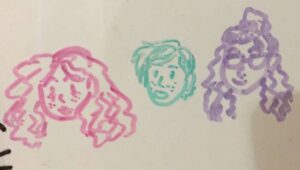
Perry’s drawing of our apartment cohort!
4. Dungeons and Death
If I was asked before this summer if I wanted to play Dungeons and Dragons, I probably would have said no, not because I was unaware of the game, but because of the stereotypical associated audience. After watching The Big Bang Theory and peering to see fellow Valpo students engage in a story, I didn’t feel like it would be the game for me. But after a Fellow talked about it and explained the game, I became interested and together, we roped other Fellows (and each of our friends… and my boyfriend) into the game. Because of D&D, I learned that opening my mind and being receptive to a friend’s interest can be fruitful for all parties: I gained a new interest and experience while they felt appreciated.
5. The Grate
One day, the Indy gang was walking around and decided to come inside due to an approaching storm. But because there wasn’t any rain yet, we decided to keep walking. Nearly one minute after this group decision, a Fellow heard ducks crying out from somewhere. We all searched for the ducks until we found a family of ducks in a sewer grate. Working together, one of us went in the grate, three of us chased the confused ducklings, and the other one of us guided the ducklings back to the mother. Many things this summer required teamwork, such as moving one another into the apartments, but this one was for sure the cutest and most anxiety-inducing moment. Teamwork, in short, makes the dream work. On a less cheesy note, working together really does produce results, especially when everyone’s on the same page. And yes, we did save the ducks!
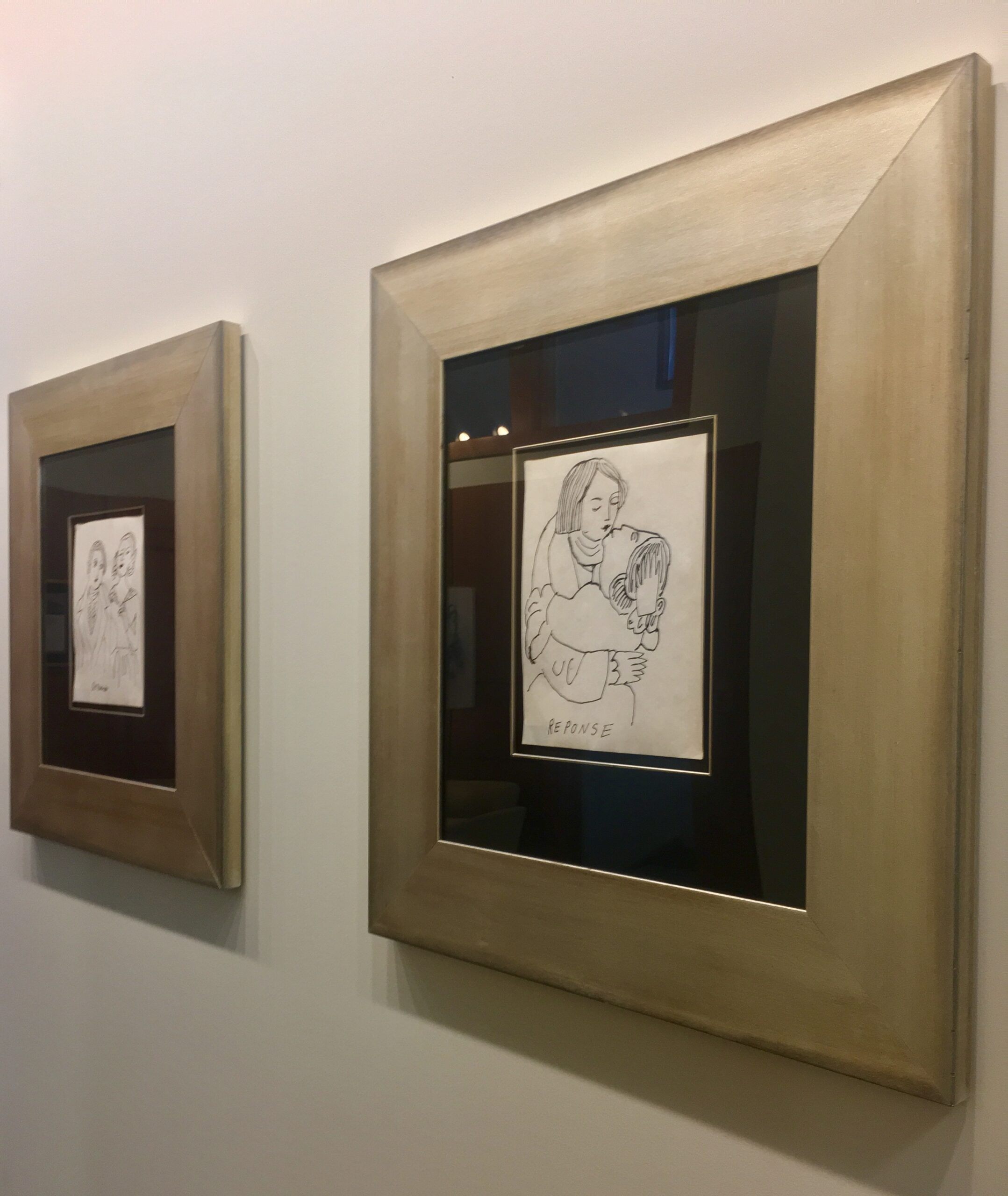
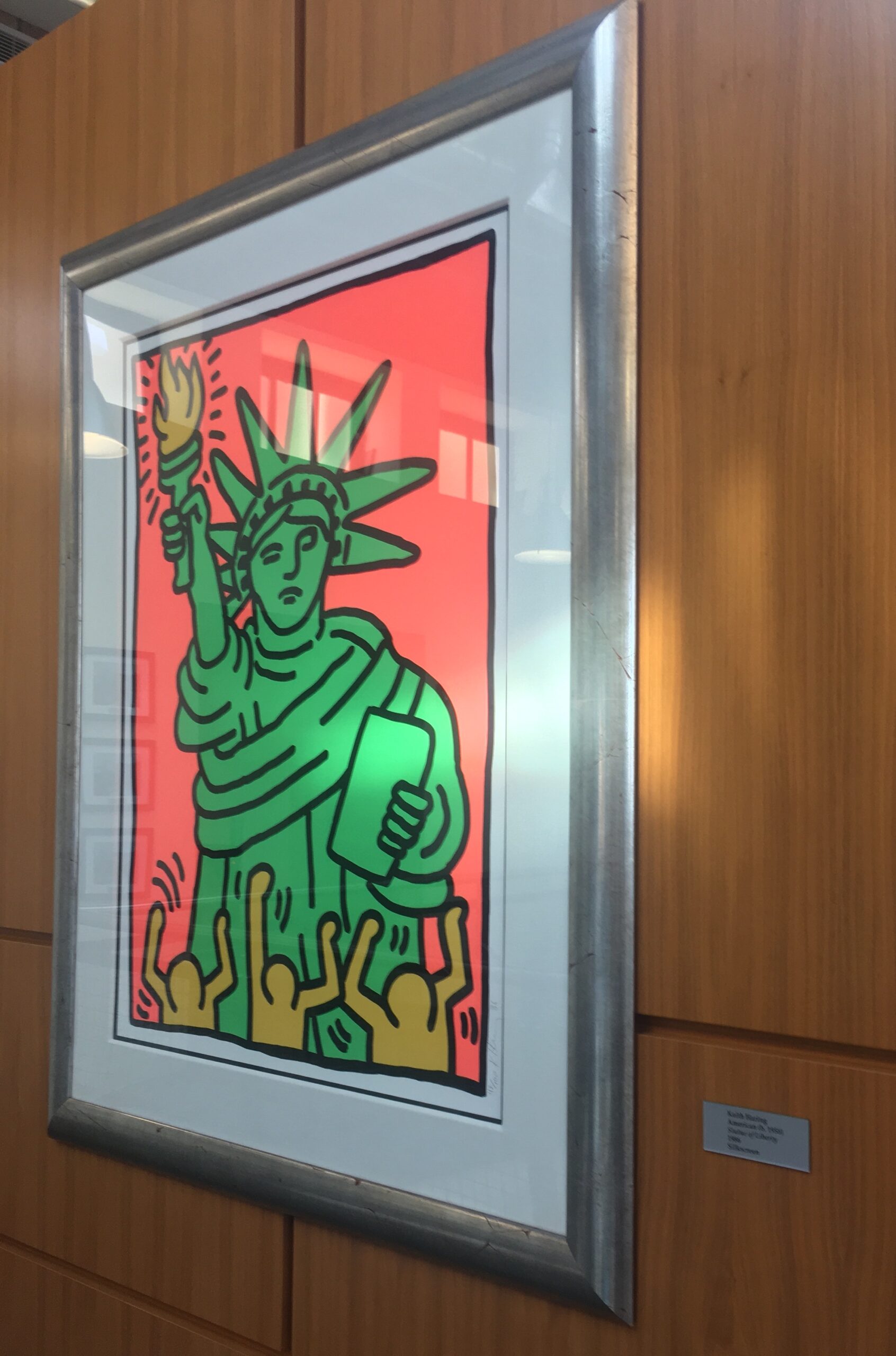
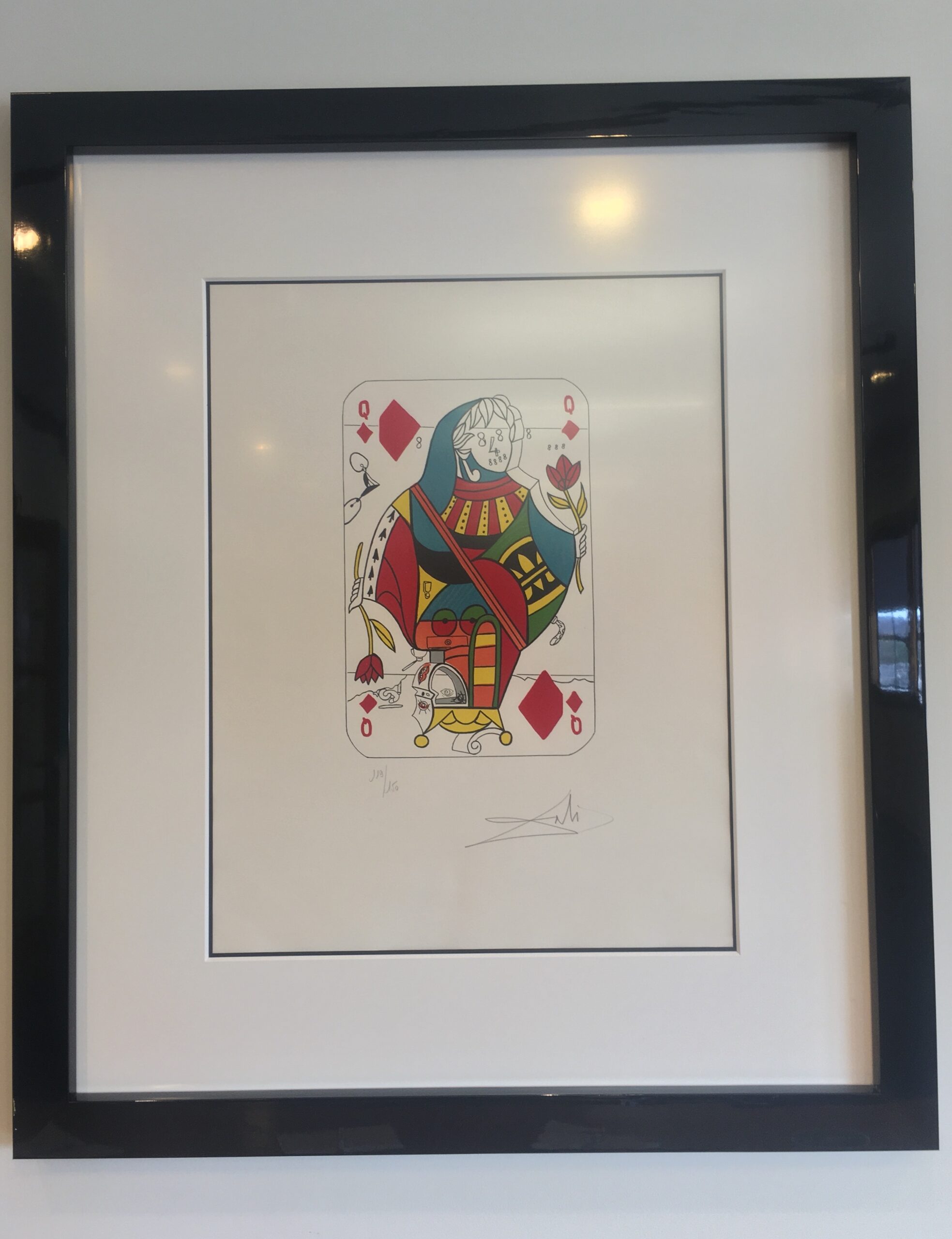
Some super cool art featured at Buckingham Companies’ Art and Home Tour.
Second, it has been a busy time since the beginning of July. ArtMix has held two main events, an Art and Home Tour (2 of 3), which is a set of events that bring guests into residencies that collect art, and the Arts for All Fest, a celebration of our students and the ArtMix community. Both went swimmingly thanks to behind-the-scenes work, volunteers, and the amazing attendees. Though these events are very different in nature, they both create a community for ArtMix and continues the ArtMix vision. I am grateful to have surrounded myself in such a positive environment, a philanthropic, kind, and generous environment that is inevitable at such an organization. Though my job was tedious and sometimes tough, it was all the more worth it to help ArtMix. I know it is cheesy to say that everything happens for a reason, which is one of my frequent sayings, but I firmly believe that this summer has helped me bridge junior to senior year and think more deeply about vocation.
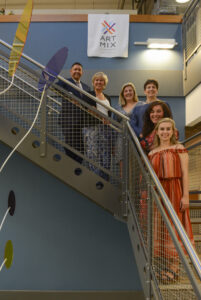
The ArtMix family featuring administrative staff, two interns, and our volunteer of the year.
SaveSave
SaveSave
SaveSave
Alright, it’s week eight in your internship. The end of summer is approaching, and you’re a couple weeks from finishing. What should you do now? You’ve asked the questions, given your input, and tried to be the best intern you could be, but what happens now?
I feel like there’s a shift that takes place over the course of an internship. I think you could consider the ‘shift’ like a series of stages. Stage one is what I like to call the “oh s**t” phase; you’re just figuring things out, and you’re not sure yet if you’ve got what it takes to handle it yet. And, from what I’ve learned, the only way to get to stage two (the “I get this, but not that” phase) is to be confident in your own ability to succeed.
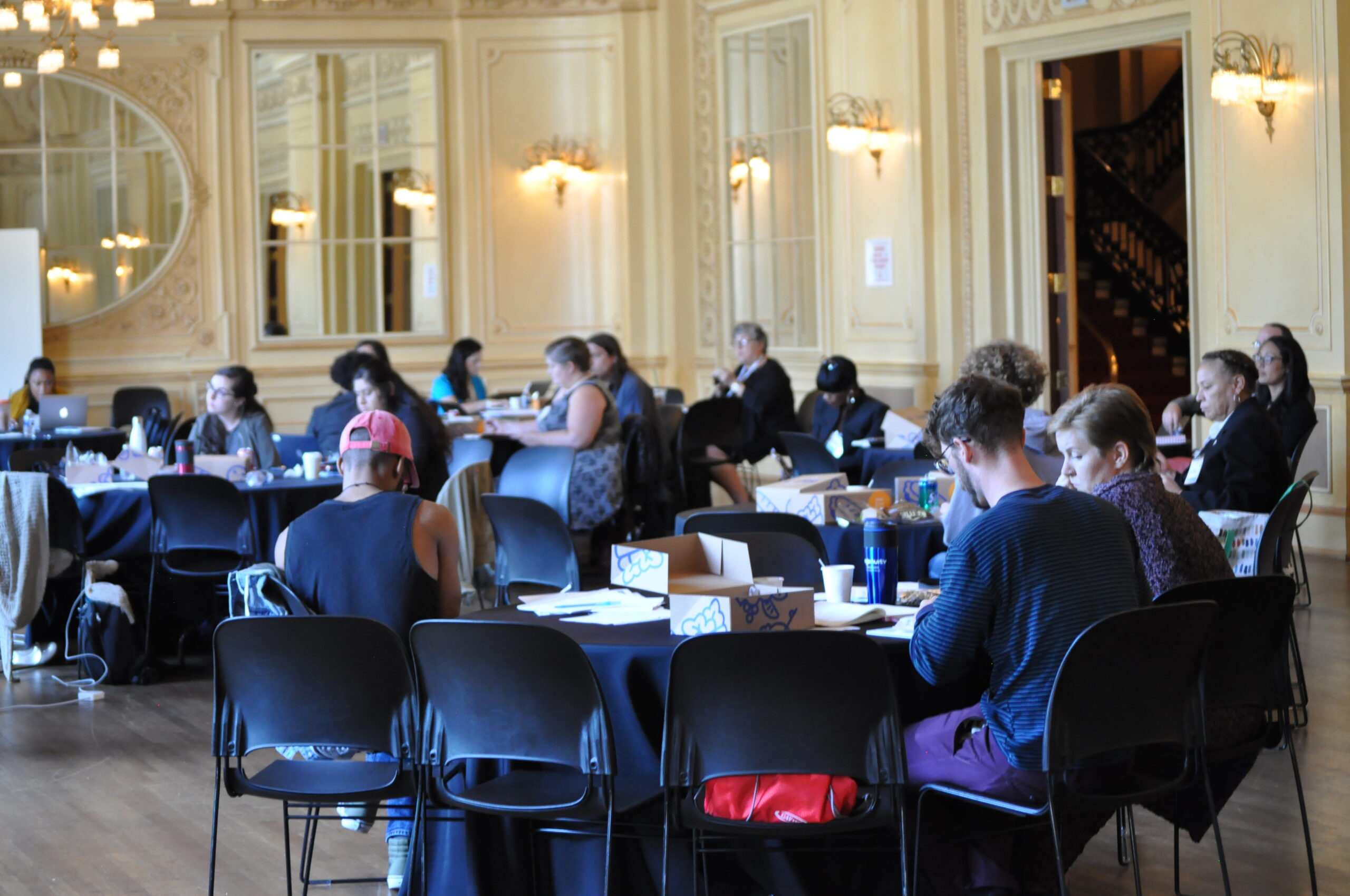
In stage one, I was afraid of letting my supervisors down and letting Ingenuity down, because I thought I didn’t know enough to make meaningful contributions. Then I realized, no one knows everything. While I didn’t know, for example, what quality arts indicators are most equitable and student focused, I did understand how to think through the problems myself. Is requiring all schools to have their musical instruments in-tune equitable? Student-focused? My colleagues decided “no.” But I thought there was something there, so I gave my opinion (me, as a non-arts education expert). I said that while it’s not fair to require schools to make their instruments in-tune when they could be funding more student-oriented opportunities, it is an important to know whether or not students have access to quality tools that allow them to create effectively. While I haven’t been exposed to the entire conversation surrounding arts education in Chicago for the past several years, I was able to trust, draw upon, and offer my perspective. It got others in the room thinking differently about how they saw the problem. So in trusting myself, I moved to stage two which is where I am now.
Stage two is all about confidence, professionalism, and enthusiasm; you’ve got to have ‘em. This is because it’s easy to become the underdog… the millennial… the kid in the office. It’s important to explicitly show what you understand while professionally asking for clarity. My favorite line has become, “what I’m hearing from you is [this], am I understanding you correctly?” This allows you to show that you are engaged in what your supervisor is saying while also asking about what you don’t know. Being the kid means sometimes your supervisors and colleagues over-explain things (this is likely because it totally looked like you were in over your head on week one– and that’s okay). Just remember: exude confidence which equals trusting, drawing upon, and offering your perspective. Once you’ve mastered that, you move on to the final stage: the “what now?” stage.
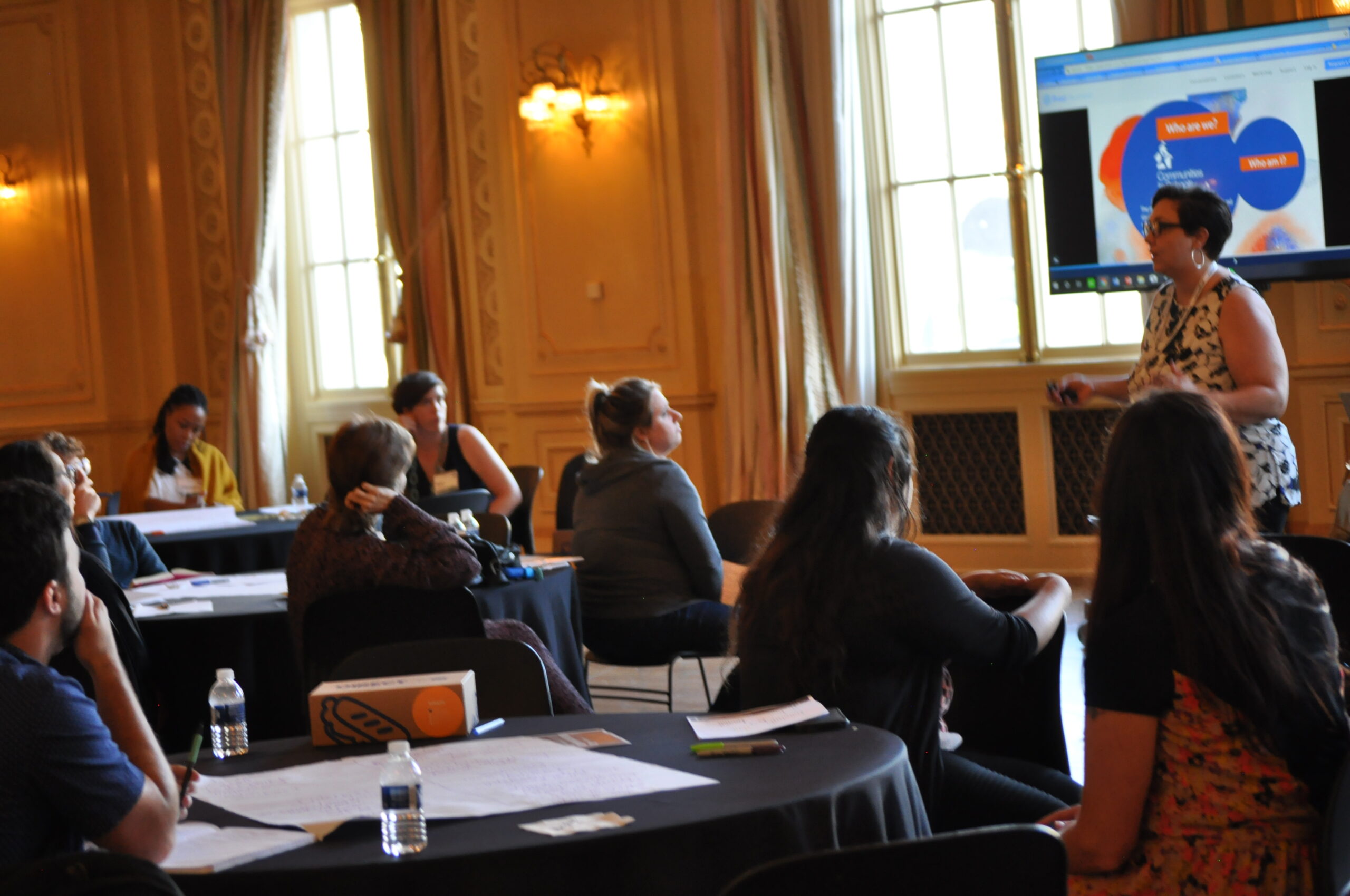
This is what I’ll be entering as I step into week nine of my internship on Monday morning. What now? I feel comfortable doing the job I came here to do and sharing my opinions, so what’s next for my to accomplish other than more experience? Exactly. You should now, at the end of your internship, start asking yourself if you’re getting the experience out of this professional opportunity that you’d hoped. At the beginning of the summer, hopefully, you made a list of what you’d like to learn how to do or get better at. It’s time to check-in. Did you accomplish everything? My starter list was to get better at networking, get better at communicating, get better at public speaking, and understand how to use this experience to show my professional capability. I think I’ve gotten fractionally better at each, but now it’s the last lap and I’m running out of time to get it all done.
Enter, stage four.
Focus on your goals. You know what you need to do to finish your internship projects, and it’s time to bring your goals to a more forward place in your mind. Make a list of which experiences you think would help you check-off your goal list. For me, that’s reaching out to more folks at the big event next week, checking-in more regularly with my supervisor, helping to present our final instructional session, and identifying through-lines in the skills I learned and the next position I’d like to apply for. Wish me luck!
Cheers!
700 fellows. 48 sub Saharan African countries. 3 days. 1 incredible experience. To say that the past two weeks working at IREX has been an adventure, would be an understatement. On July 29, all of the 2018 Mandela Washington Fellows from 27 institutes across the country descended onto downtown Washington DC for the annual Mandela Washington Fellowship Summit to close their fellowship experience.
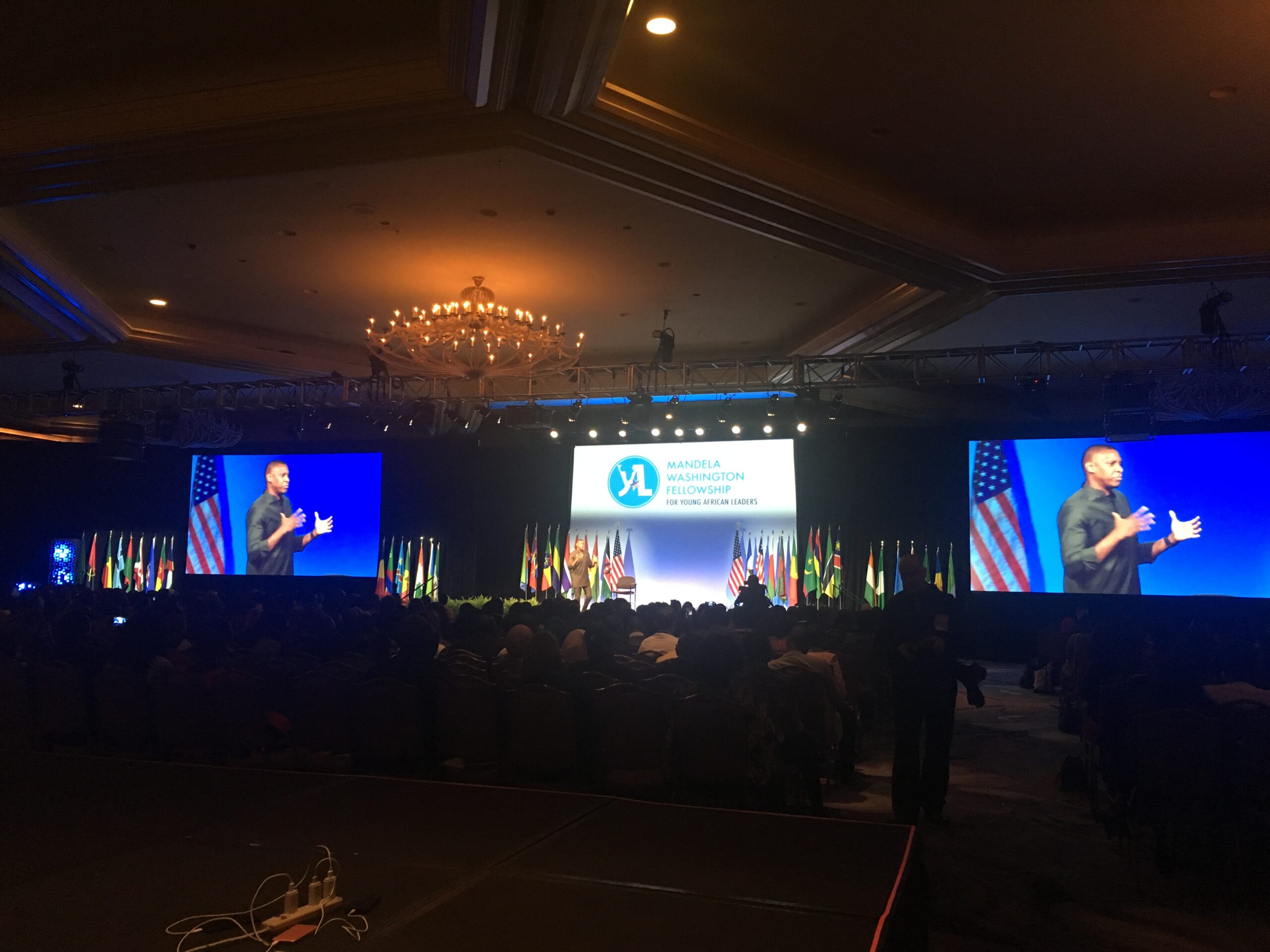
Keynote speaker, Masai Ujiri, speaking at the Summit
This summer, my internship working with the YALI (Young African Leader Initiative) team involved pouring over spreadsheets, looking through passports and tax back forms, and running errands all over the city. While I learned tons from my co workers, especially with technical skills in excel and salesforce, I eagerly awaited getting to meet our fellows in person. Last Sunday, all of the YALI team packed our bags and moved into the Omni Shoreham Hotel, where the Summit was to take place. The days were long and tiring starting at 7 am everyday and not ending until the late evening. After welcoming the fellows Sunday afternoon into the night, we started Monday with the opening plenary followed by keynote speaker, Masai Ujiri, President of the NBA team, the Toronto Raptors. Masai is Nigerian and connected well with the fellows. He spoke of how the press often boast that he is the only African to ever reach the highest position in professional sports in North America. Masai saw this differently, he saw this as a place of improvement, because he should not be the only one. That theme kept on throughout the summit, that people under cut the value of Africa, and the importance of Pan Africanism and the potential for countries to work together.
Between ushering fellows through the maze of the old Omni hotel, I got to time keep and microphone run which allowed me to sit in on several sessions. The session that by far stuck out to me the most was the ignite talks. Select fellows were chosen to stand up in front of their peers and tell their stories. These fellows had overcome great struggles such as persecution from Albinism, being a refugee in a war torn country, becoming blind at a young age, and trying to raise a family in poverty. Here were people from all different countries that were only between the ages of 25 and 35 that had already lived through so much, but here they were in Washington DC, having the power to tell their stories.
After several other incredible sessions from a panel on empowering women to a congressional panel with Senator Chris Coons and other representatives, the final activity was the talent show, Wednesday night. This was my favorite part. Fellows dressed up in their traditional dress and preformed, ending in an all out dance party. It was a great way to end a jam packed three days.
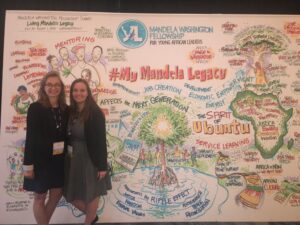
Fellow YALI intern, Camille, and I in front of the #mymandelalegacy pledges
The theme for the Summit was “Living Mandela’s Legacy”, in honor of Nelson Mandela’s 100th birthday. We asked that everyone make a pledge on their personal Mandela Legacy. For me, my Mandela Legacy is to take all I have learned this summer through the CAPS program and to continue to work to invest in people at Valpo and as I hopefully continue to work in international development for many years to come. One of Nelson Mandela’s most famous quotes is “It always seems impossible, until it is done.” And while my internship is nearly done, there is still so much to do.
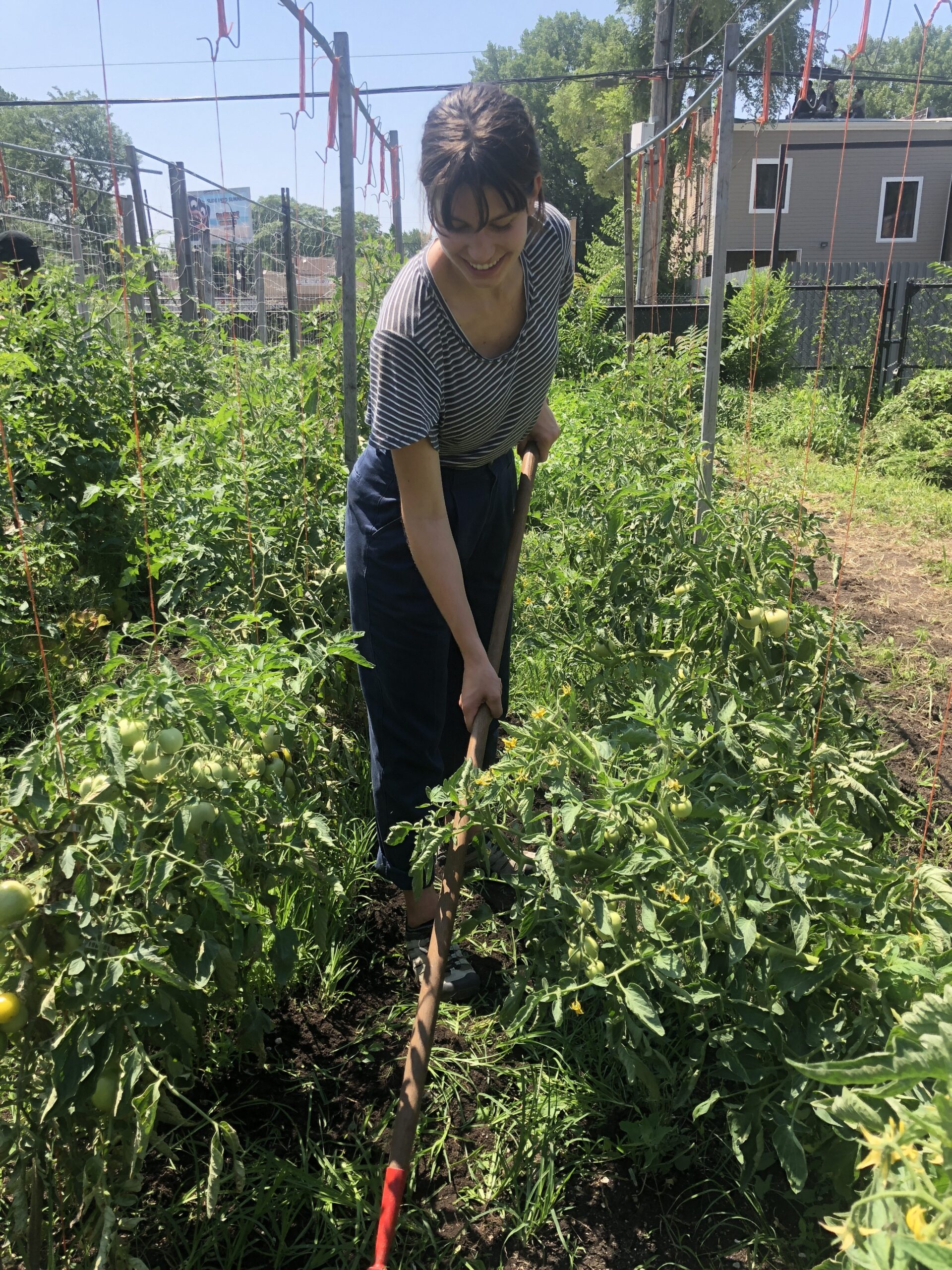
Weeding the tomato plants with a volunteer group.
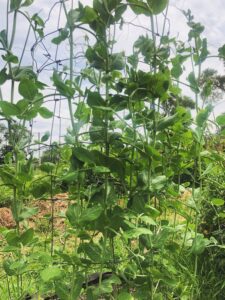
This week is my last week at Growing Home, so naturally, I have been taking more time to pause and reflect on my CAPS journey. Last week, I spent time in our Learning Garden which serves as a hands-on experience for kids to touch and taste the produce we grow. The garden is the responsibility of my department to maintain, so I’ve spent a lot of time in that space over the summer pulling weeds, pruning beets, and harvesting all kinds of vegetables: tomatoes, radishes, green garlic, kale, swiss chard, and a few strawberries, (getting to sample a few along the way, of course). While working in the garden, I was surprised to see how tall our pea plants had grown from when we planted them a few weeks after I started my internship. These plants, which were once pea-sized seeds, had climbed to nearly 3 feet in just a few weeks. As cheesy as it sounds, I cannot help but connect my personal growth through the CAPS experience to the growth of these plants. Just as it’s difficult to notice a plant’s growth in real time, my own growth wasn’t always apparent day-by-day, but looking back through this summer, that growth is undeniable.
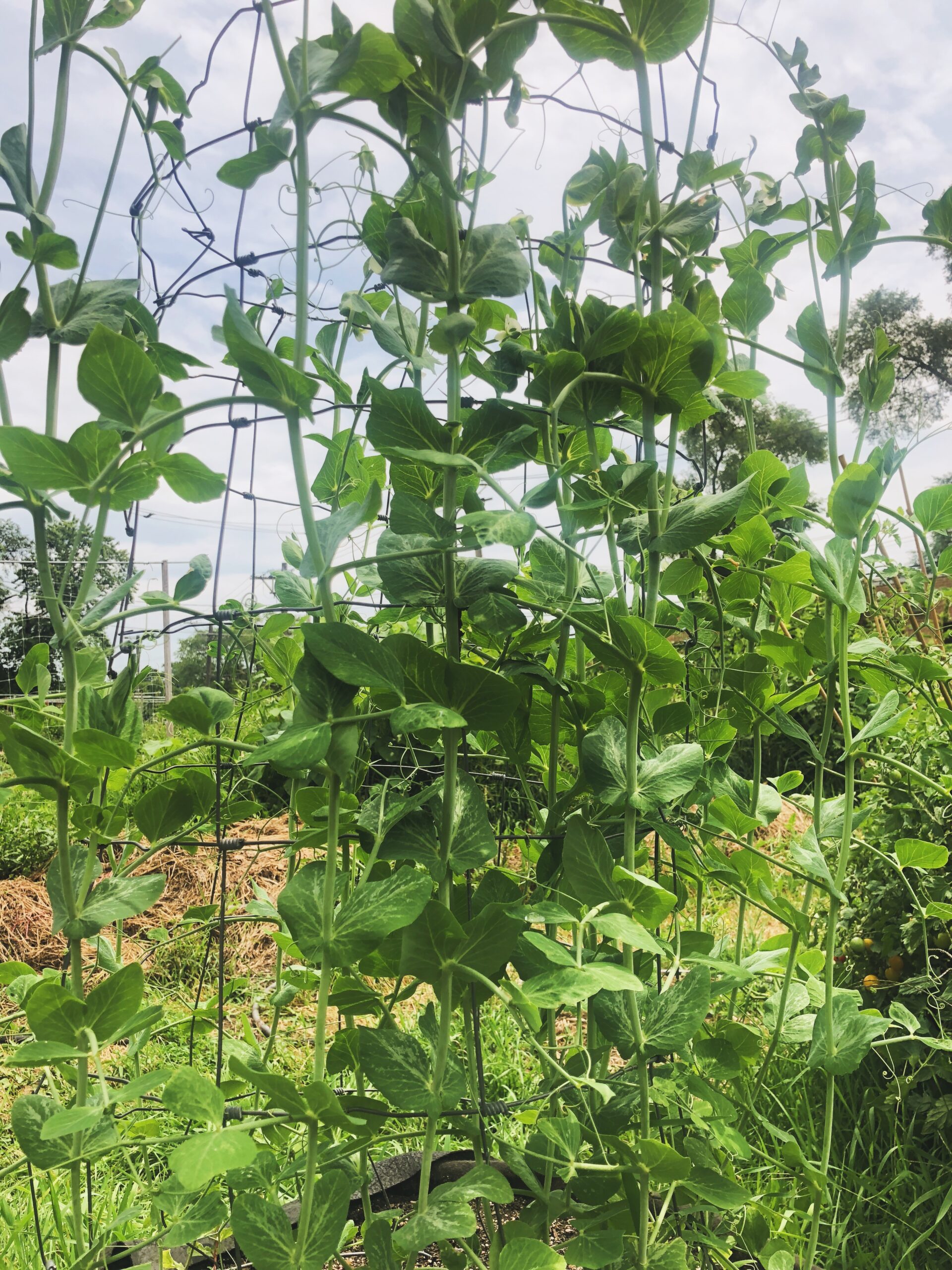
Our growing pea plants
I am so grateful for the people and experiences that have supported my growth over the summer. One of those experiences has been the opportunity to work in each of the departments at Growing Home, which gave me a full experience and understanding of the organization and the work that they do. I mainly worked with the Community Engagement department hosting volunteer and tour groups on the farm, attending community events, and, lately, I have spent my time to helping prepare for Growing Home’s first Back to School Farm Fest at the end of August. This preparation has included everything from making a promotional flyer to creating 70 seed germination necklace kits that will be used as the kids’ activity to teach them about the beginning stages of plant life. Although I won’t be here for the event, it has been fun to see it take shape and to see the corner of our office pile up with boxes of in-kind donations, especially the 60 backpacks, full of school supplies, that will be given to children at the event.
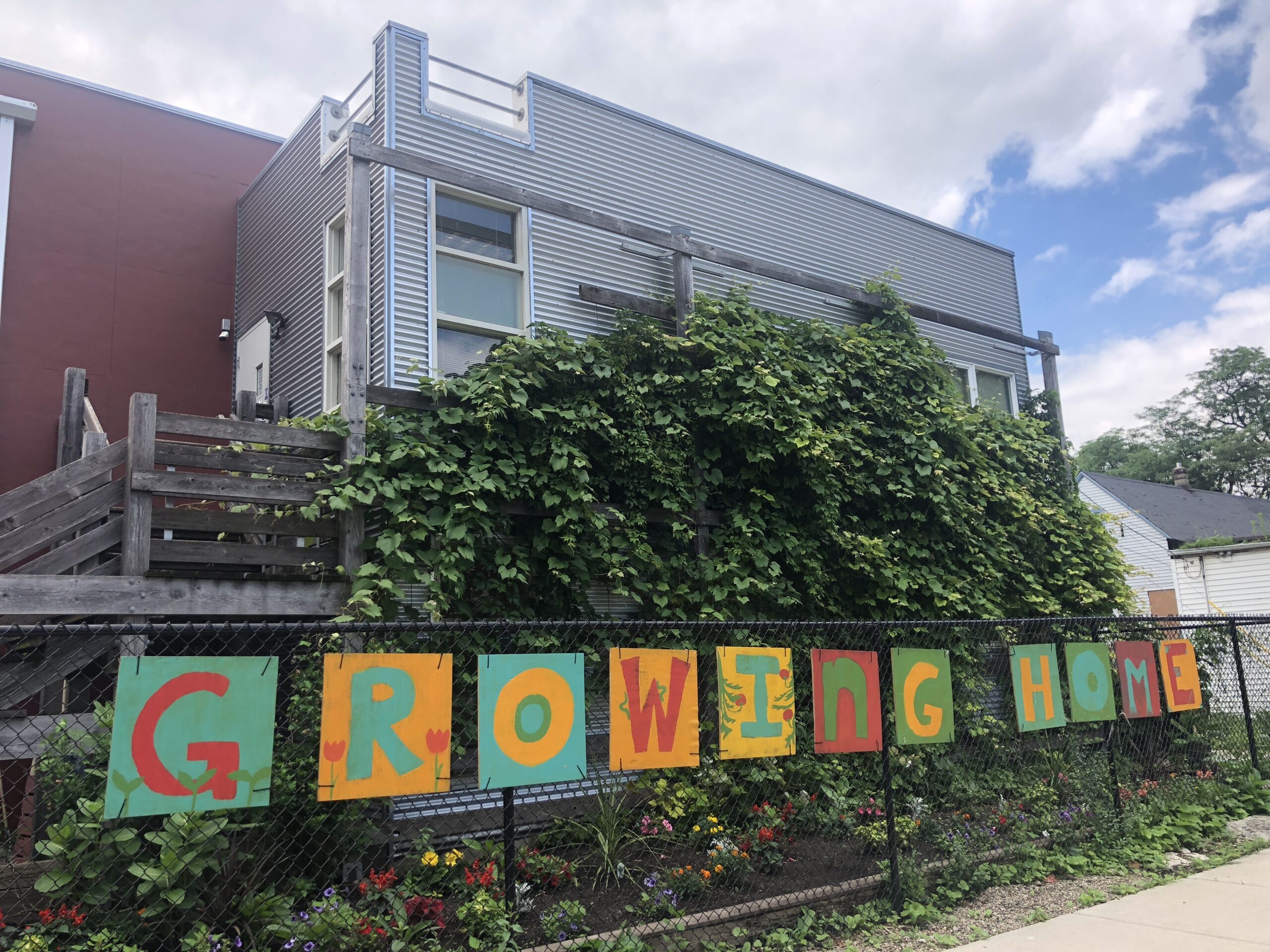
Outside of my department, I visited the office where our development team works and learned more about what our development team does to keep the organization running smoothly and to raise the funding needed to keep the organization operating. I was able to learn about the process of organizing a fundraising event and helped create some social media posts.
Being given a variety of tasks and experiences has been one of my favorite parts of internship at Growing Home. I’ve learned proper way to bunch pieces of kale to form a uniform bouquet, helped with resume and job search workshops, acquired in-kind donations from local businesses, prepared weekly cooking demos, and recently created a short video for a grant. As a self-identified planner and sometimes overly-cautious person, these experiences have shown me my ability to take on new tasks or challenges and succeed, even in unfamiliar circumstances.
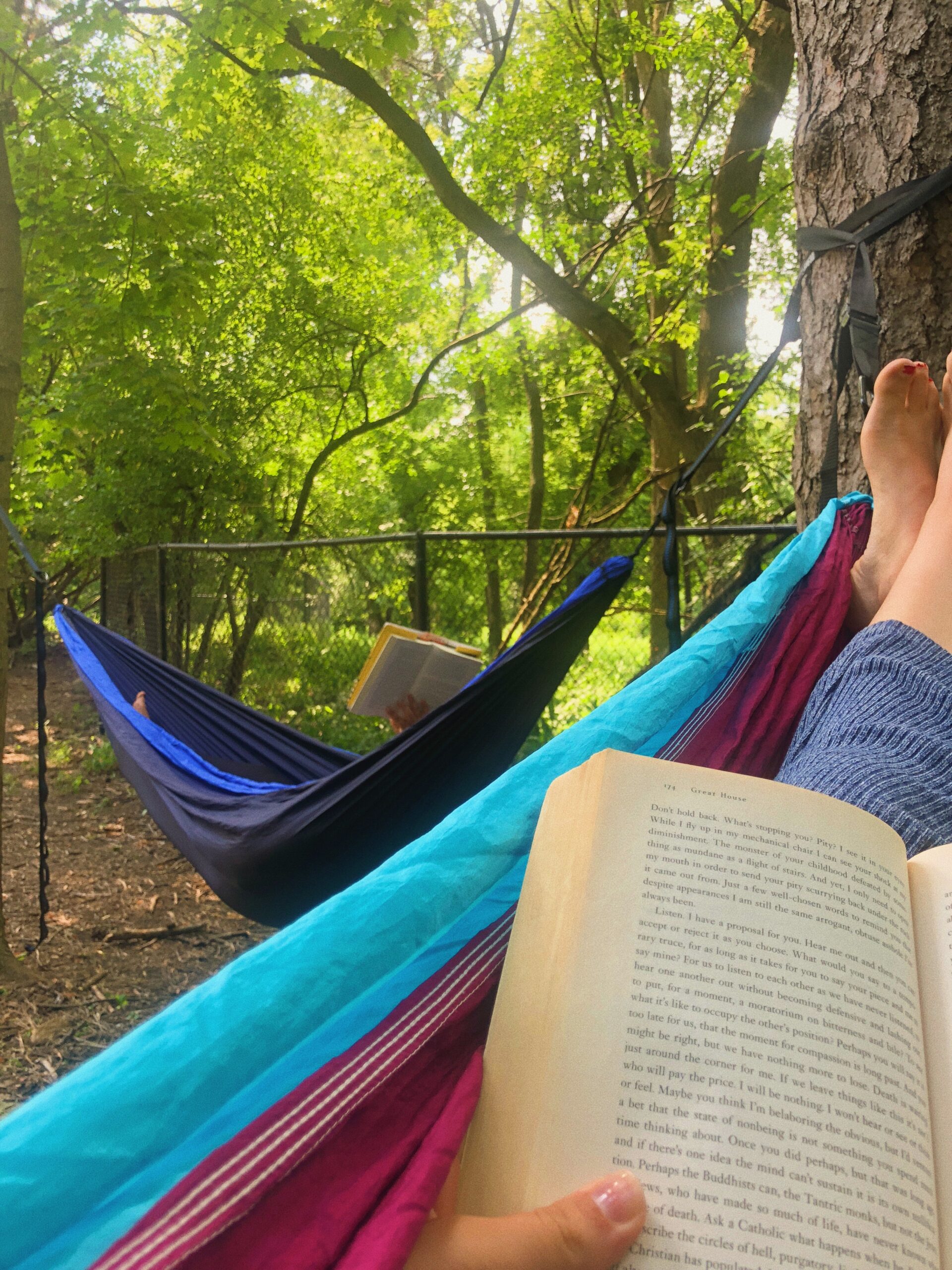
Taking some time away from the farm to hammock and read with my fellow CAPS Fellow, Emily.
Overall, my CAPS experience has stretched my perspective, not only on the work that goes into running a non-profit, but also on the many injustices in our food system and the amazing work community members in Englewood are doing to overcome the challenges and barriers they have had to face.
Although I will miss working with the talented staff at Growing Home and spending time with the Chicago CAPS cohort, I’m happy to have made lasting connections with these wonderful people who have supported my growth this summer in the same way the metal cage supports the pea plants ability to grow taller and stronger. Going into the next semester, I’m thankful for the personal and professional growth I’ve made this summer, but just like the pea plant, I still have plenty more to grow.
My confidence is often borderline arrogance; however, I mean it when I say I’m a hot commodity at the American Red Cross. Not only do they literally want my blood, but my skill set has garnered a lot of attention throughout the region. I’ve been working as a Regional Communication Intern for the Red Cross, meaning I maintain their social media accounts, graphic design, and video. The last one is my focus, passion, and something that the Red Cross was very interested in. I think it’s important to stress that I am currently their only staff video editor in the state, as it is responsible for all of my stress.
My supervisor, Duchess has been very supportive of my editing passion since she interviewed with me, and I’m very grateful to have her constant encouragement and understanding of the process. I receive plenty of support from everyone in the office; however, supply and demand has come to create another barrier between myself and those who don’t have the same understanding. It hasn’t been negative by any means, but I’ve been nonstop for about three weeks and am still receiving pitches for video projects during my final days. In this fast-paced environment, Duchess and the Indy CAPS fellows have helped me prioritize, recognize my value, and work up the courage to be more assertive in the working world. I know the skill I have is valuable, and I don’t feel arrogant in saying so. My time at the American Red Cross has made me realized that my time and energy have high values and that I have every right to recognize that.
I no longer feel like I’m making an excuse when I say “I don’t have the time to pick up another project”, and I’ve gained confidence in discussing what’s top priority and what can wait a few days. My biggest inspiration regarding self-worth and negotiating expectations is Duchess. She has provided me with a professional means to carry myself as a leader without being overbearing. Thanks to her guidance as my supervisor and compassion as a friend, I feel comfortable admitting stress and asking others to help combat it. With the projects are clearing up now and the end of my internship is in sight, I can say with conviction that knowing Duchess and this experienced overall has strengthened me both individually and professionally.
As the summer internship comes to a close, I want to reflect on the experience I had at Indiana Humanities, a statewide non-profit that encourages Hoosiers to think, read, and talk. Over the past couple of weeks, I was fortunate to work big events and go to places that no other internship can offer.
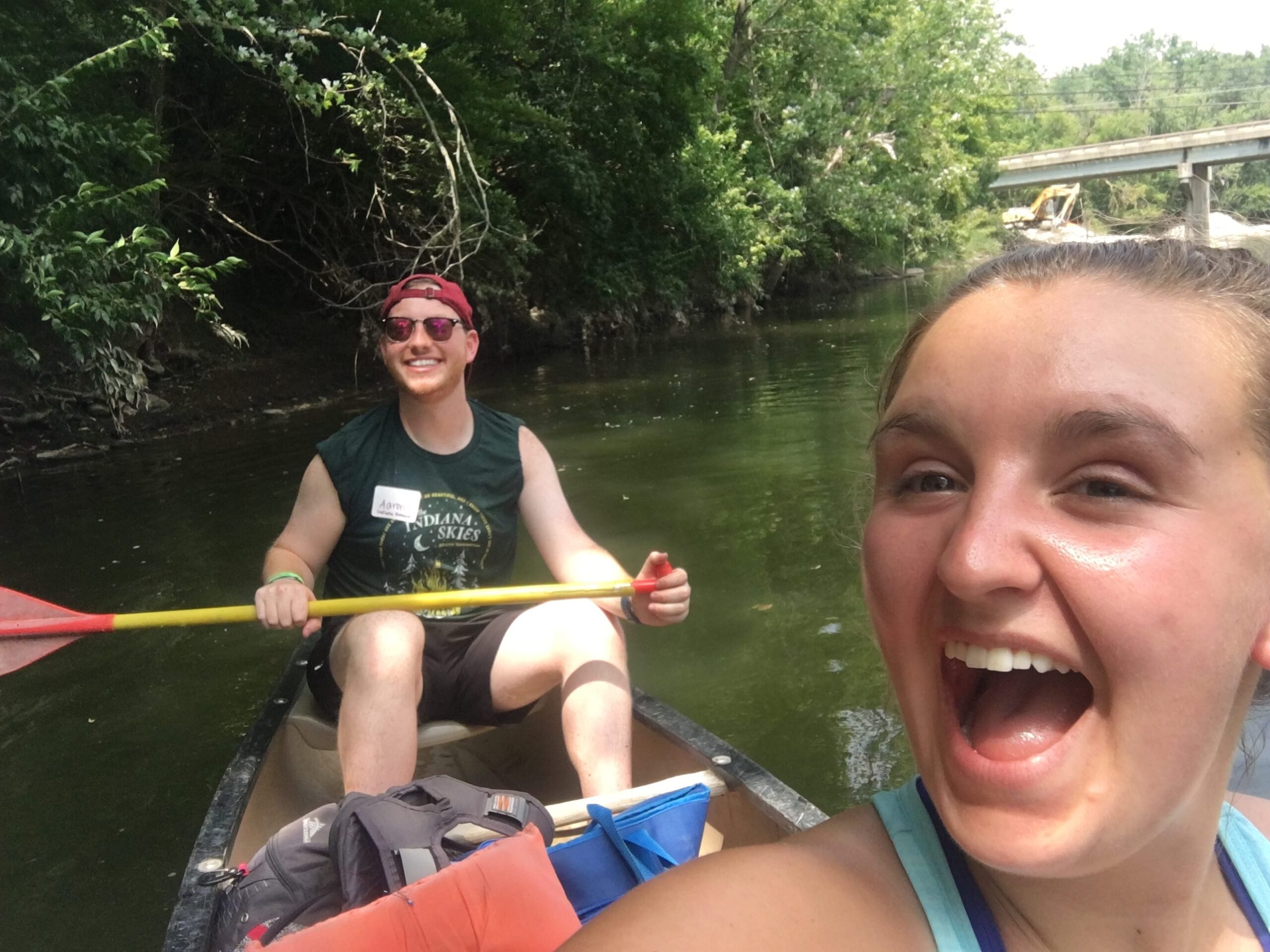
My co-intern Julia and I paddling on the White River.
The Next Indiana Campfires Series is a program unique to Indiana Humanities. This program combines treks into nature with literature and campfire discussions. The series won the Helen and Martin Schwartz Prize for Public Humanities Program in 2017, a national award given to the best humanities program in the nation. I was able to take a canoe trip down the White River while engaging in a conversation about literature. My co-intern, Julia, and I shared a canoe for the trip, and it was a bonding experience. I never thought that a four-hour canoe trip would change a relationship, but let me tell you, it definitely does.
One experience that specifically that brought us closer was having to work together when we got stuck between a couple logs and stopped moving. The river was very low, so not only were we stuck, but the boat kept dragging across the bottom of the river, making it hard to paddle out. Of course, with our luck, at the same time, it started to pour. At that point, we both looked at each other, decided to take a breath, and worked on getting out of the mess we were in. A few minutes later we were able to get free. About a half mile down the river we met up with the rest of the participants who were on a sandbank under trees trying to stay dry. Soaked through, we paddled up and joined them until the rain stopped.
As part of the program, participants gather to discuss the connections between nature, literature, and place. Kevin McKelvey, a University of Indianapolis professor, led our discussion. He read poems, short stories, and excerpts about nature in Indiana, and asked us to reflect on what we thought of the readings. Many points were brought up about how the White River is impacted by the current political climate both in the state and in the nation. Not only was it a wonderful (and wet) experience, I learned a lot about the White River and how the environment around the river impacts so many people.
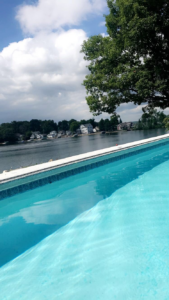
The lake house pool with Hamilton lake behind it.
With Indiana Humanities, I was able to participate in the staff retreat. We stayed at the President/CEO’s lake house on Hamilton Lake in Hamilton, Indiana. During the three-day retreat, the staff discussed the successes and improvements of the current theme, Quantum Leap, which connects the STEM (science, technology, engineering, mathematics) field to the humanities; the next theme and its programming; grant application changes; the strategic plan for the next couple of years; and a discussion on the book titled The Immortal Life of Henrietta Lacks written by Rebecca Skloot.
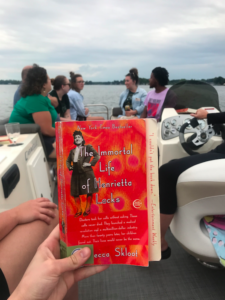
The Indiana Humanities staff during the book discussion.
I found that the discussion of the book was one of the more entertaining parts of the weekend because we engaged in a deep, thoughtful conversation. The Immortal Life of Henrietta Lacks is about Henrietta’s cancer diagnosis and how her stolen immortal cells, now referred to as HeLa cells, helped start a scientific and medicinal discovery period. Taken without Henrietta’s consent, her cancerous cells were used for testing that led to discoveries in polio vaccines and how many chromosomes people have. It also helped scientists learn more about the AIDS virus and leukemia. The book follows the Lacks family – how they struggled to overcome poverty, to accept the fact that Henrietta’s cells have outlived Henrietta, and how the family has not been compensated for the advancements her cells have brought to the field of medicine. We engaged in conversation about whether life can, or should, have a patent on it, if the Lacks family should be paid, and if Skloot was using her white privilege to share this story of the Lacks family.
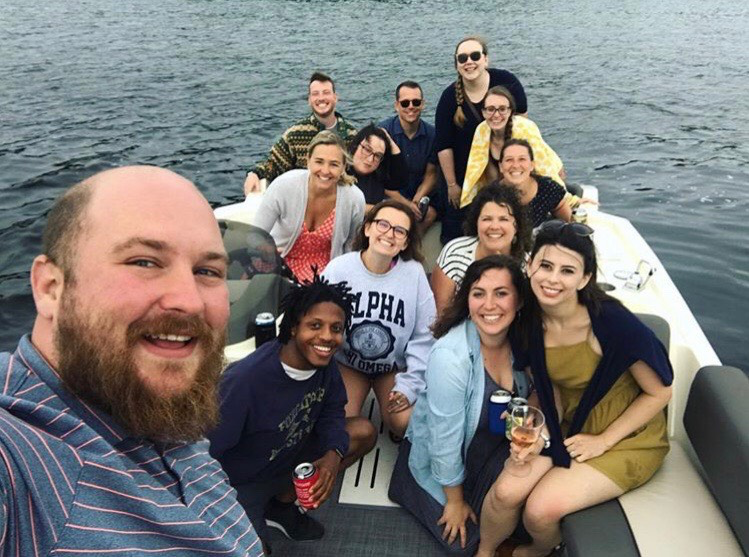
The Indiana Humanities staff hanging out on Hamilton Lake.
The staff retreat offered me the opportunity to get to know my coworkers outside of the workplace. We played Mafia (the card game) and hung out by the pool. We went paddleboarding and kayaking out on the lake. It was nice to be away from downtown Indianapolis and enjoy time together on a boat just to hang out.
I only have one week left here at Indiana Humanities, and I’m going to make the most of it. The connections I have made with the staff and other interns are strong and I know that I will be in contact with them as I grow in my profession. Thank you, Indiana Humanities, for the wonderful summer that I have experienced here.
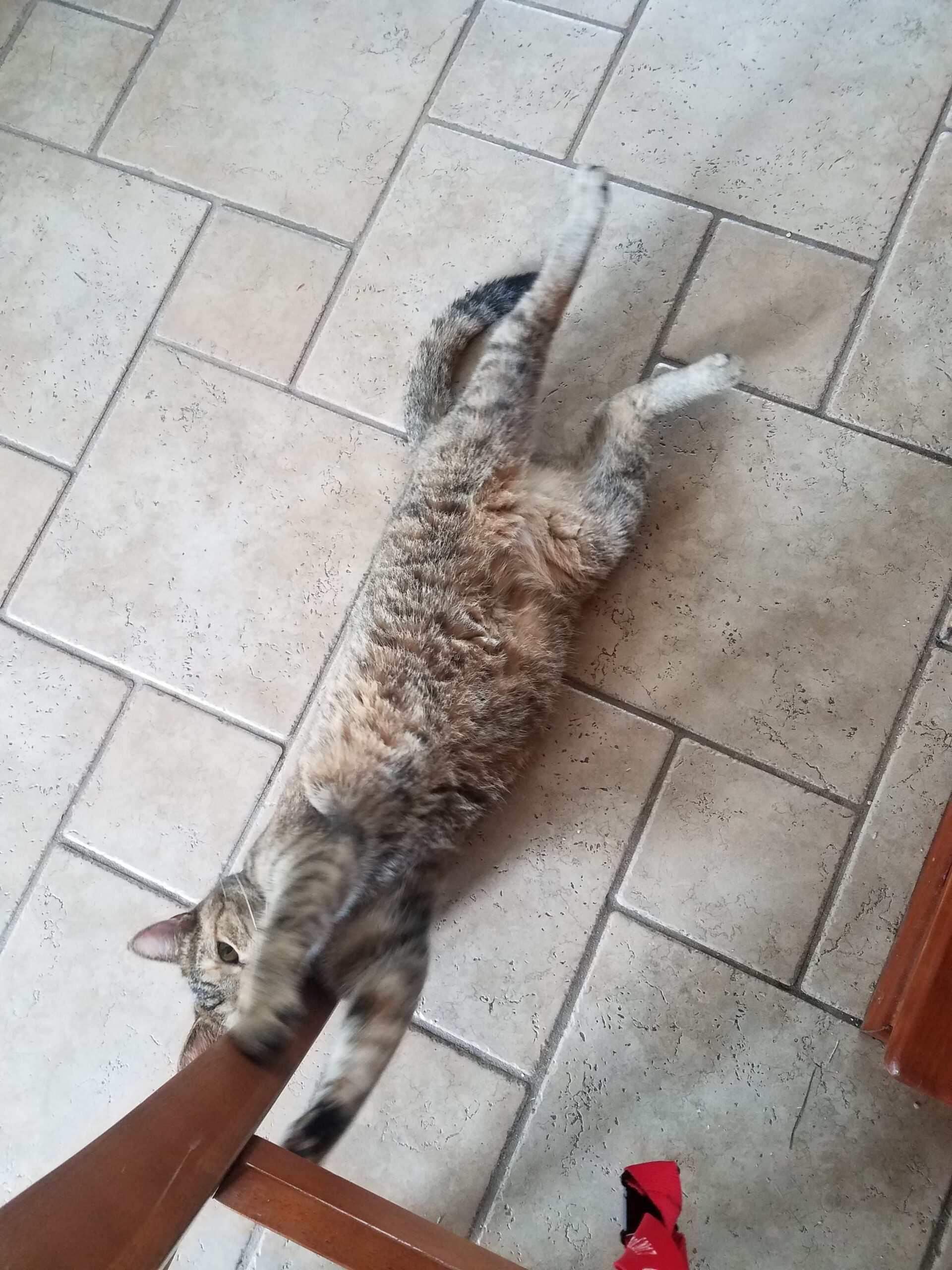
One of my boss’s three cats, picture taken from the desk in his house where I usually work
The majority of my time spent in Indy after my trip to El Salvador so far has been focusing in on what project I want to work on for the remainder of the summer. After some deliberating with my supervisor, we decided that I would work on researching ultraviolet (UV) water purification processes and their potential compatibility with water system projects that CoCoDA has been implementing in Central America.
I didn’t have many, but one of the concerns that I had going into this internship process was that I would end up just doing busy work for the summer. This is work that could potentially be useful, but in the end is just a made up task to keep me busy. In this scenario I still would have done all the wonderful learning and reflecting that I knew would come with the CAPS style internship, but without really contributing to the organization. I had no idea that on top of the learning and reflecting I would be doing research for the organization that could change the way that they do water projects in the future. This research could really contribute to providing a more sustainable water system to families, and that is an exciting concept for me.
The current method of purifying the water in the systems that we have helped implement so far is through chlorine tablets, a method that works, but with a couple drawbacks. The first drawback is the upkeep. A trained person has to apply the chlorine to the water in regular monthly or weekly intervals throughout the year. This also comes with the regular purchasing of the chemical to purify the water. The second major drawback is the change in the water’s flavour. After shocking the water with chlorine, the flavour of the water becomes quite bad, providing a motivation for the people to put less chlorine in the water. The potential for a new method of purification that doesn’t change the flavour and only requires UV light bulb changes once a year is quite appealing.
This UV purification leads to a number of questions though. What specific purification device do you use, one that is already manufactured or should you attempt to design a new one? At what point along the journey of the water, from the ground to the home, do you purify it? Should you purify all the water or just the water that will be used for drinking? These questions and more all have many answers and are often dependent on each other. My job this summer is to find potential engineering solutions to these unique problems.
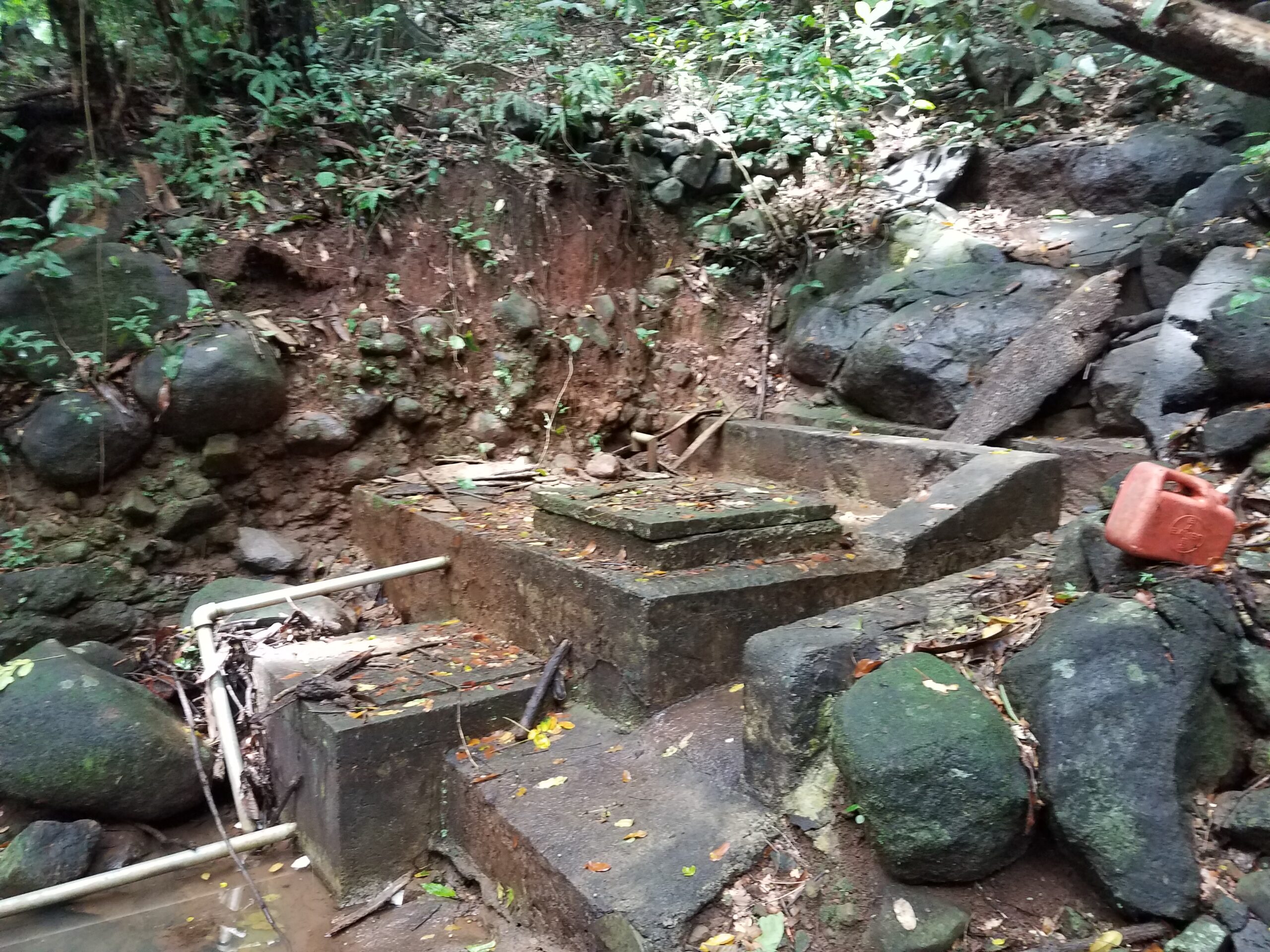
A water collection tank, the beginning of the water’s journey as it makes it way to the families in a community
Besides working on the project, Monday of this past week brought a CoCoDA board meeting. This meeting continued to help me understand the inner mechanisms of a service based organization. The majority of the meeting centered on keeping the board up to date with what CoCoDA was doing, but seeing the employee interaction with board members showed me how imperative it was to have a governing board. The presence of an objective panel is a way of making sure that CoCoDA stays on the right path and it instills confidence in the employees that CoCoDA is not being run unchecked.
This really cool project paired with the organization I am working for, and the other (really awesome) CAPS fellows that I am living with has so far made my time in Indy an enriching experience. I am so happy with how the summer is going and I’m excited to see where it has yet to go.
One month before I left for Uganda, I called my parents to share the news: “Hey, remember how I’m going to Austin for that internship this summer? Well now they’re letting me go to Uganda first!!” They knew that I was excited about the chance to work with Water to Thrive (W2T), a nonprofit that builds wells in sub-Saharan Africa. However, they were somewhat concerned about the two-weeks in the African bush with such limited communication. I’d already been studying in Europe for five months, so they had been looking forward to my return to the U.S. On this call, I didn’t tell them that I’d already booked my flights to Uganda, nor that I didn’t know if I’d get any funding. I had made up my mind to go. And nothing, not worried parents, nor homesickness, nor the crazy logistics of getting there, would stop me.
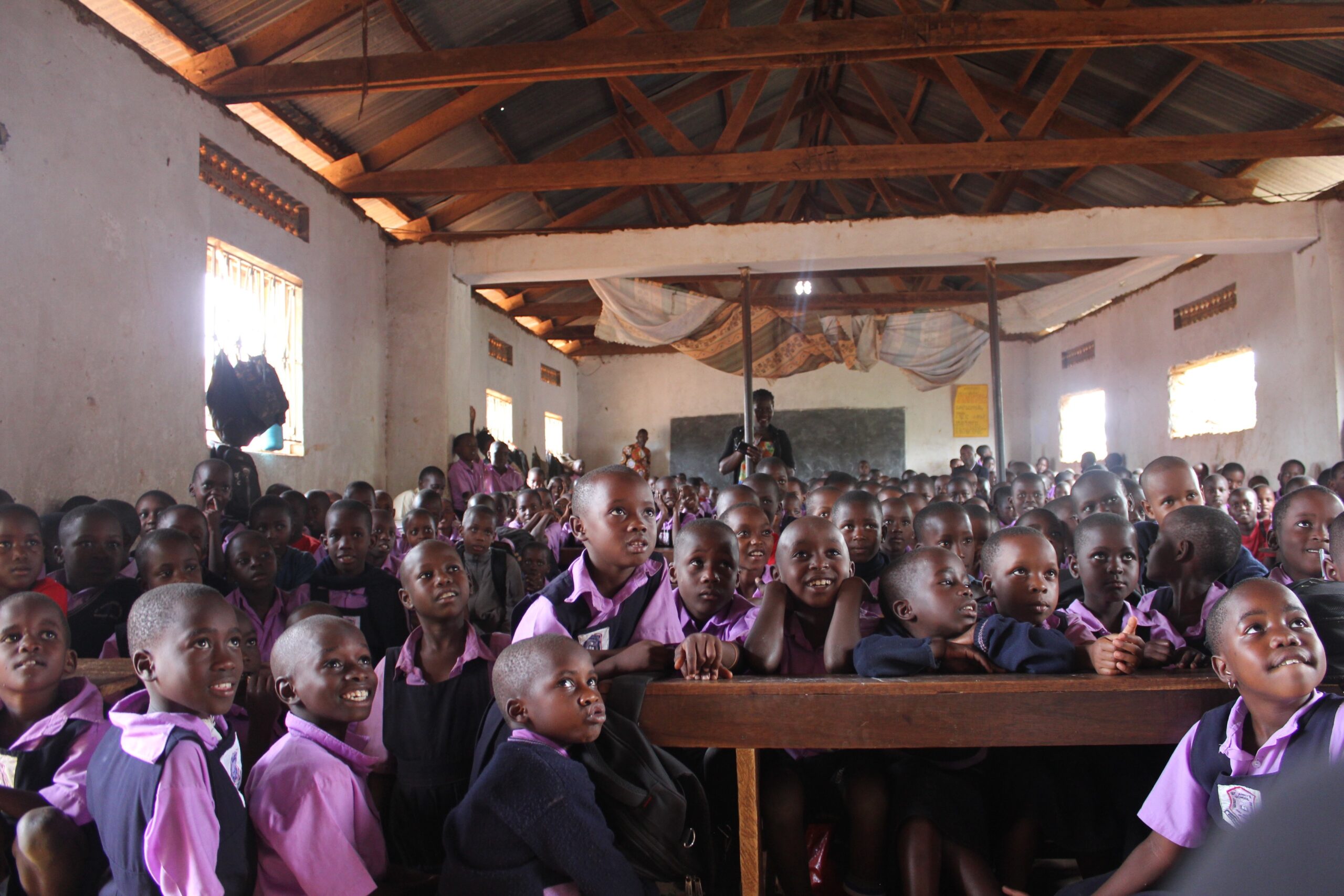
Visiting a primary school in the Mityana district.
My role on this trip was mainly as an observer — to gain some first-hand knowledge of the culture and various water projects. Upon returning to the states, I would be doing research and data analyses on the impact of W2T’s partner organizations and drafting a grant proposal and newsletters. So I had a role or a job to do — sort of. But as I stepped outside the Entebbe airport on my first day, anxious and sleep deprived, and not sure if I had the right VISA, I felt mostly like an outsider, and a spectacle. Robert, the driver who picked me up from the airport, laughed and told me that he’d immediately recognized me. My colleagues had told him to look for a “young woman with long hair who looks like it’s her first time in Africa.” And I did look that way: like a tourist. Travel writer Paul Theroux writes that “Travelers don’t know where they’re going; tourists don’t know where they’ve been.” I like this idea: while tourism is about arriving at a carefully packaged destination, travel is about the detours, the ongoing journey, and paying attention along the way. It’s not about arriving.
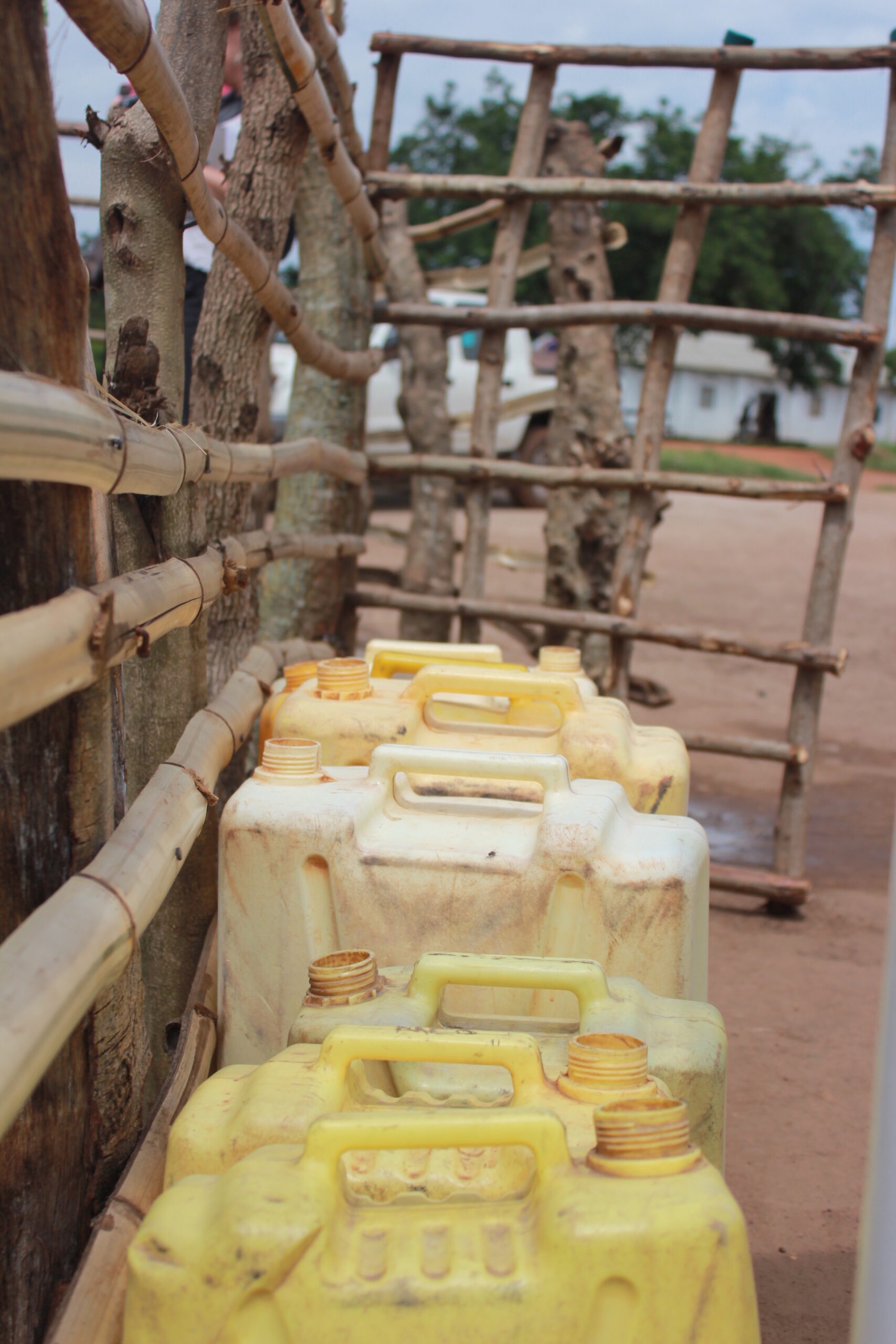
Jerry cans (the most common method of gathering and storing water) lined up next to a well.
In Uganda, I traveled with Susanne (the W2T director, aka my boss) and Gashaw (W2T’s Ethiopian hydrogeologist). Susanne called our trip a “vision” trip, to distinguish it from the many mission groups that take trips to build wells in Africa. While our visit was short term, W2T’s commitment to the communities it serves is long term and community based, and always works through local community organizations. But unlike Gashaw and Susanne, I didn’t have any real skills to offer the communities. While they analyzed water projects and worked out funding with partner organizations, my biggest role on this trip was simply to watch and listen. I could collect the stories and learn what these people had to teach me. And in those two weeks of travel –– of bumpy car rides on roads built for cattle and bicycles, of celebrating and singing and impromptu dance lessons –– I learned that it’s not just about the water, not just about jerry can contamination and borehole depths, but also about history, and race, and what is enough.
Armed with a camera, a journal, and my hiking boots, I spent ten wide-eyed days trying to take in everything around me. At the very first well we visited, I met a 23-year-old woman named Grace (two years older than me), who told me
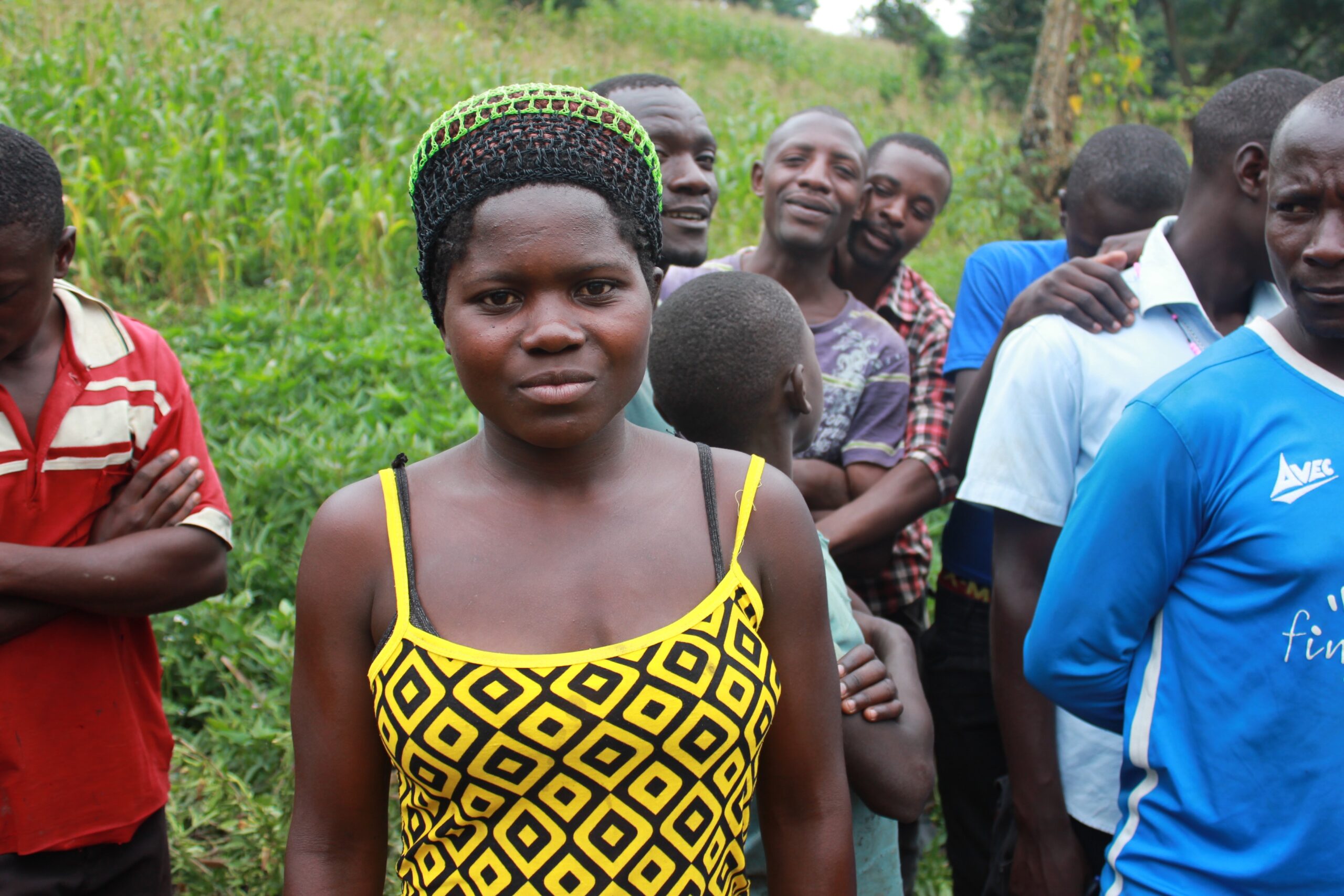
Grace, age 23, is married with four kids.
that she was thankful that her four young children now didn’t get sick so often. In another village, one of the elders who spoke a little English told us that the old women were “crawling on the ground in happiness” now that they had water within easy walking distance. I chased kids as they shouted “Muzungu, muzungu!” (white person), who would
“accidentally” let me catch them and then shriek with laughter as I scooped them up. Yet other villages would explain that their new well still frequently ran dry from the sheer volume of people using it. They wondered if we might work on a second well to better sustain their needs. I stood with villagers and listened to humbling and heartbreaking prayers. They asked God to bless the water he had brought them and to remember those villages who still need a water source.
I have more questions than ever, about race and privilege and responsibility. Questions that I’m only beginning to be able to articulate, questions laced with uneasiness and discomfort. But these questions feel big and important and relevant, and I’m excited to keep exploring and learning about these themes as I continue my work here.