
Last summer at the end of my internship my coworker told me her favorite quote, “One person with passion is better than forty people merely interested”- E.M. Forster. But as a I packed 28 boxes filled with cell phones, insurance cards, and hundreds of papers, to be sent to universities across the country earlier this week, I could not help from thinking that maybe 40 interested people may actually be useful. In all seriousness though, that quote has really stuck with me over the past year as I traveled abroad to Namibia and now as I have begun my CAPS placement at IREX in Washington DC.
IREX is an international nonprofit that focuses on development. In the past I have worked with several very small NGOS, often with a local staff of 2-3 people. IREX though has a staff of over 400 world wide and 178 locally, so when I walked into the skyscraper in the heart of the DC business district, I knew this was going to be a very different experience than any others that I have had before. I immediately questioned how these people can be maximizing the work they do, but I quickly found that the larger the organization, the larger the possibilities for great impact.
IREX’s moto is “investing in people, inspiring change.” Over my time at Valpo, I have taken several classes that discuss the dangers of the white savior complex and unhelpful outside intervention. It is for this reason that instead of infringing on other countries, IREX finds local people with passion and invests in them so that their dreams can be achieved. This summer, I am working on the Mandela Washington Fellowship for Young African Leaders which is a program part of the Young African Leaders Initiative (YALI). This program brings 700 African leaders (who were selected from over 40,000 applications) from every sub Saharan African country to the United States for a six-week program at some of the country’s top universities. Following this, they all convene in a summit in DC so that ideas and opportunities can be shared. Following the summit 100 of them are chosen to participate in a professional development experience (PDE) at local NGOs, businesses, and government offices all over the country. Clearly, planning and implementing requires an immense amount of logistics and coordination. It is my job to help specifically with PDEs and helping to plan the summit. So far, my team of 16 has been incredible and it is great to see how much each of them care about all the fellows, even though often it can get overwhelming.
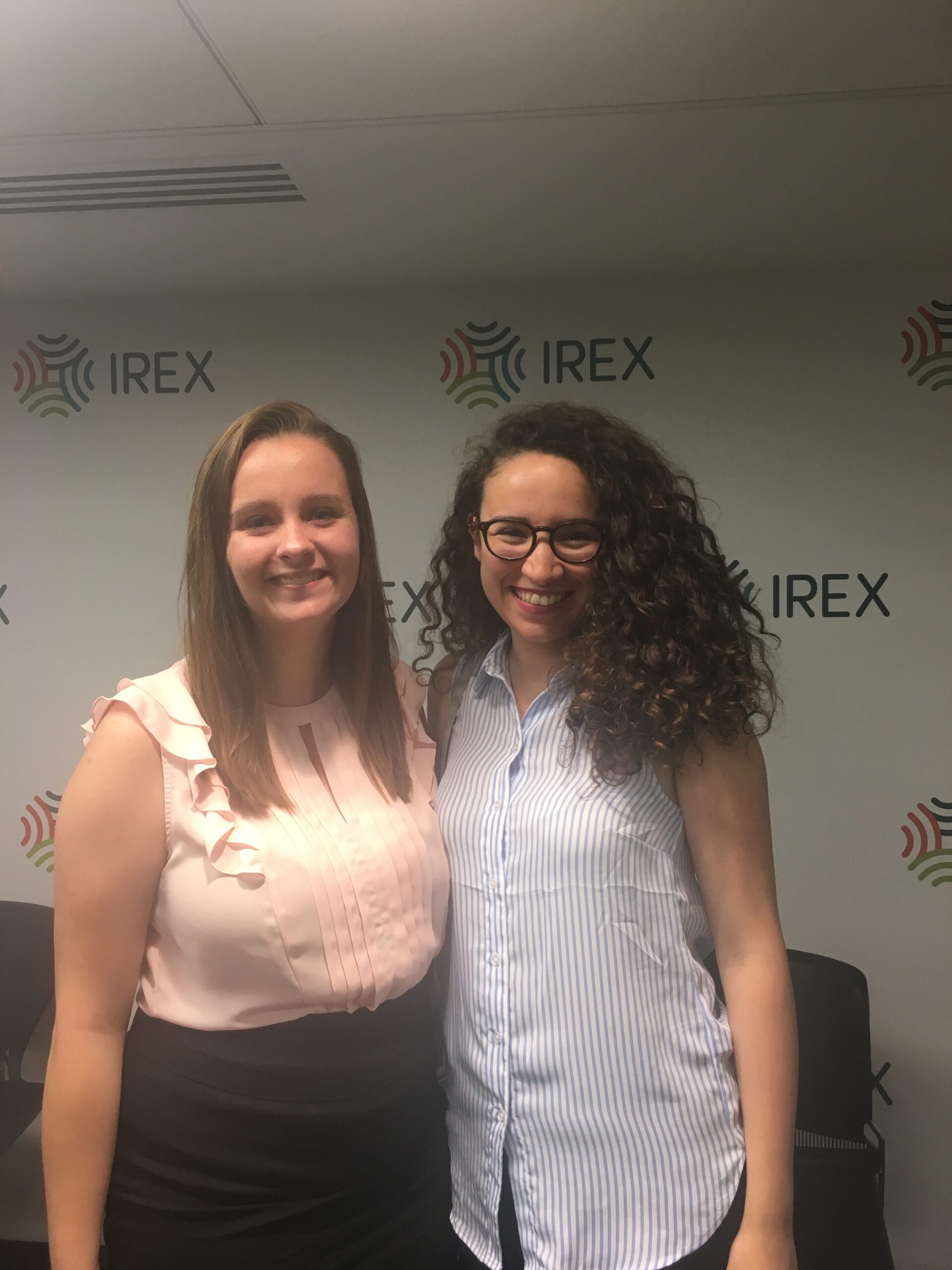
IREX alumni Faten Ghriss and I after IREX’s 50 anniversary alumni panel
This week IREX is celebrating its 50-year anniversary and with that they had a large celebration and brought back several alumni of their programs. While a good part of my job involves sitting in front of a computer screen for most of the day, getting to listen to the panel of four alumni talk about what they had achieved because of the work of IREX was inspiring. The first guest was Mohammad Al Abdallah, Executive Director to the Syria Justice & Accountability Centre. Once a prisoner in Syria, he spoke out against the injustices of their government and IREX stepped in and helped him conceptualize his organization. Secondly there was Alice Sayo, Founder of Nasaruni Academy for Maasai Girls, Kenya, a school that empowers girls to stay in school and avoid being married off at a young age. The third Alumni was Aferdita Saracini Kelmendi the General Manager of RTV21 in Kosovo and Macedonia who spoke out against the government almost 20 years ago in favor of freedom of speech. Lastly there was the youngest panelist, Faten Ghriss, the Co-Founder of Young Tunisian Coders Academy, which empowers youth to work in the tech industry in Tunisia. These people each were all from widely different backgrounds, with very different struggles which just showed to me the scope and reach that one organization can have. Each one of these people was filled with passion for their cause and and just needed a little help to be agents of change.
While working takes up a majority of my time, I still have found time to explore the city, which has an overwhelming number of free events and someone waiting at every metro stop to talk politics. From attending the Pride parade to walking around Arlington cemetery on Memorial Day, to going to the congressional baseball game last night, I must say that the DC cohort (there are only two of us) has been crushing it.
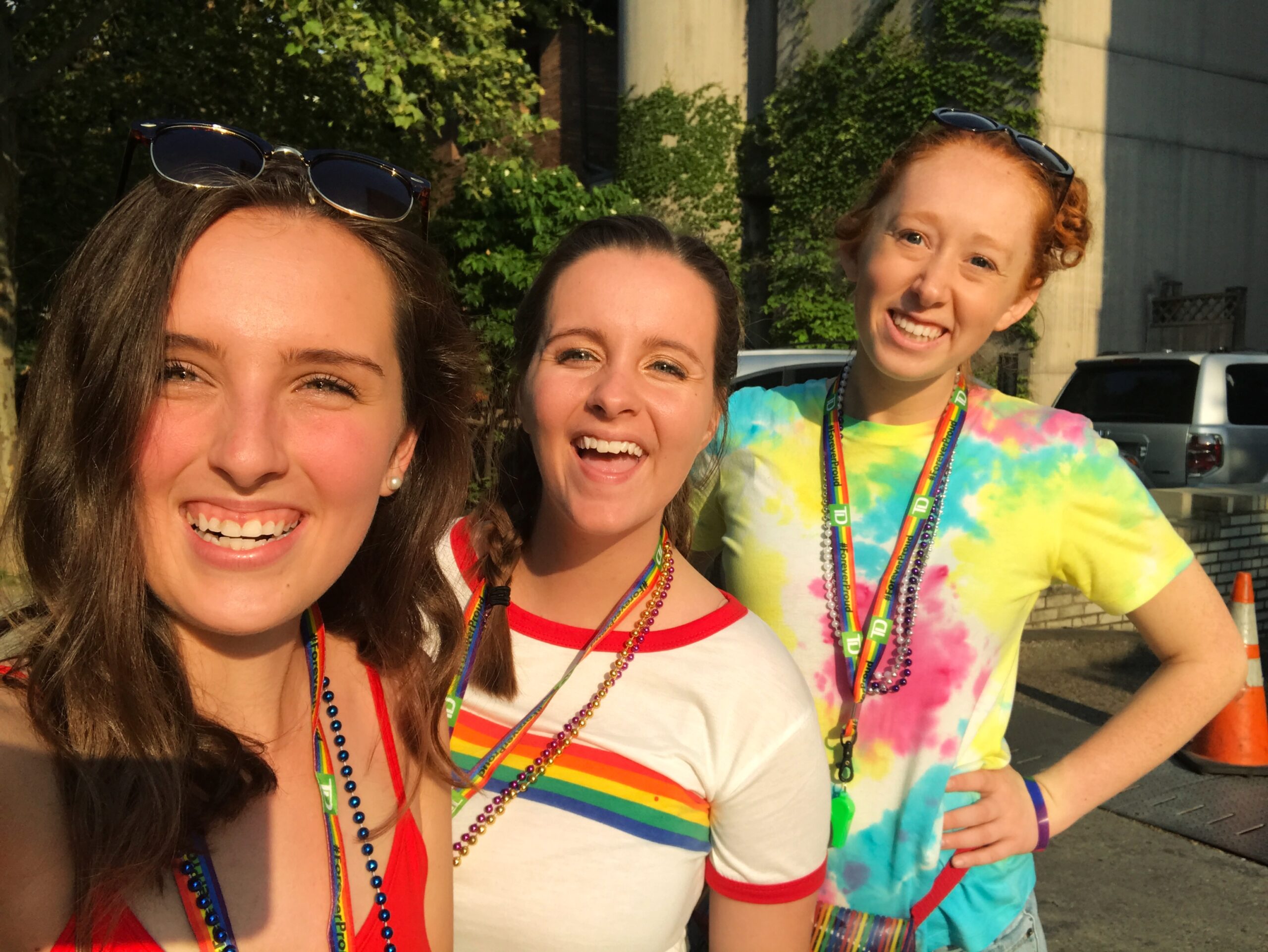
Jesse, our roommate Katie, and I at the Pride Parade
While I am for sure still learning the ropes at both IREX and navigating the metro, I have already had such an incredible time here. I am beyond excited for the many adventures yet to come in the next two months as I continue to meet and work with people with passion, while I work to figure out a passion of my own.
We traded our Chapel bells for rumble of the L train. Chicago. A city that will never cease to amaze me. Being from a Chicago suburb, I am no stranger to this majestic city. I spent my weekends exploring different pockets of city under the careful guidance of my family. I like to say that my family bubble wrapped my Chicago experience. I could not take public transportation until I was 17, and even then I was under the protection of my brothers. My mom is a nurse and my dad is a taxi driver, they know firsthand how bad Chicago can be. They were just trying to protect me, but they cannot shelter me forever.
The independence is liberating. Living in Chicago allows me to explore myself outside of the safety net of home or Valparaiso. I was overjoyed when I discovered my placement was in Chicago because it meant I could grow in a state I love. Being a big city, Chicago offers diversity that is not highlighted often back at school. Although every person has their differences we all share one thing in common, taking public transportation. Everyone has their own love hate relationship with CTA. On one hand, it is easier that having your own car because you will not have to deal with paying an outrageous amount of money for a tiny parking spot. On the other hand, the estimated time of arrival of the CTA is unpredictable because of unscheduled stops. Complete strangers bond over their shared feelings about CTA. It is truly a beautiful sight.
Not as beautiful as my commute to my internship though. I made the decision to walk to my placement to get better familiar with my surroundings. Every morning, I walk over the Chicago River as I head to Ingenuity’s office. Ingenuity is the glue between Chicago Public Schools (CPS) and arts partners. Ingenuity was birthed from the city’s need to provide quality arts education to all of CPS. My organization tackles this goal through four innovates: data and research, public affairs, outreach, and partnerships and professional learning. With a mission as vast with these four innovates, you think there is a large army of people advocating on the behalf of arts education in CPS. Well, there is. Nine dynamic leaders blazing a trail in educating and advocating for arts educators. The staff of Ingenuity works tirelessly with CPS Department of Arts Education and arts partners to enrich the lives of children in CPS.
I am honored that Willow and I have been inducted as fearless warriors in the fight for quality arts education to all of CPS. I feel like I have become a part of the Ingenuity family. As a Partnership and Professional Learning Intern, I am excited and nervous to plan our annual Partner Starter Institute to acclimate arts partners to the culture of CPS and instill the importance of partnership. This summer is just beginning, but I know endless adventures await me as I explore the city and learn more about the importance of arts education. This may not be Valpo, but it is a place where I belong. A place I can call home. 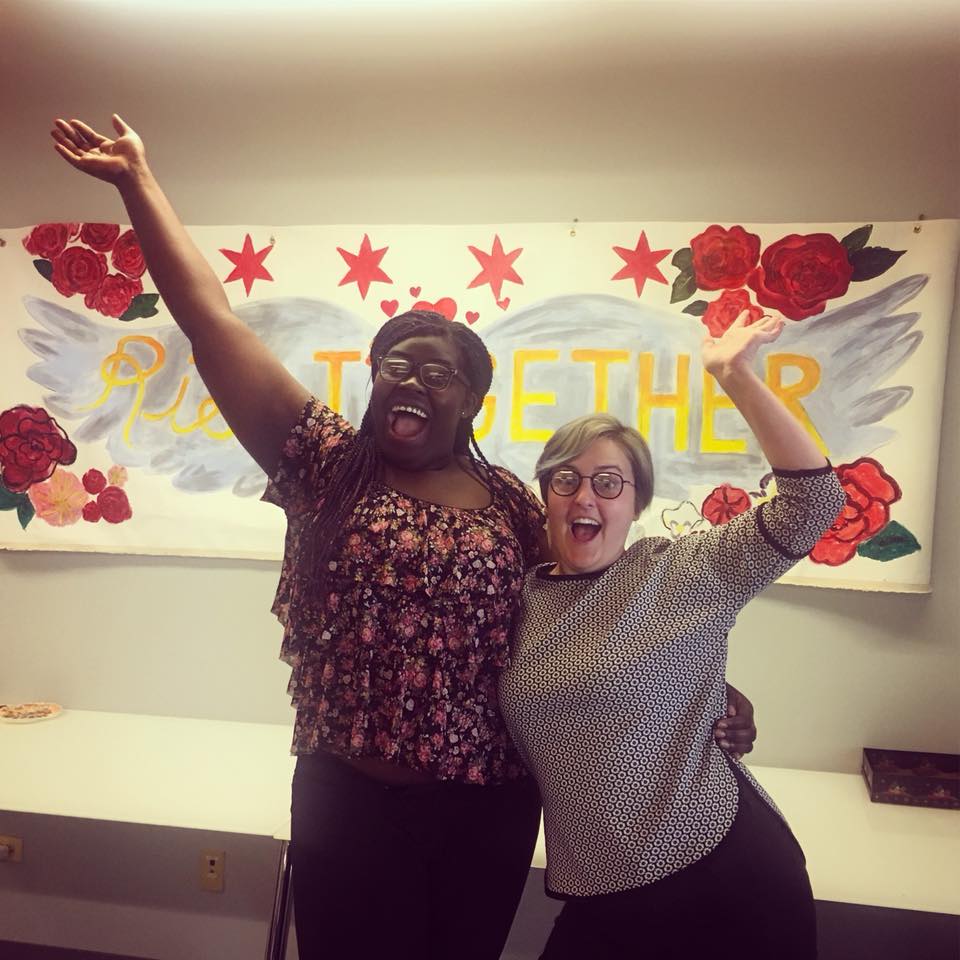
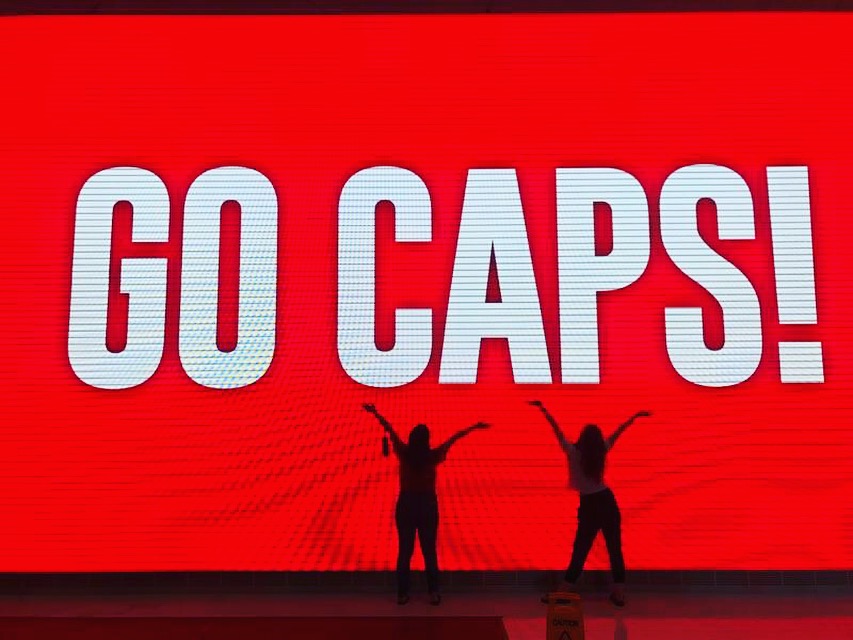
Caroline and I posing outside of an office cheering on the Caps!
C-A-P-S LET’S GO CAPS! This was the constant refrain around DC and outside Capital One Arena last Thursday night as fellow CAPS member Caroline and I watched the Capitals bring home the Stanley Cup. It was incredible to see the energy and watch the city come alive around the event. D.C. is an amazing city, vibrant and overflowing with political energy and I have really enjoyed my time here so far.
The cheering refrain was also a constant reminder of my CAPS internship and the reason I’m able to have these experiences this summer. I’m interning with Venn Strategies, a government relations and public affairs firm in the heart of Washington, D.C. I just finished up my third week and it has been a whirlwind. I am a part of two client teams based around tax and infrastructure, two things I knew very little about before arriving here. It’s been humbling to realize how many things I don’t know. At Valpo, I think of myself as a fairly intelligent and capable person and I really dislike asking for help. At Venn, I’m learning that being smart can mean asking for help, and that double checking to make sure I’m doing a project correctly means not looking bad if I finish it and it has been done wrong. My coworkers have been incredibly helpful and willing to teach me about things I’m still not sure of. I’ve really appreciated their patience as I learn the basics of writing policy memos for clients and over hearings on topics from railways to tax structure.
One of the best experiences I’ve had so far was participating in the Center for Reproductive Right’s State Summit. CRR is a client of Venn’s and I helped to organize the materials and prepare for the summit. The night before the event I attended a reception where I got to meet Congressman Joaquin Castro (D-Tex.) and several other important players in the reproductive rights field. The reception took place on the roof of the Newseum with a gorgeous view of the Capitol and surrounding area.
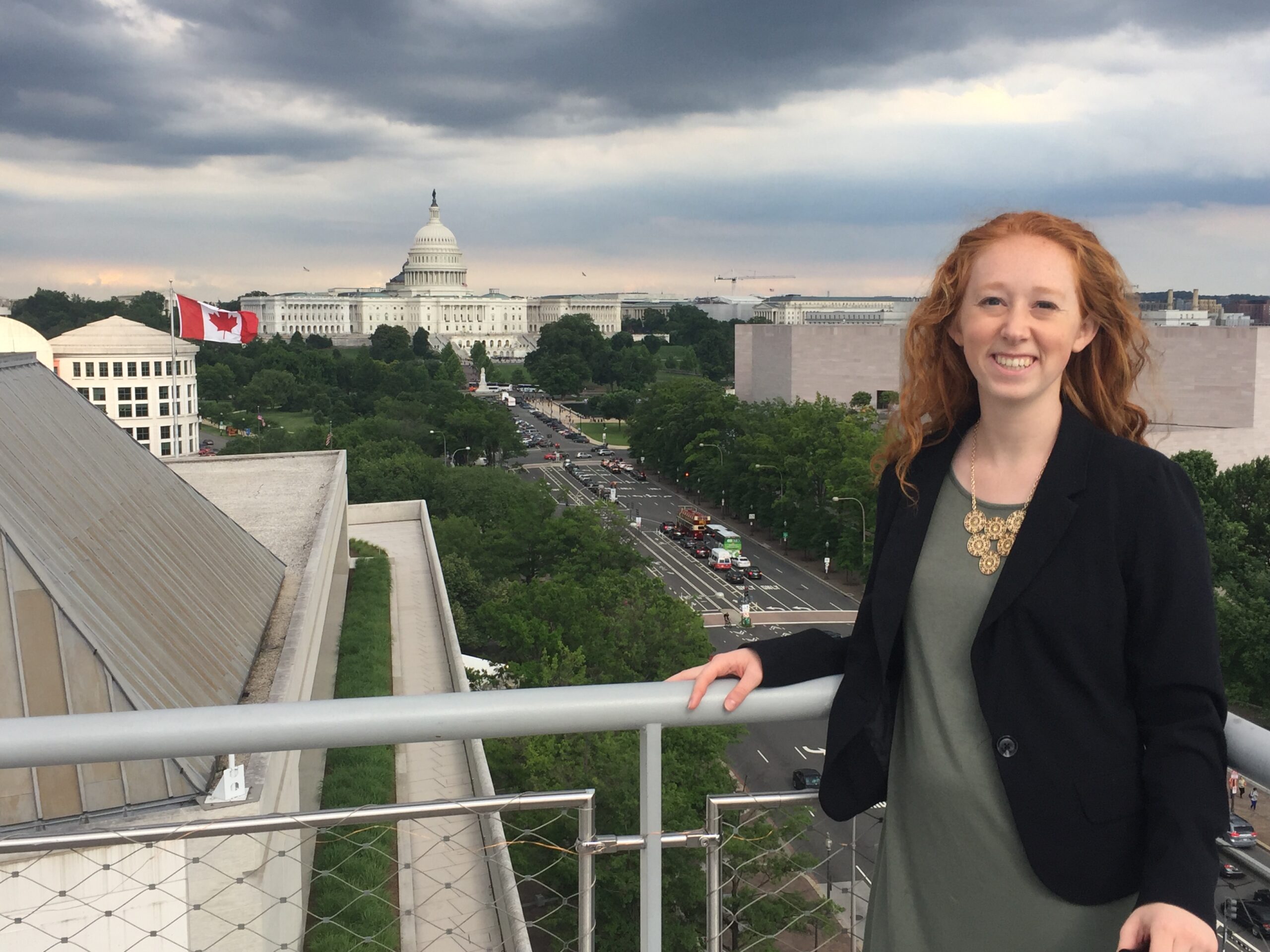
At the CRR reception on top of the Newseum
The next day I attended the summit as an assistant to my coworker managing the event. I got a firsthand look at everything that goes on behind the scenes to put on a large event (this summit was for 200 people!) I have a new respect for anyone who has ever stuffed folders or made name tags after seeing how much work it takes. When we had gotten everything under control, I was able to participate in the summit and listen to panels on maternal mortality and non-profit cooperation and alliances. CRR hosts this summit every year to empower state leaders in the reproductive justice movement. Their hard work is really inspiring and gave me a lot of hope for the future. Watching the news and looking at social media, sometimes the world seems like an incredibly negative place. However, as I watched these strong women encourage and support one another, I felt empowered and was reminded that I too am able to make a difference. It was a really interesting day and seeing it all come together helped me to understand the importance of the work that I’m doing here.
All together, I’m definitely achieving the goal I set for myself of understanding what lobbying looks like. While I had a general idea at the beginning of the summer, I was aware that I had probably watched too much Scandal to have an honest picture. My coworkers have showed me, through taking me to meetings and explaining goals and plans to me, how cooperation and honesty (not blackmail) can help make real policy changes happen for their clients. I’m having a blast here in D.C. so far, and can’t wait to see how much I learn and grow over the next seven weeks.
Indiana has never been a state that I have found very appealing. Although yes, I go to school in Indiana, northwest Indiana and the area around Valparaiso University has a very different feel than the rest of Indiana. The rest of the state sees what they know as “The Region” as a suburb of Chicago more so than part of the rest of the state.
When I got placed in Indianapolis, I was skeptical, although it seemed everyone else was excited for me and kept “saying congratulations.” I didn’t know what to expect because I’ve only been to Indianapolis one time prior to the internship. I didn’t know what there was to do around the area or how the people are. During my interview with my placement here in Indy, my now supervisor, Kristen Fuhs Wells, vice president of Indiana Humanities, asked me what my thoughts on Indiana were. I responded saying, “I have my opinions,” but I went on to explain that I hear all the stereotypes about Indiana, but couldn’t judge for myself since I haven’t seen to the rest of the state yet.
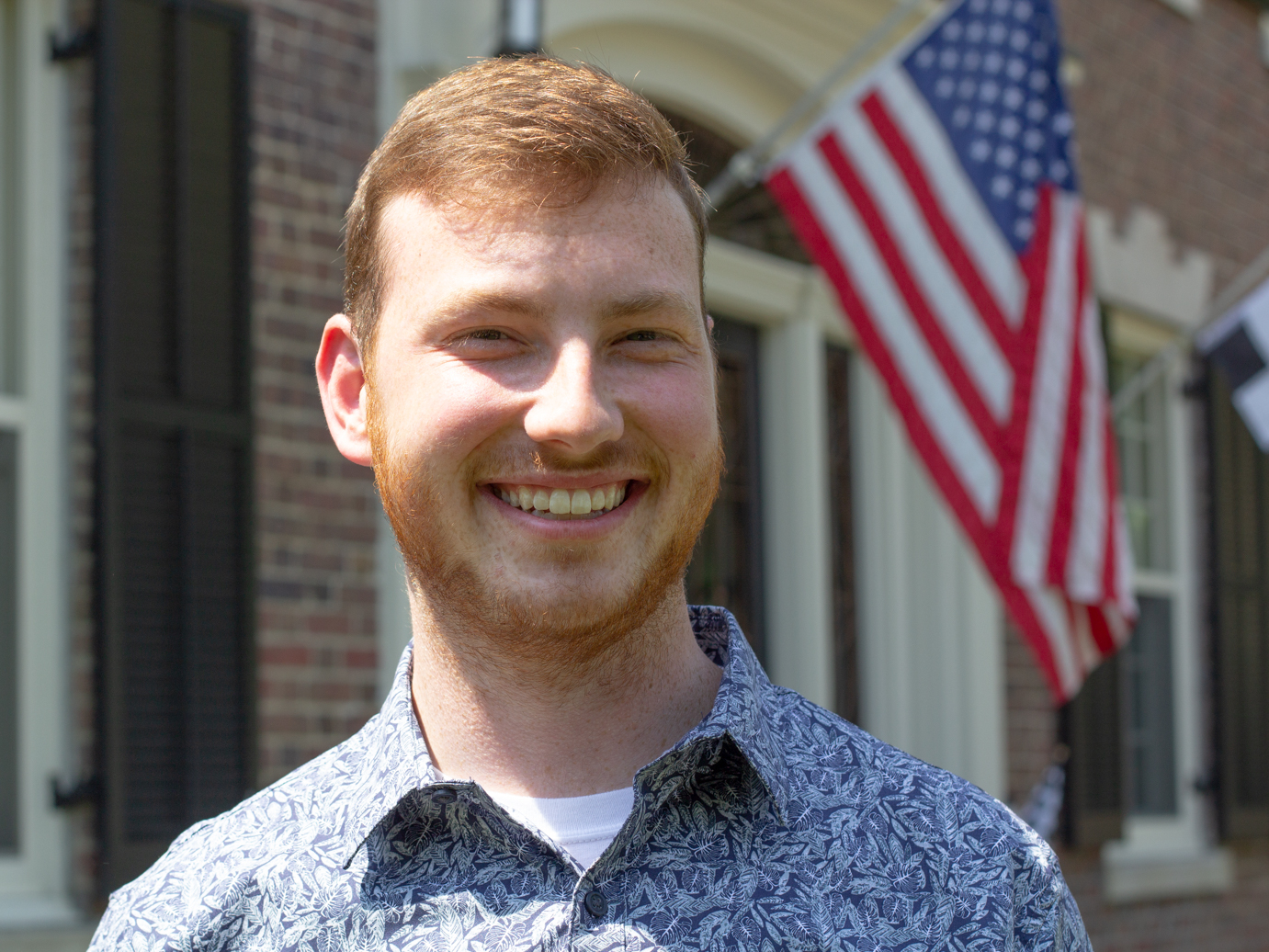
From the Indiana Humanities intern photoshoot outside of the office.
Turns out you should not make assumptions about a state, even if the stereotypes are true. I have been in Indianapolis for the past two weeks and have had the most fantastic experience, both inside and outside of my internship placement. I am placed at Indiana Humanities, a statewide non-profit that whose mission is to “connect people, open minds and enrich lives by creating and facilitating programs that encourage Hoosiers to think, read and talk.”
Over the past two weeks at Indiana Humanities, my focus has been on research and alumni engagement of the Lilly Scholars in Indiana. For those of you who don’t know, Lilly Endowment Inc. hands out a scholarship to a couple graduating high school students in each of the ninety-two counties in Indiana and provides them free tuition to either a private or public university in Indiana. Indiana Humanities received a large grant from the Lilly Endowment Inc. to run the research on the Lilly Scholars. I specifically have been looking at other mentorship and leadership programs across the country and seeing what they do to engage alumni, and have been using that information to help begin to create a Lilly Scholar alumni network.
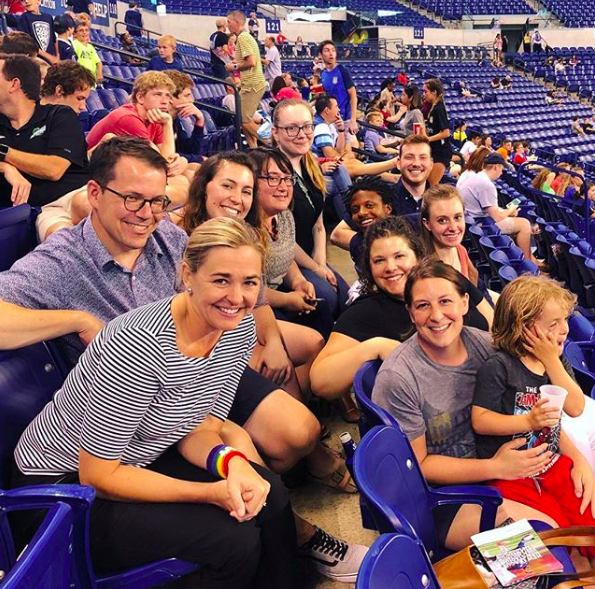
The Indiana Humanities staff having fun bonding at the Indy Eleven soccer game at Lucas Oil Stadium.
With Indiana Humanities, we also have taken an outing to the Indy Eleven game at Lucas Oil Statidum which was a great bonding time for the entire staff. As well, we threw a “Garden Party” to help show off the new renovations of the house and had plenty of visitors. In addition, through the internship I got the opportunity to attend the Indiana Philanthropy Alliance (IPA) Conference just outside of the city and got a chance to meet with numerous staff from Community Foundations (those that help choose the students the Lilly Scholarship goes to) across the state to see what ways they are engaging alumni and what ways they would like to see more engagement. Also, in a few weeks, we are going to have our annual Bar Crawl around Indianapolis. This year, the theme is “Out in Indy” and this historic bar crawl through the city will explore stories of Indianapolis’s LGBTQ community at five different locations. Next month, I am going to help facilitate an event by Indiana Humanities and the Hoosier Environmental Council where we go kayaking on the White River and read while hiking and kayaking in the area which I’m very excited about.
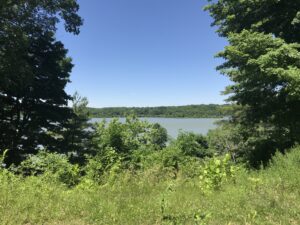
From the walk at Eagle Creek Park.
Although, for the past week, work hasn’t been the only thing I have done. I was off Monday, June 4th, and decided to take a long hike through Eagle Creek Park, only a twenty-minute drive outside of Indianapolis. The walk was about seven miles, but it was a beautiful path with a lot of beautiful plants and animals. Along with that, the other CAPS Fellows in Indy and I actually try to go on walks almost every other day, just so we can go out and explore the city. It has been a blast getting to know them and I really look forward to the rest of the summer with them.
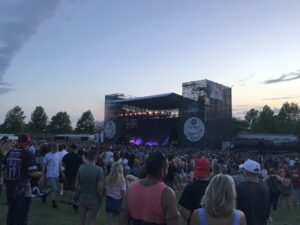
From the Indiana Farm Bureau Insurance Lawn at White River State Park where Post Malone performed.
Lastly, I got the chance to go to a Post Malone concert on Wednesday, June 6th. Another CAPS Fellow who was placed in Indy and I actually got FREE tickets to the concert. One of Post Malone’s friends from backstage came up to us and handed us tickets to the concert (just to let you know, the tickets were priced at $250 – $300 dollars). It was such a fantastic night and got to see the artist who is known for his hit song “Congratulations,” where the title of this blog comes from.
Though it’s only been two weeks, I think the next eight are going to be a wonderful time and I will now forever be grateful to Indy for the opportunities I’ve already had here.
Before we even get started here, I think it is important to know that I grew up in a small farm town in Northeast Indiana, to devoted and incredibly loving parents. My hometown, North Manchester Indiana, is a Tree City USA with one university, two retirement homes and three stoplights. If you travel 4 miles east of town limit, you’d find my parents’ house tucked in a woods with a long gravel lane. This environment has to be one of the top places for a child to grow up. I had frogs to catch, hills to sled down, and many cousins to play basketball with in my grandparents’ barn. Now that I am three years out of high school and into my degree at Valparaiso University, I love to reflect on my past as I am continuously blown away by my present and future.
Now that you know where I am from, I want to tell you a little about where I am at right now. Currently I am sitting in the north lawn of the Field Museum in downtown Chicago, with the skyline in its full glory as the sun shimmers on the high rise office and apartment buildings. I can see the lake to my right but its natural beauty is somewhat overtaken by the noise and energy of the city in motion. I am contemplating whether I want to get a donut or a cookie for a treat from one of the shops along my walk back to my apartment, or if I should just grab some groceries and stay productive. All of this moment is something different than what I grew up knowing, yet I am able to fit into stride with the millions of people who live in this city. Obviously I have a sense of adventure and curiosity to be able to fit into the crowd like this, but I also believe that I feel comfortable here because of the people who I have met so far. Today as I was in my supervisor’s office talking about the events of tomorrow, and into the room walks a jovial man (Mark Bouman) who will be going with us tomorrow on our drive to Gary, Indiana. We do a little introduction and I find out that he not only graduated from VU, but he also had the same professor as me… in fact, he had Professor Janke’s first class and I had his last! As I reflect on this moment I feel a comfort knowing that we have an immediate connection. I also feel proud to be a student at VU, because this man has been incredibly successful in his career and he is just one example of why VU’s reputation extends in circles outside of Valparaiso. For these reasons, I am anticipating an incredibly bright and successful summer.
Though my past is geographically different than my present, my passion for people and nature remains the same. It is now evident to me that my backyard woods and my grandparents’ basketball games were much more than temporary entertainment. In fact, these things are a huge part of who I will forever be. I will always be a student of nature and a social member of a team. Therefore, I am so excited to be working on environmental community engagement in the Calumet Region for a cohort of Field Museum people that have a passion for healthy people and healthy places.
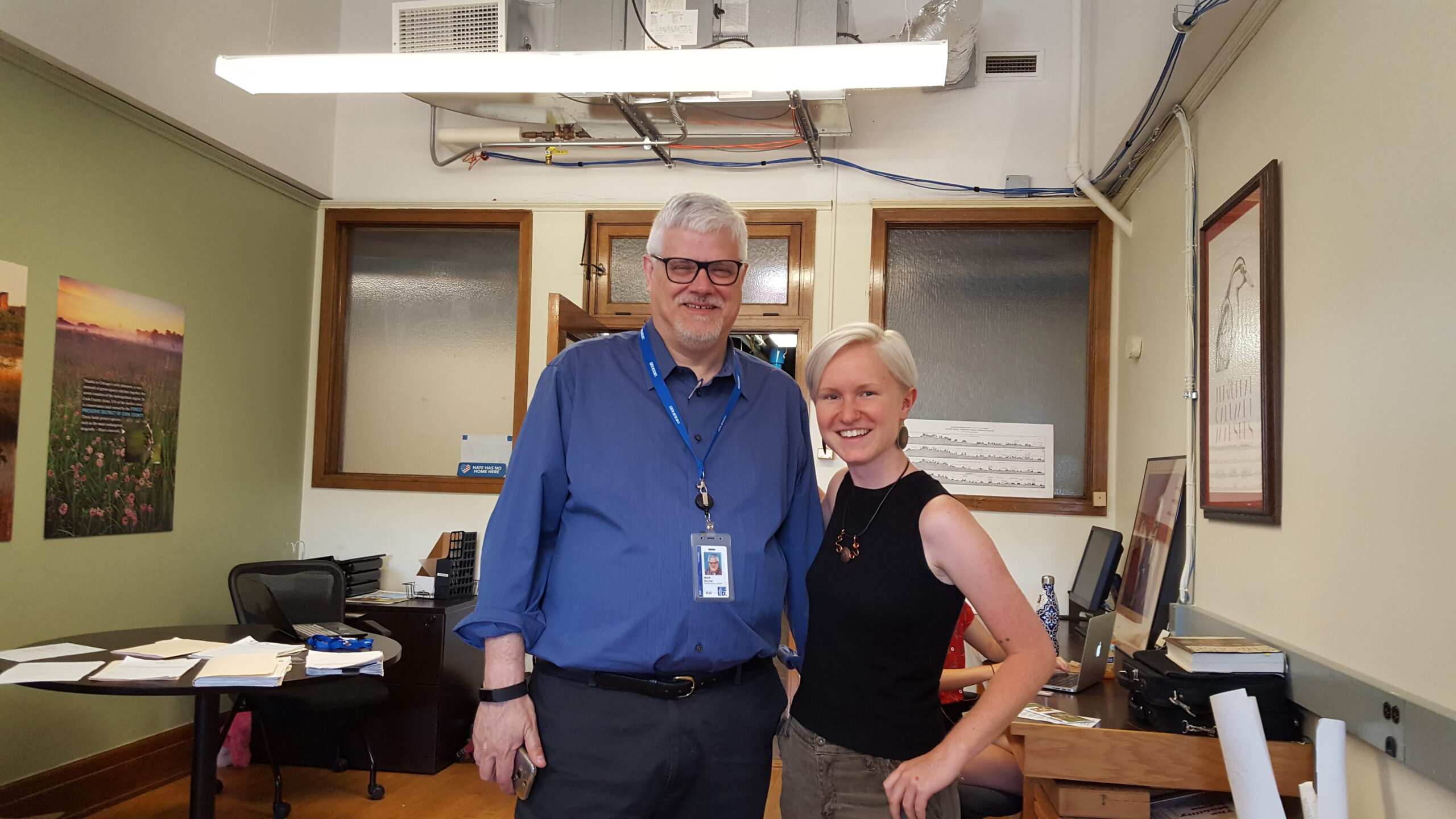
AKA, students of Ronald Janke’s first and last classes.
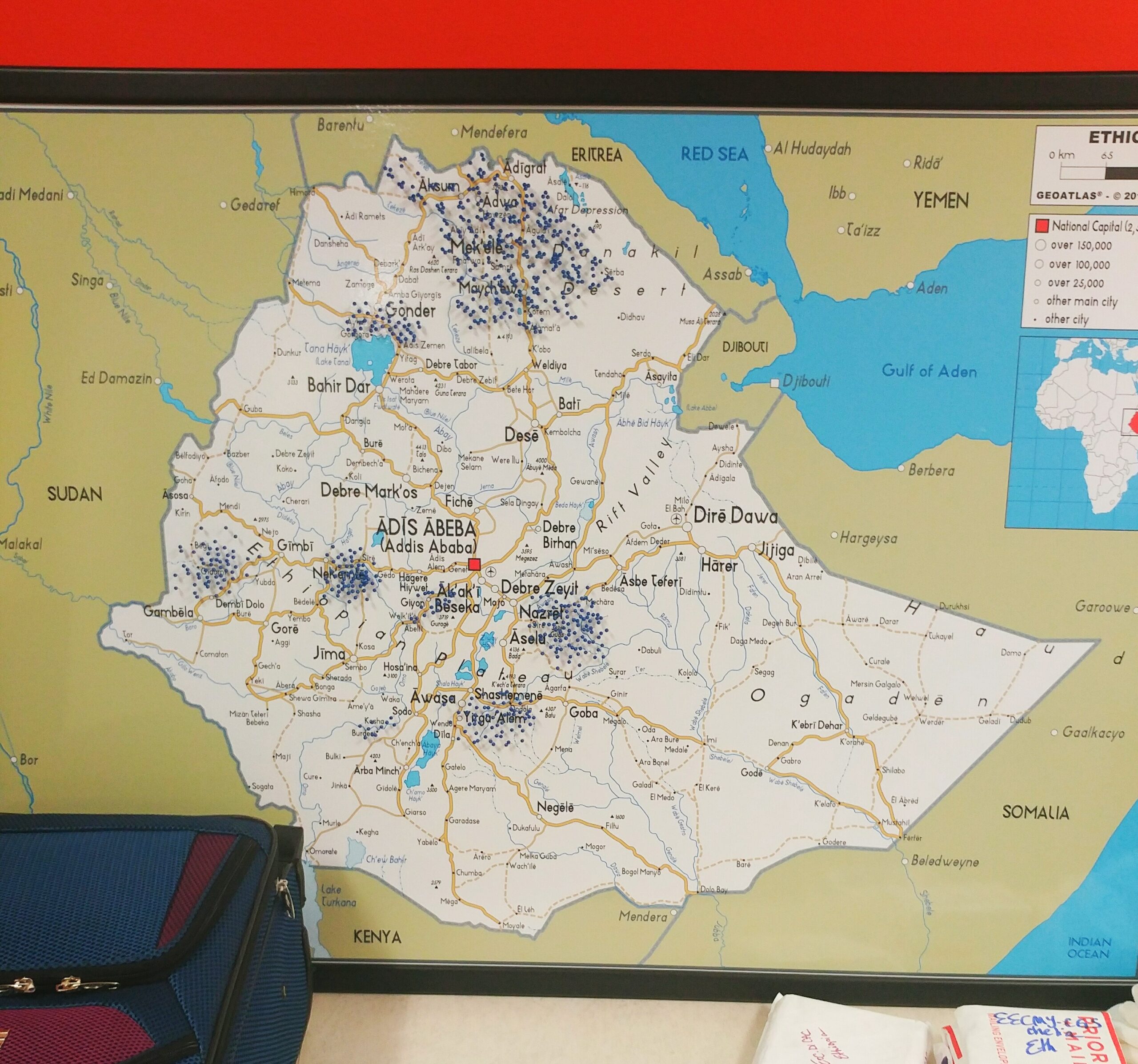
A map of Ethiopia with the blue pins at the locations of water projects.
It’s the question I have gotten many times a day for multiple weeks, “Are you ready?” Last week, it was referring to my trip to Austin and the start of work. This week it’s been directed towards my trip to Ethiopia which begins tomorrow. Which is one day from today. Which is not a lot of time. Each time I hear the question, it carries a different meaning. Sometimes the question refers to logistics, other times the packing process or vaccines and medicines, but the trickiest is whether or not I’m prepared mentally.
This summer I am working at Water to Thrive, a non-profit in Austin that works with organizations in East African countries (Ethiopia, Uganda, and Tanzania to be specific) to provide clean, safe drinking water to communities. I am primarily working on the beginnings of a bridge project in a village in Ethiopia that sees their only bridge connecting two sides of the village washed out each year in the rainy season. I will also be working on a best practices document that has a rich history of previous CAPS Fellows work. My supervisor has told people many times this week that I’m a great writer (which really puts the pressure on for this blog), so I’m picking up writing tasks as I go along as well. I’m incredibly excited to be working for an organization that aligns so well with my passions and studies.
Now back to preparedness. It’s difficult to express exactly how I’m feeling in casual chit-chat. It’s hard to succinctly explain how completely prepared I feel to be unprepared along this entire experience. I’m acutely aware that there’s no way to truly prepare for the journey on which I’m about to impart. That doesn’t mean that I haven’t prepared countless lists in an attempt to do so. I love lists. List writing is one of my favorite activities. I have a book full of lists, but in preparation for this summer, I’ve been viewing them more as a preparation exercise than concrete lists of exact things I will do and ask (other than a beautifully color-coded packing list, which will be adhered to). Spending time thinking through what W2T and I am hoping to gain from this experience to inform later work is helpful, but I don’t plan to pull out my list of questions to about well rehabilitation and rattle it off word for word to each member of the WASH committee.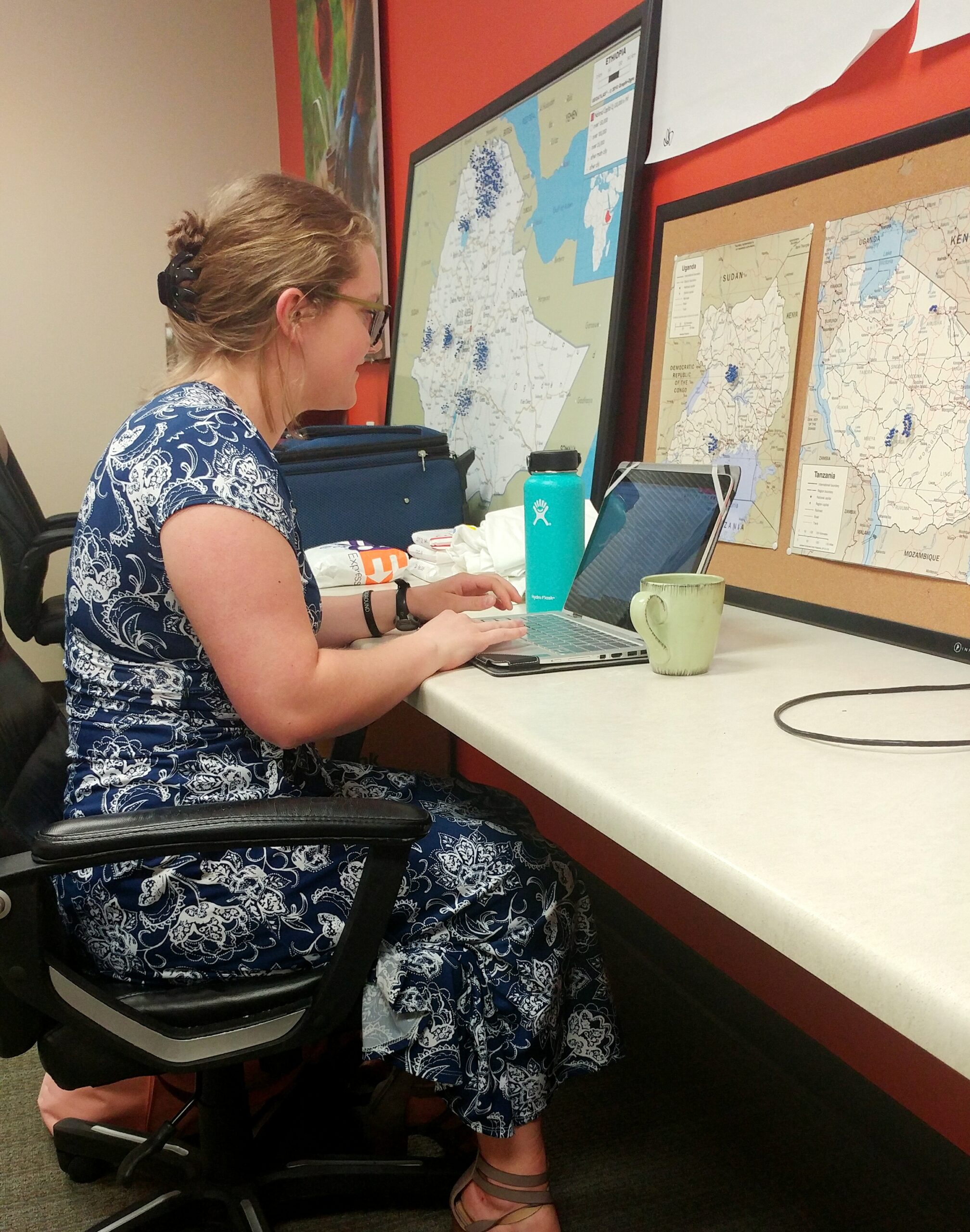
If there’s anything Valpo and civil engineering, in particular, have taught me so far, it’s to know how to adapt and to never know what to expect. On approaching the Atrium Office Centre on my first day, I was met with a drab building ripped straight from The Office, but once inside, I was met with one of the most vibrant, energetic spaces I could have imagined. I came to Austin knowing it would be different from the rest of Texas, but I was met with more food trucks and breakfast tacos than I could have ever imagined. I consider myself very familiar with concrete, the primary bridge building material in Ethiopia, and while one may think that all concrete looks the same on the surface, it’s an incredibly variable material, so I have no idea how central Ethiopia’s will compare to what I’m used to working with, but I’m excited to learn.
So I think I am ready for this trip and the work of this summer. I’m ready to learn better ways to communicate with people across cultures and languages. I’m ready to soak up as much information as I can and make new lists about what I’ve learned. I’m ready to be open to whatever the next nine weeks bring, and I’m ready to fully participate in the community of Water to Thrive and Austin.
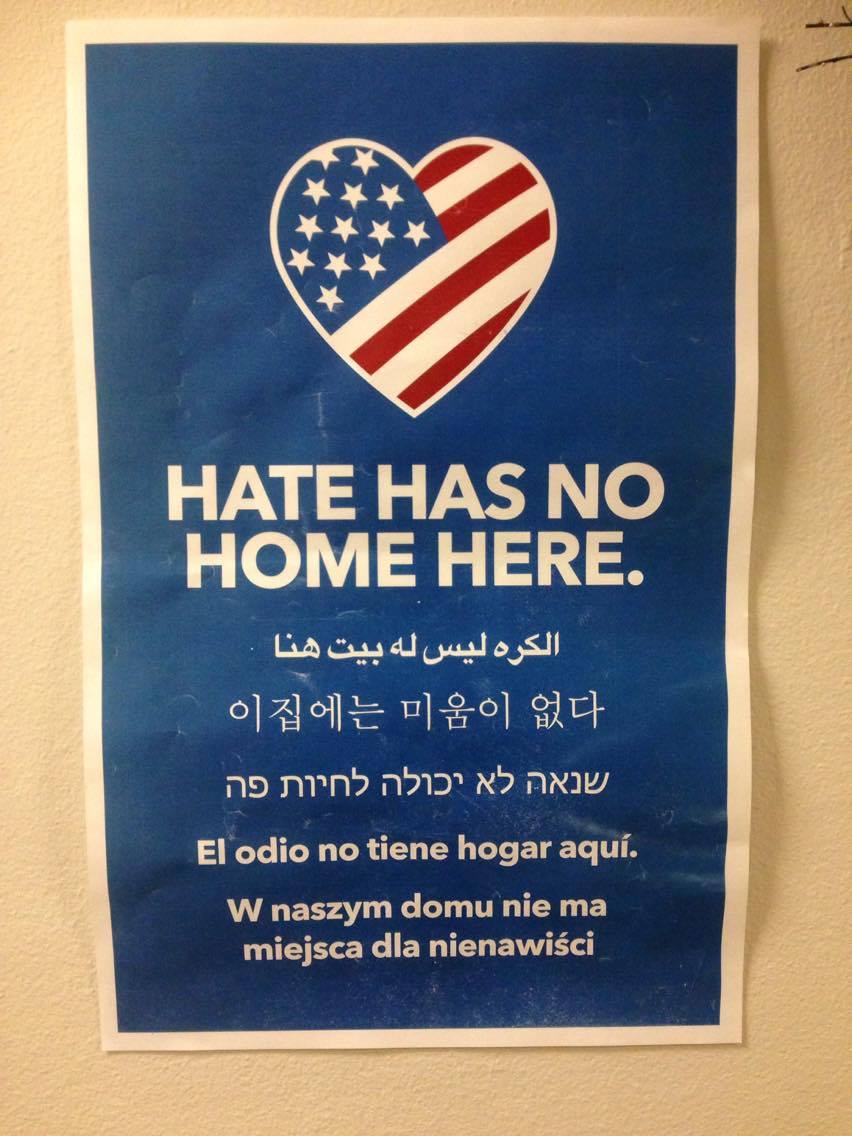
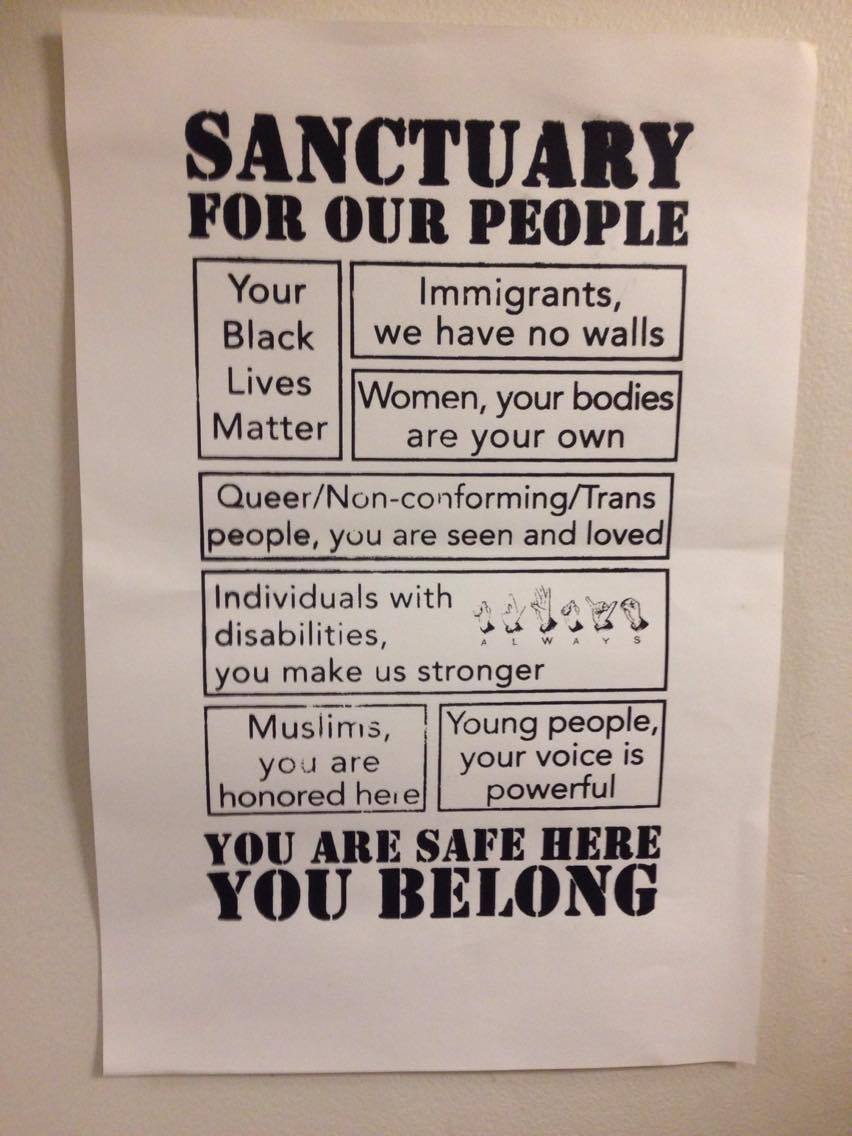
Dedicating my summer to the CAPS Program, and more specifically the Interfaith Committee for Detained Immigrants, is not something I think I could have properly prepared myself for, but now that I have had some time to reflect on the entirety of the experience I am even more grateful for this opportunity. This past spring semester I studied abroad in Southern Africa, and came back with a lot of thoughts and feelings, and was hit harder with reverse culture shock than I had expected. Being in Chicago proved as a good transition back into the United States, or at least back to Valpo. I grew up on a cow farm, so living in the South Loop on the 15th floor of an apartment complex and driving in Chicago traffic was just as foreign to me as the countries in Southern Africa. Working with ICDI, I had the opportunity to learn about the entirety of the U.S. immigration system, immerse myself in interfaith dialogue, learn the ins and out of a non-profit organization, and see the first hand effects of our ever changing politics after only getting my political information after the presidential inauguration through a skewed lens(being abroad, local residents giving their opinion on U.S. politics, people fearing for me how the U.S. would be different once I got home). Reflecting on many of my experiencing, I am just beginning to fathom how much I have learned.
Participating in pastoral care with individuals in immigration detention centers gave me the opportunity to have interfaith dialogue and speak with people across different cultures, background, histories, and religion. Attending Immigration Court gave me the knowledge and understanding of the court system to speak confidently about the root of my beliefs when it comes to immigration within the United States. I have learned how to be more active in human rights dialogue through different venues within my internship, making connections with others, and living within the CAPS community. I have been able to raise more awareness for human rights issues and work towards dismantling the systems of oppression within our society. All ideas and passions that were more fully developed during my study abroad experience and learning firsthand about systems of oppression within the Southern African context in relationship to Apartheid, Namibian genocide, and making connections to similar events that have taken place within the United States such as the Native American Genocide, Segregation, and blatant racism. Through my participation in ICDI I learned more about non-profit organizations in a United States context and found affirmation for my sense of calling to attend seminary and do pastoral care through a lens of social justice in the future.
With such an intense internship, it was necessary to process with other people and decide what the take away of the day, week, or summer had been. In communicating with other CAPS Fellows in Chicago, we realized many of us had grown up with parents from the generation of “You don’t talk about religion, politics, or money.” I always questioned this growing up and was given various answers as to why not to talk about these things: “People might not agree with you”, “It’s just being polite”, “There are nicer things to talk about.” As I have quickly learned at University, avoiding conversation about these topics is exactly the opposite of what we should be doing, and shows the vast amount of privilege we were raised with. Not talking about religion shows our religious freedom. I have learned that talking to those whose understanding of faith is different than my own, and it has led to fascinating conversation and reflection about why we carry out our religious practices the way we do. Avoiding the topic of politics, especially today, shows a certain amount of privilege. If the majority of the white, middle class, English speaking population were to not follow the news, they would be able to assume that there is nothing happening in the world that is directly affecting them. This population is safe and has nothing to worry about. Many minority populations are, have been, and will continue to be directly affected by politics and national news, including but not limited to immigrants, people of color, non-English speakers, those living in poverty, black lives, the LGBTQ community, Muslims, and more. And lastly, being able to avoid the topic of money, or not worry about money is a privilege many do not have as a majority of the wealth in our country is held by a very small percentage of United States residents, a gap that is continually becoming wider and wider.
Other aspects of my internship that had a large effect on my learning within the experience were speaking with my mentor, and reflecting on ideals of leadership and purposeful work. Conversations with my mentor were highly motivating in following my passions and not working to meet the expectations others have about me, and focusing on the social justice issues I am most passionate about and have the most need despite the levels of controversy and debate surrounding certain issues. We talked about the importance of mindful conversation, especially with those different from one’s self, advocating for one’s self, and the importance of self-care amongst passionate work. While this summer’s internship was one of the most challenging experience I have been a part of to date, I am very thankful for the work I was able to for ICDI, and for the countless number of lessons, conversations, and unforgettable moments I had the blessing of being a part of.
I owe so much of what I have learned from those who have come before me and have been doing advocacy work for years and years. The two Sisters who began ICDI have the largest passion for equality for ALL people that I have ever seen. It is purely inspirational and motivating hear their story of all the obstacles they have overcome to open safe houses for immigrants, fundraise, begin a court watch program, pass a state law to give those in detention the right to pastoral care, and stand on the steps of the Broadview Detention Center every Friday for ten years to hold a prayer vigil for families being separated by deportation. These two Sisters have reached out over the years to hundreds of individuals that volunteer and participate with ICDI weekly. I am grateful for other volunteers I worked alongside with and learned from, and supervisors who shared their stories and wisdom with me. While I am glad I am back at school, I will be missing working every day with these important and necessary ministries, but I know I will be back to volunteer as often as I can.
If you feel called to help as well, ICDI always welcomes more volunteers: http://www.icdichicago.org/
Everything was worth it: these are the words that come to my mind when I think of the long hours spent compiling spreadsheets, scrutinizing travel documents, making supply orders, and ultimately working with an incredibly dedicated team to ensure the fluid execution of an event with over 1,000 participants. Admittedly, there were days when my demeanor was less inspired and moments when I allowed the aura of the capitol to distract me from the value of the work that I was a part of. This compounded with my natural introversion, resulting in a self-induced monotony, a symptom that allowed for days to pass quickly, the city to become a mere blur, and leisure hours to be spent inflecting in hopes of uncovering a solution. As luck would have it, this was one of those conflicts that was solved with the simple virtue of patience, leading to a personal victory over monotony.
 I shall preface this triumph with a description of some realizations that my experience with IREX allowed me to discover. I have always known that, when faced with important tasks of any kind, my work ethic becomes trenchant, meaning that I focus the entirety of my efforts on the details of a project. Though the intent behind such a practice is to maximize efficiency, the transposition of this practice into the professional workplace resulted in a mental drain that affected my ability to focus and recharge over time. Another realization, partially derived from the aforementioned point, manifested itself through a consistent frustration with the lack of perceived impact that I saw my work having; my default thought was always “I still do not feel as if this is enough,” something that I always struggled with in the humanitarian field. Of course, my deeds were acknowledged and often rewarded with more responsibilities, but the distance between myself and the Fellows that we were working with still seemed so vast. These realizations taught me that bringing lightheartedness into your work is just as important as bringing seriousness and concentration. Furthermore, I discovered that I am inherently inclined to desire perceptible results in my work; the tangible fruits that can be gleaned through dedicated labor is a crucial step for my consciousness to appreciate the processes that compose the project.
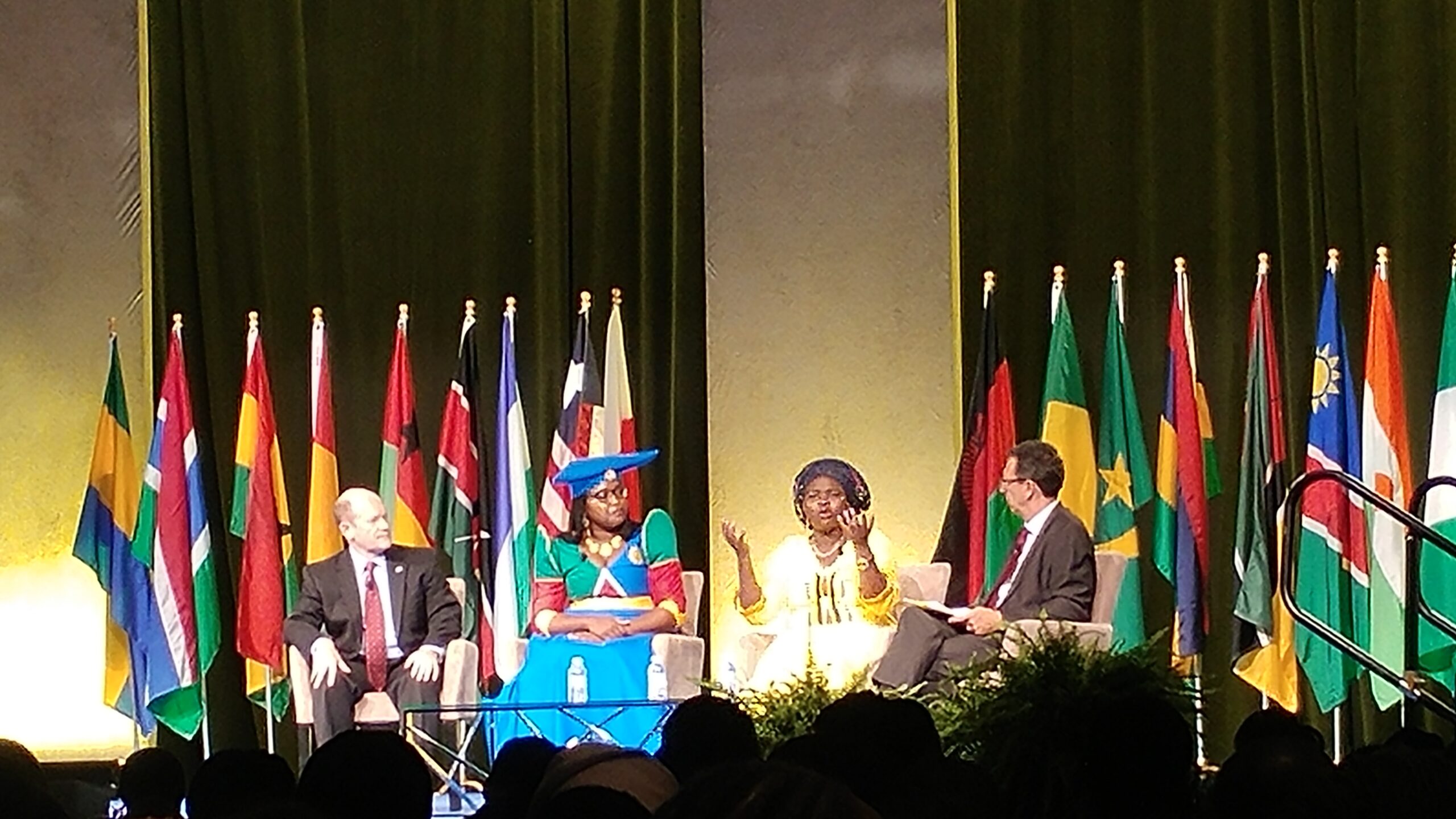
The discoveries that I made about myself explain why the Summit (the gathering of all 1,000 Mandela Washington Fellows in D.C. for a three-day conference) was the climax of my internship with IREX; it is a major component of why I can confidently say that everything was worth it. Fundamental human interaction with various Fellows was enough to reignite my passion for working with others to provide support and access to the resources that can change lives. There was a moment, at the closing of the Summit, when the Fellows received hand-tailored certificates from the State Department, marking their fulfillment of the Fellowship’s requirements. It was during the distribution of these mementos that I realized just how much of an impact a small team can have on the lives of a thousand people, and in turn, how much of an impact those thousand will have on ten thousand more, and the process continues to repeat itself. A common adage echoed by each of the Fellows was that “We are the future of Africa,” and to simply have served on a program that could provide that degree of confidence and hope in the future is enough to bring those same emotions to my heart and even tears of happiness to my eyes. Above all, my experience as a CAPS Fellow has given me the resolve to persevere; in the maw of hatred and bigotry, humanity will always serve as a vehicle of hope in our world. Thus, it is our duty to serve one another, lead responsibly when called, follow passionately when necessary, and ultimately know that the good fight will be worth each ounce of effort when we witness our actions positively impacting those who seek simply to sow hope in places where it is all but lost.
I honestly should not have gotten the Data and Research internship with Ingenuity. I was completely under qualified. My application was a total shot in the dark; I only hoped the arts education organization in Chicago would see that I applied to every position they offered and maybe understand just how much I wanted to work for them. The internship description called for candidates who had:
- Familiarity with ETL tools for data warehousing (e.g., Zapier, Apatar, CloverETL, Talend, Pentaho)
- Experience writing APIs
- Experience designing and developing software and/or computer systems
Even after nine weeks with Ingenuity, I can’t tell you what half those words mean. Thankfully after reviewing my resume, my supervisor envisioned a different project for me — one that would teach me new skills while still utilizing my writing and research abilities. (I could write a whole other post about what I learned about applying to jobs I think I’m “under qualified” for, but I’ll save that for another time).
This summer I took the lead on writing the annual State of the Arts report which examines the arts education landscape in Chicago Public Schools (CPS). The 100-page publication will be available in October, and I had a blast collaborating on data analysis with co-workers, providing feedback to the designer, and presenting preliminary findings to Ingenuity and CPS directors. Possibly the best part of the summer was learning how much I enjoy working with data.
As an English and music major, I had firmly established myself as “not a numbers person.” In fact, the only reason I worked to pass AP Calculus in high school was to never have to take a math class again. I wasn’t necessarily bad with numbers, I just didn’t find excitement in them as I did with a good novel or a new piece of music.
However, working on the State of the Arts report showed me that I do actually like numbers — I like numbers that tell a story.
Ingenuity collects A LOT of numbers from schools, arts organizations, private and corporate funders, and the CPS district offices. Some days I spent hours pouring over spreadsheets trying to make sense of all them. My supervisor, co-worker, and I would do mental aerobics trying to figure out how to manipulate numbers into meaningful data. Some days I left the office with a pounding headache and no answers to our numerical problems, but the days we figured out solutions were extremely rewarding.
Once we collected and analyzed our data, it was my job to write it into a narrative. No one wants to read a 100-page report and still be asking “why does this matter?” in the end. By framing our numbers within a larger narrative of supporting schools in providing arts education to every CPS student, our data has meaning.
So while on paper I should never have been made the Data and Research intern at Ingenuity, I ended up being in exactly the right position to learn how important numbers can be in advocating and supporting a field I am passionate about.
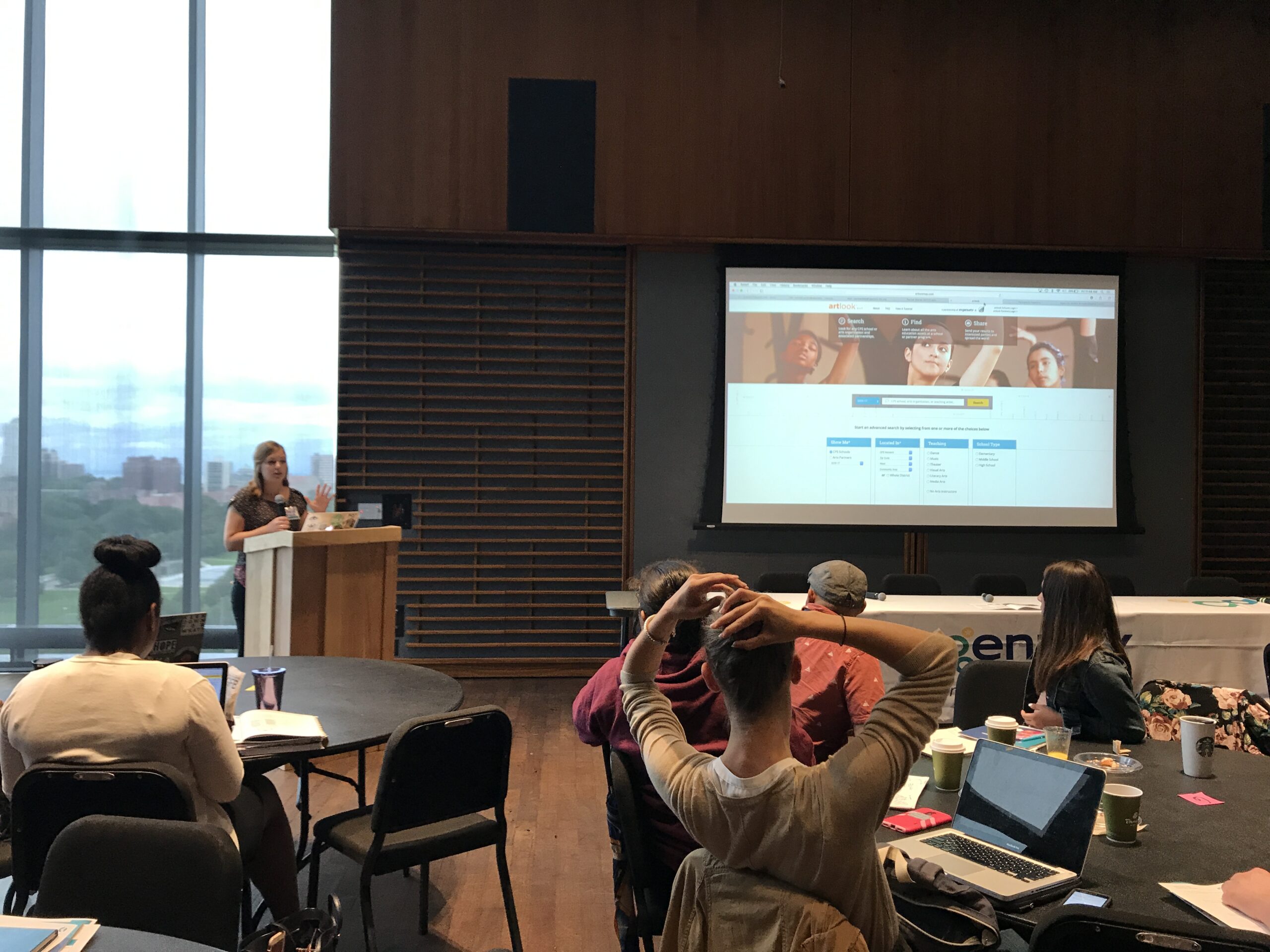
Much of the data Ingenuity collects is available at artlookmap.com. This summer, I also had the pleasure of leading a breakout session showing new arts partners how to utilize the website.
When I first decided to pursue nonprofit public relations a year or so back, it was mostly because I didn’t want to work in corporate America. The idea of big business meetings filled with people in suits (which is how I stereotypically envisioned the corporate world) just didn’t appeal to me. So when people asked me what I wanted to do when I graduated, I said nonprofit PR. But now, after having a couple of internships in nonprofit communications, I know that that decision I made on a whim was the right one.
Over the past few semesters, I’ve taken some classes that have ignited an interest in human rights, so much so that I bookmarked the website with the Universal Declaration of Human Rights. Here in the U.S, we take so many of these rights for granted. But there is a plethora of places around the world where people don’t have their fundamental human rights. Obviously, the lack of human rights is a difficult problem with no easy solution. There are political, economic, and social reasons as to why people don’t have all their human rights and nothing is going to fix that overnight. However, there are changes that can be made to aid the process. As I’ve learned during my time at Water to Thrive this summer, water is one of those changes.
Article 25 of the UDHR states, “Everyone has the right to a standard of living adequate for the health and well-being of himself and of his family, including food, clothing, housing and medical care and necessary social services, and the right to security in the event of unemployment, sickness, disability, widowhood, old age or other lack of livelihood in circumstances beyond his control.” No access to clean water = No adequate living. It’s as simple as that. Unclean water sources lead to waterborne diseases, such as diarrhea. I’ve gone through a myriad of statistics to support this claim. 50% of rural Africans suffer from waterborne illness. 10% of children die before their 5th birthday because of diseases such as diarrhea. I’ve seen pictures of women gathering water from the same streams where their livestock are drinking. That’s just not healthy. In the villages where Water to Thrive builds clean water wells, waterborne disease is nearly eradicated.
Article 26 states “Everyone has the right to education. Education shall be free, at least in the elementary and fundamental states. Elementary education shall be compulsory. Technical and professional education shall be made generally available and higher education shall be equally accessible to all on the basis of merit.” Education is one of the biggest areas I’ve focused on at Water to Thrive recently. Children spend hours every day walking to retrieve water, causing them to miss school. The diseases they get from these unclean water sources also keep them from attending classes. Just the other day, I was reading through some testimonials from a school in Uganda where W2T is hoping to build a well. These kids talked about how they have to miss school to gather water and often get diseases like cholera and typhoid from it. Although they have the right to education, many cannot get that education because of something as simple as water.
My time at Water to Thrive has taught me a lot, from marketing skills to navigating Austin public transportation, but what has impacted me the most was learning about the African water crisis and reflecting on the effect it has on human rights. Through writing articles and working on an informational packet to send out to schools, I’ve been able to share the importance of clean and accessible wells. Although I’m not out in the field building wells myself, I still feel that I’m making a difference through spreading awareness. St. Francis of Assisi once said, “Don’t change the world, change worlds.” While Water to Thrive isn’t going to single-handedly end the African water crisis, they are changing the lives of individuals every day. And that’s what service is all about.