
One morning on my commute to work, the woman sitting next to me on the train struck up a conversation with me, as we are often on the same train for a portion of our respective commutes. I took two things away from that conversation, the first being that I am fooling no one in my efforts to seem like a seasoned Chicago 9-5er, as she immediately intuited that I am an intern. The second thing I took away was her reminder that I am looking at the next forty years of my life in the workforce. I’m not sure if that piece of sage wisdom was supposed to terrify me (40 years of working seems pretty daunting), and at first it definitely did. With time, however, I’ve come to regard that statement as crucial in my personal journey to find a career or goal to work towards in my life that I feel called to do.
I’ve been working at Concordia Place for five weeks now. Concordia Place is a Lutheran non-profit whose mission is basically to support members of the community at all stages of life, from early childhood to the teenage years to retirement, through accessible services that have arisen out of the need Concordia Place identifies in the communities it serves. I am shocked that the time has flown by so quickly, but the abundance of things that I have learned about myself, nonprofits, and the needs that often go unmet in the Chicago area community, are proof of the passage of time.
My supervisor, Cameron, has been awesome about taking me along on her meetings around the city, whether it be with Concordia Place board members, public relations consultants, or potential donors, and helping me to understand how a nonprofit runs from all different angles. For a nonprofit that I had never heard of until my involvement in CAPS, Concordia Place has a large and impressive network of players and contributors, and the people of Concordia Place have worked tirelessly to get this far. In a political and social climate that has presented charitable need in so many different areas and issues, I am impressed by how Concordia Place continues to grow.
In a recent meeting I accompanied Cameron to, I learned about the concept of compassion fatigue. Compassion fatigue is best described as a feeling of indifference towards charitable campaigns addressing even the most important of issues, due to a saturation of appeals for aid for various social issues. As human rights are infringed upon with increasing frequency lately, there are just too many problems vying for attention. For example, it might be difficult for Planned Parenthood to campaign for funds right now, when the ACLU is also campaigning for funds to help families separated at the border, which is a recent social issue that is dominating the news cycle. Both organizations work towards a very worthy cause, yet people cannot put their time, energy, and money into an infinite number of worthy causes. They do what they can, and no one can do it all.
As a college student who is lucky enough to attend Valpo and feel safe and at peace in my privileged bubble in Indiana, it is easy to understand how compassion fatigue comes about. Eventually, we just stop talking about social injustices and things occurring in our country that are against our personal convictions, because they are too numerous, and the thought of all that needs to be fixed in the world is overwhelming and upsetting. And because these injustices often are not directly impacting those as privileged as myself, we can just push these thoughts aside. This is a dangerous pattern of ignorance and comfort to fall into.
This CAPS fellowship couldn’t have come at a better time, as I myself was beginning to fall into this pattern. What could I, an average college student, do to help fix any one of these problems? It often felt like the answer to that was nothing. Now, working for a nonprofit, I see that there is so much that I can personally contribute with my talents and gifts, and even more importantly, so much that can be done when numerous compassionate and driven minds come together for change. Compassion fatigue is a very real phenomenon, but one that can be combated with passion and persistence. I’ve learned that any progress towards change is worth being celebrated, no matter how great or small. And optimism is key.
If I’m looking at the next forty years of my life, the nonprofit sector seems like a great option as a place to spend them. The lady on the train’s terrifying advice now suddenly seems terrifying for a different reason, in that forty years doesn’t seem like nearly enough time to achieve all that I wish in making this world a better place. Although at times it may feel both difficult and hopeless to fix social issues, I feel called to push aside compassion fatigue and just do what I can with what I have to fight for change.
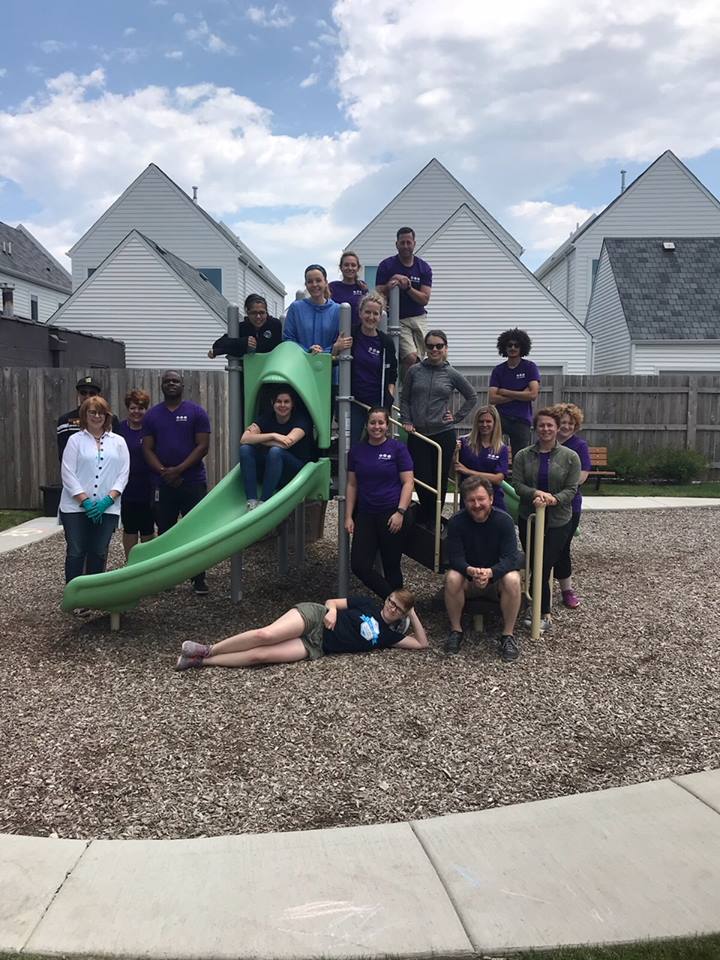
Volunteer day at the new Concordia Day center opening later this summer on Milwaukee Avenue!
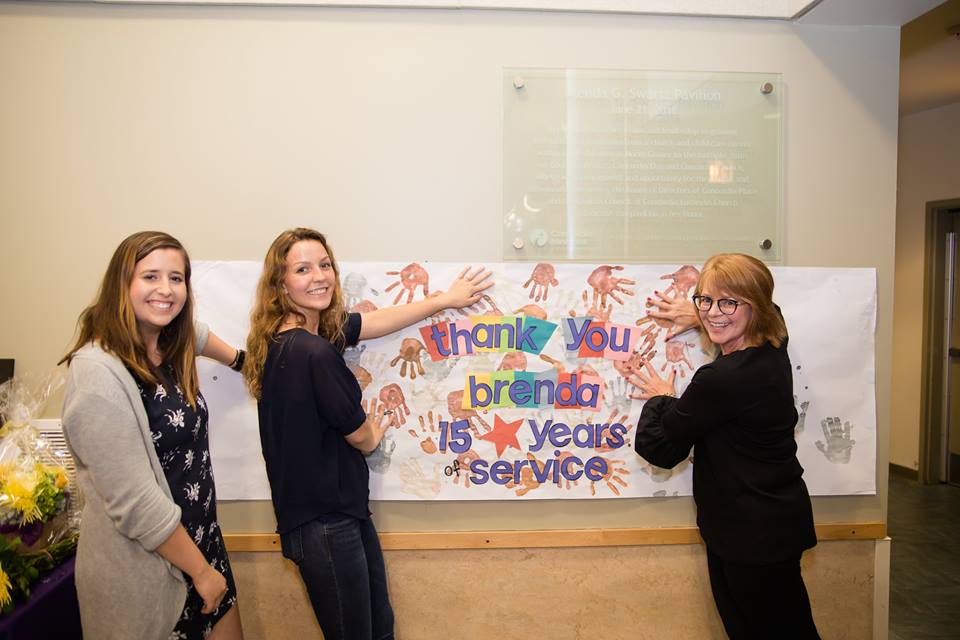
Concordia Place interns with CEO Brenda Swartz at her 15th Anniversary Party
 Since this is my first blog, I’ll introduce myself. Hello, I’m Alicia, and I want to be an advocate for human trafficking survivors. It’s always a little awkward for me when I tell people my career aspirations. Human trafficking it’s exactly a light dinner conversation people expect when they ask me, “what do you want to do after graduation?” It may seem like I’m being unnecessarily specific, but I’m actually expanding my options. In high school I wanted to be a psychologist that specializes in healing trauma caused by human trafficking; however, VU has helped me broaden my career horizon while still centering it around human trafficking survivors. I could work as a lawyer, a policy maker, a researcher, an FBI intelligence analyst, or a caseworker. This why I find myself interning under caseworkers at Heartland Alliance’s Refugee and Immigrant Community Services (RICS). While this internship has been interpersonally and emotionally challenging; it has helped me grow in self-awareness and awareness of refugees and asylees.
Through this internship, I’ve learned more about the refugee process, specifically the resettlement process. I’ve seen first hand some of the difficulties that immigrants and asylees encounter. I’ve often found myself thinking about how I would feel if I had to live in a country I can’t easily communicate. I know their journey can be dismal and hopelessness at times, and I wonder if they think the immigration is or will be worth it. When I encounter families, in particular, I’m reminded of my own family. They made me think of my grandfather and his immigration to the U.S. For the first time, I thought about the challenges that he went through. All that I have in the U.S.—my very existence—is because of his decision to move here despite not knowing much English or having any family here. Even though I can’t talk to him now, I feel so fortunate to be doing something that positively affects other people coming to the U. S.

Because of how RICS teams function, I am able to contribute to the workload as an intern in a measurable way that is not overwhelming. I’m surrounded by people that have the same goal of helping others in the most compassionate and effective way. The type of people these jobs attract and the way this workplace is structured gives me the opportunity to be apart of the most supportive, encouraging, understanding, and well-communicated group of people that I’ve ever worked with. I’m given space to learn how I can make a meaningful impact on participants* and improve my interactions with them.
This is especially important for me not only because of my ancestry but because of my identity as a U. S. citizen. Recently, I heard someone say that the separation of families at the border is not a Trump administration problem. It’s a problem that all of the U. S. is responsible for. The lack of compassion in our actions (or lack of actions) toward refugees and asylees is and has been a tragedy. At our highest intake of refugees (when we accepted more refugees than any other county recorded), we still accepted less than 1% of refugees around the world. I feel so fortunate that I’m able to talk to people about my internship and incite compassion for these fellow human being. I feel fortunate that I’m able to share this with you, my reader, and people I have and will meet with.
There is, however, an obstacle I face that inhibits my capability of maximizing my efforts: anxiety. At Heartland Alliance it’s important to create a welcoming environment for the participants by knowing the participants by name, greeting them when you see them, and asking them how they are doing. It’s also important to create a friendly environment for fellow coworkers. This is a challenge for me because I get more anxiety than the average person during certain social interactions. For example, I get a great deal of anxiety from names; pronouncing someone’s name wrong, calling them the wrong name, or completely forgetting someone’s name genuinely bring me fear because I feel like I’m unintentionally insulting someone and/or making them feel insignificant. I can work on and manage anxieties like that, but it can be exhausting to manage from 9am to 5pm for 4-5 days a week.
Based on this experience, being a case manager for human trafficking survivors might not be the career for me; however, I think it’s still too early to be sure. I have no doubt that being a case manager for human trafficking survivors would give me a more holistic understanding of human trafficking survivors. Long term, I might be more comfortable with a job that specializes in helping them with one thing (such as mental health) instead of managing their entire case. That way, I can focus on the participant for a prolonged amount of time and help with the specifics of their mental, legal, or ect case. However, my opinions on this may change. Only time and experience will tell.
*Participants are the refugee and immigrants coming to the office. Heartland Alliance uses this term as a reminder to the employees and the participants that the participants are not just passively receiving services; they are expected to actively be involved in attaining their goals.
As a recent graduate from Valparaiso University in Social Work and Spanish, I have begun to experience life in the “real world”. From various job applications to calling insurance companies, I am learning what it means to be an “adult”.
In this time of transition between my next job and the end of my college career, CAPS is filling the time with experiences that have opened my eyes to understanding the complexities of being a part of a non-profit organization. While this is not the first non-profit organization I’ve worked for, I have had the ability to see more of the “behind-the-scenes” aspects, such as the logistical planning and important meetings, such as meetings for fundraisers. In addition to these invaluable experiences, I’ve also come to discuss and explore what my calling is in this work that I do, but also understanding one essential aspect of service work: I am not a savior.
That probably goes without saying, but sometimes embedded subconsciously in our minds and hearts is the feeling that we are “saving” a community through the work we do. But we need to rephrase and review how we approach the service sector. The point of service and outreach is not to fulfill and feed the “savior complex” many individuals have, but rather to ask and assess what the community needs. We are more prone to assume what a community needs instead of taking the time to investigate what the community needs most, whether this is through forums, community surveying, or even personal testimonies from those living there. I admit that I had a “savior complex” stepping into the field of social work. I saw myself as someone saving other people, when in reality, it isn’t about me. It’s about the community or the client. Instead of saving, perhaps we should seek to empower.
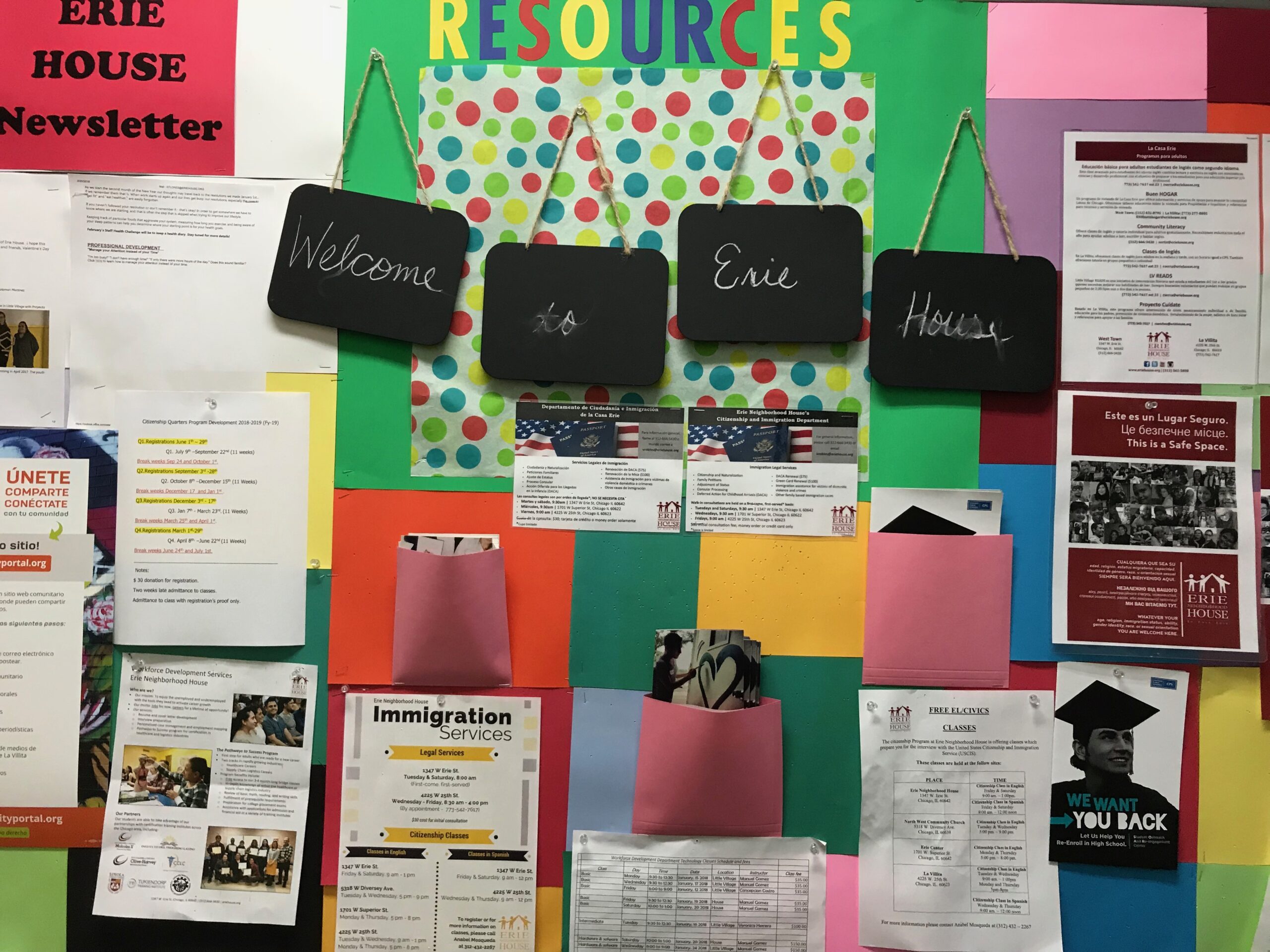
There’s a famous metaphor that alludes to this concept of empowerment through the idea of teaching an individual to fish versus giving fish to an individual. Teaching the individual how to fish allows one to continue being self-sufficient. Other times, the individual knows the skills, such as “how to fish”, but doesn’t have the resources. And yet other times, they don’t have a place where opportunities or “fish” are readily available. Thus, non-profit work and service work should ultimately be about giving clients the tools to be self-sufficient and assessing the needs of the clients instead of assuming or giving without empowering them. Many of the programs here at Erie House support this idea of empowerment and independence. Through the citizenship classes offered to youth mentoring programs, the philosophy is that we are helping a community help itself. We are helping individuals help themselves. We are empowering, not saving.
Therefore, through my service work at Erie House, I am learning to be an accountable, active member in society. I am learning to give the tools, link clients with the necessary resources, and ultimately act as a way of getting clients to their goal—I am not delivering their goals to them. In all, I am just an everyday person looking to give back to a community with the hope that the cycle of giving and empowering allows the community to thrive in new and bigger ways.
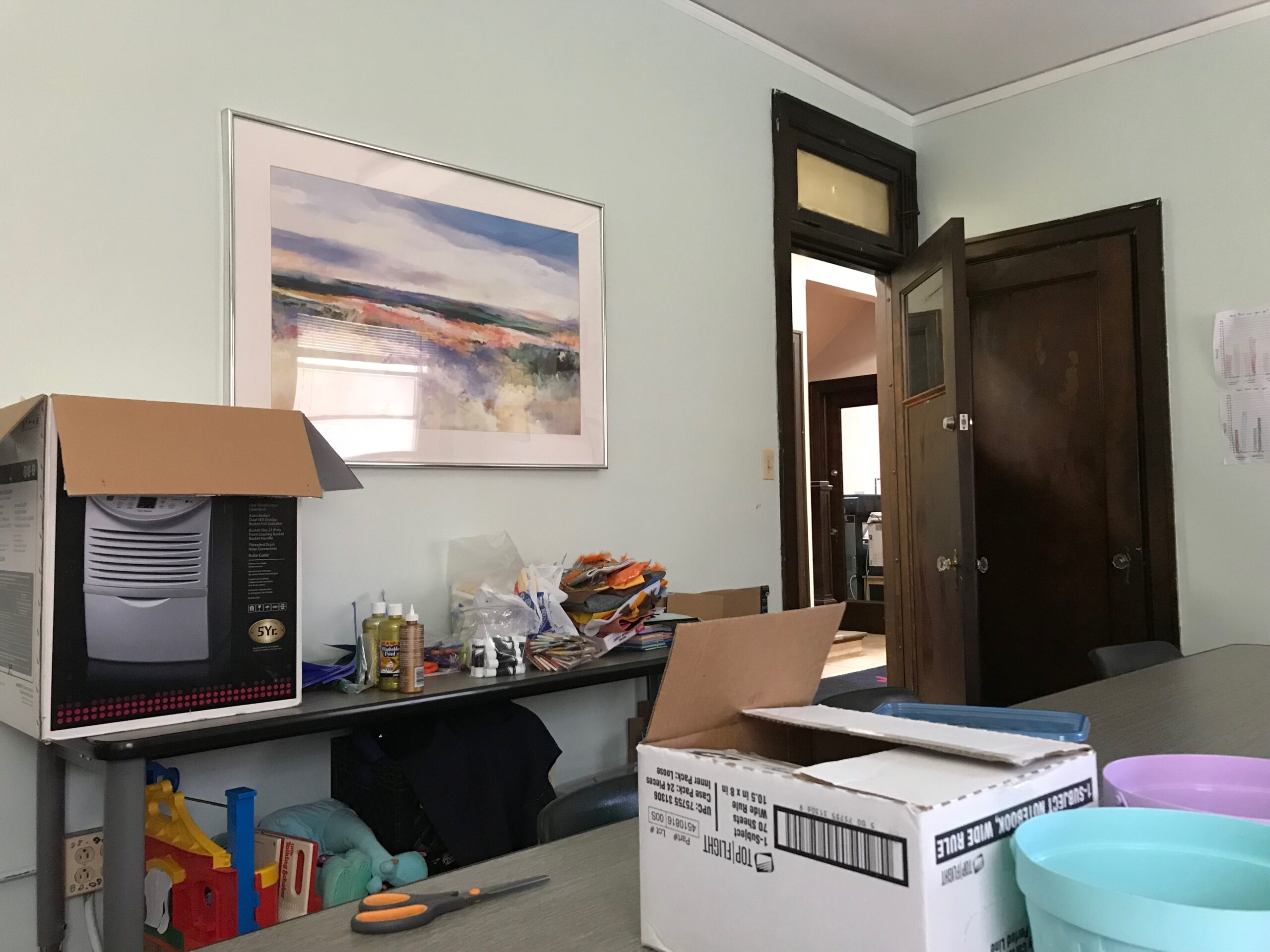
Even though the work I do isn’t always glamorous or “fun”, I know that in the long-run, I am serving an organization that is here for the right purposes and serving the community in the best ways it can through the programs and resources offered. So as I sit here and continue to sort crayons and crafting materials, I know that these seemingly trivial tasks are important to the community and to the organization as a whole.
“I get to do this every day.”
This thought has echoed within my mind repeatedly over the course of the last few weeks, carrying through the Chicago view from my apartment window, to the neighborhoods surrounding my brown line L commute, to the community-style lunches enjoyed by my department each day that bring together different cultures, flavors, and perspectives. I am reminded of it when I hear and learn new languages from my office desk, and when I witness the kind of joy that can only come from a two-year old ready to run outside to play. And though my first few weeks in Youth and Family Services have consisted more or less of blindly stumbling around while simultaneously trying to pretend that I actually know what’s going on, I remain thankful that I stumbled into Heartland. During these first few weeks in Chicago with Heartland Alliance’s Refugee and Immigrant Community Services team, I have had ample opportunity to reflect on the post-graduate transitions and new beginnings that, while new and exciting and overwhelming and meaningful, can also be difficult and stressful. This relatively very small transition on my part pales in comparison to the types of transitions that our participants are making–transitions to a new country, culture, language, and community, among so many other things. Coming into my internship, I knew that Heartland worked to help provide a space for the latter among our participants and staff- a space for community- but I am each day more fully beginning to realize the type of community that I myself am entering during this time of transition. Heartland is inherently relational in both philosophy and practice; something that I both resonate with and am constructively challenged by each day. Living out inherently relational sometimes means setting aside immediate tasks in favor of conversation with a participant, prioritizing people over productivity, and knowing that people can and must take that priority. These moments act as reminders that help me more fully engage in the relationships I claim to strive for, redefining my previous notions of professionalism in a way that prompts me personally to grow.
In  building these relationships, part of my work with Youth and Family Services involves K-12 extracurricular programming, meaning that last Wednesday, we hosted our annual Girl Power Pajama Jam (find a cooler work event, I dare you). During GPPJ, I had the opportunity to listen to, laugh with, and learn from some brilliant young women all while wearing PJs, eating pizza, and focusing on the theme “girls can do anything!” It is a unique privilege to be surrounded by women from all over the world, to witness them form friendships as they go, and to be simultaneously welcomed into those friendships (but maybe most importantly, to hear the incessant laughter that follows a 15-passenger van jam out session post-pajama party).
Yet our participants not only welcome us into their lives, but their homes, sharing stories and personal space. On a recent home visit, being granted the opportunity to enjoy tea with a Syrian family, we chatted about family and summer and Chicago, and I 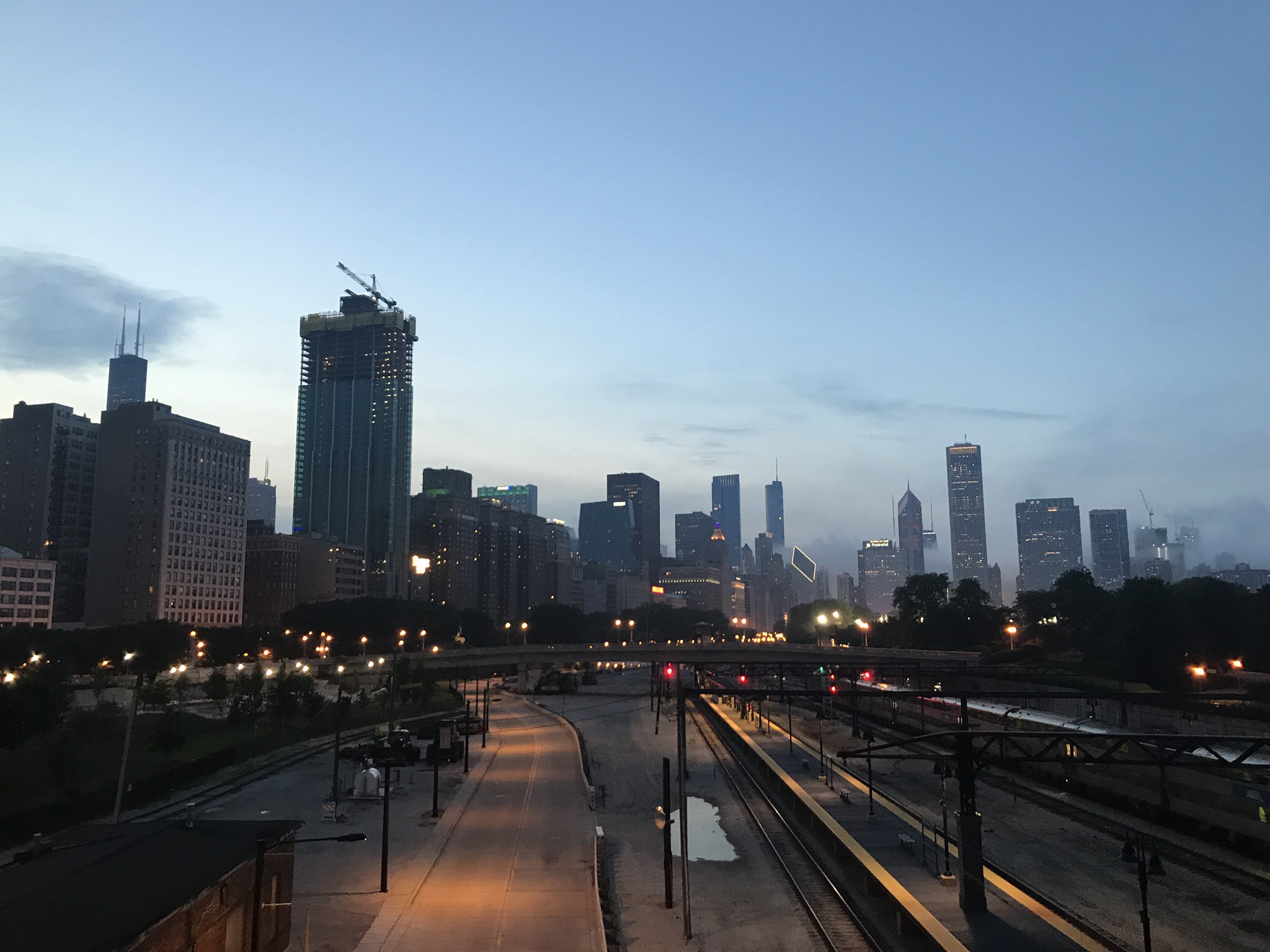 was asked about my recent move. After sharing that I appreciated my time in the city and at Heartland, a question was posed with sincere concern: “but do you have friends?”
Coincidentally, life also happens to be inherently relational, and it looks like this summer, I’ll be learning about priorities. I look forward to continuing to learn from my friends at Heartland Alliance.
When I was just beginning my CAPS placement process, my dream of what this summer would hold was a filmy concoction that I excitedly stirred; my recipe grew as I poured in stories that previous fellows had told me, sprinkled in the advice of every person that would answer me, and threw in a dash (or two) of anxiety for good measure.
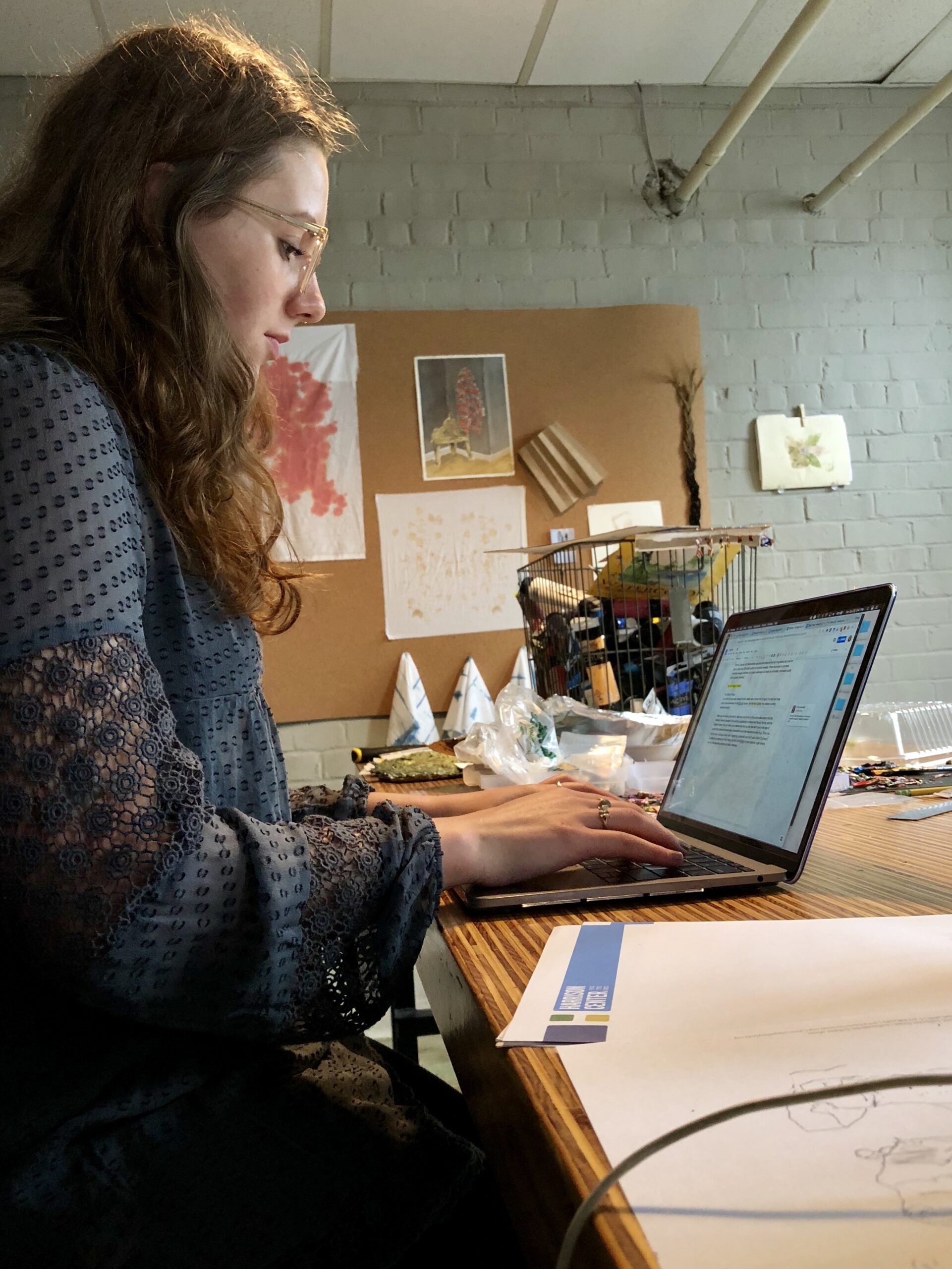
I like to reward myself towards the end of the day by moving downstairs to work in the resident studio of one of my new creative friends, Abi (who also took this artistic photo).
This past Wednesday marked exactly one month (it’s felt like two weeks!) that I’ve been interning at the Harrison Center as one of their many summer Cultural Entrepreneur Interns. I can confidently say that my dream had as many holes as it did substance and that I didn’t even need to cook it up (but who am I kidding– I’m definitely already gathering the ingredients for what I imagine the upcoming school year will bring).
One of the many epiphanies I’ve acquired and tucked away has been that it is okay to dream (and worry) about my future; even though I’m certain it won’t unfold in the detailed way I plan it in my head, it’s a part of my process for realizing what I want for myself and for those around me.
Yet parts of my dream have been greatly affirmed– like my vision of a free-flowing work environment that’s continually sparked and tamed by powerful, art-loving women, and my strengthened confidence in my writing abilities and future potential. I still get a few butterflies whenever I stop and think about how I’m working a stable, 9-5 job where my responsibilities entail writing (¾ of every day), interpreting art, strengthening community, and advocating for the persuasive and healing powers of the literary arts.
When I was filling out my application for the CAPS Fellows Program, I was very skeptical that there would actually be a real-world, successful organization with a mission to create change through art. At the time, I was freshly-obsessed with the concept of Artivism (art + activism) which I’m now happily able to say with certainty is one of my callings and purposes in society. It was when I first fell into the rabbit hole that is the Harrison Center’s website, that the flame for my future-summer-potion was ignited; I’m using my creative skills and passions everyday for a cause that’s bigger than me.
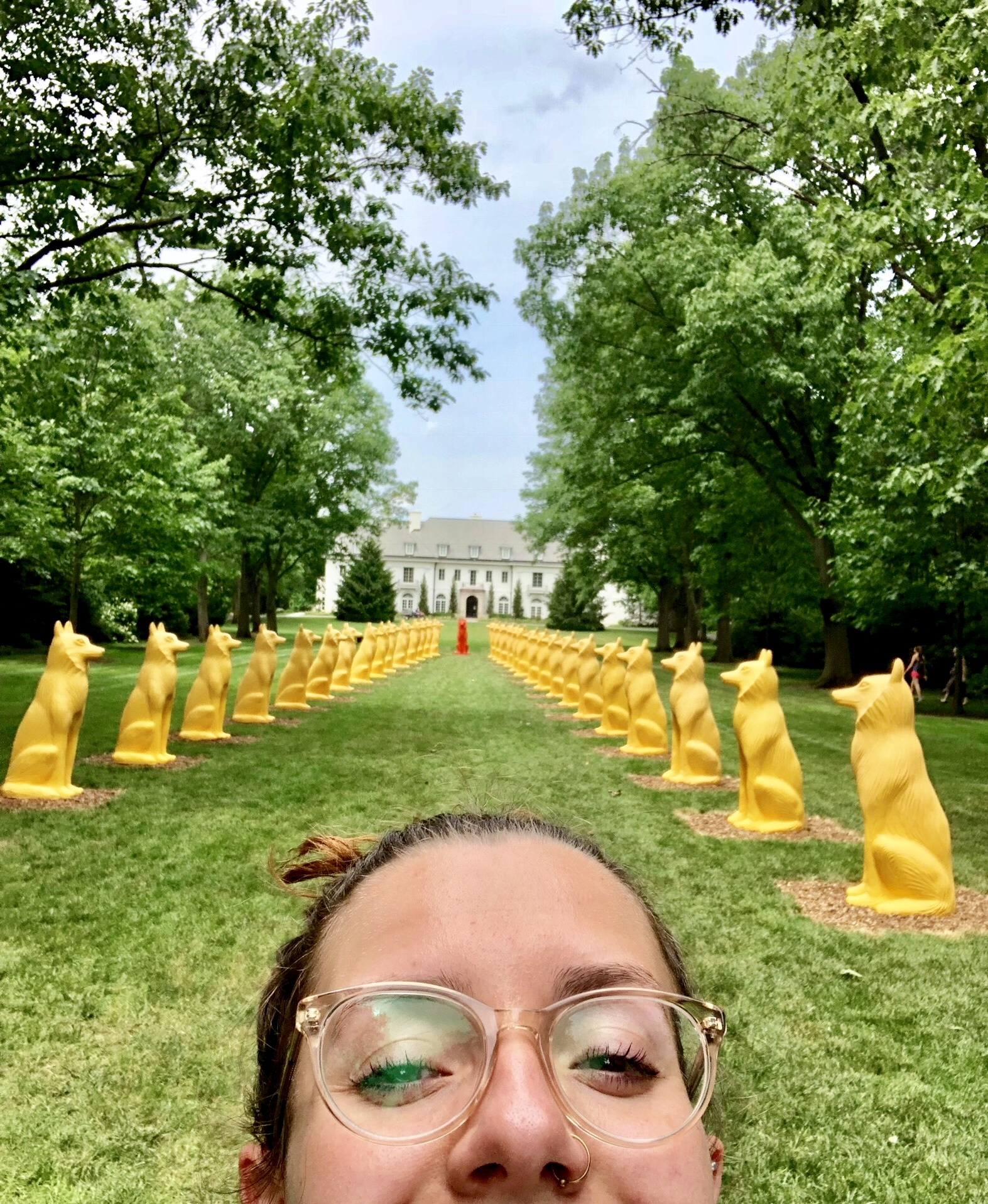
At the end of my first full week of work, my supervisor spontaneously invited me to come with her to the Indianapolis Museum of Art where I got to wander around for a few hours while she had a meeting.
My time in Indy has also filled some of the cracks of my dream that–at the time–I didn’t have the trust or courage to plant into my heart. Knowing that the literary arts is often an underestimated platform of expression, I was motivated to share with the Center what I envisioned. My supervisor, Joanna, trusted me with the freedom to choose how I wanted to execute this goal– as long as I was also blog-writing, taking initiative and advocating for myself. After my first couple days, I was feeling intimidated by the lack of writers that I was working alongside and the demand to push myself outside of my comfort-zone.
Flash-forward a week after my first day: I was leading about 20 people–fellow interns, HC artists, my supervisors, and a board member–in an Ekphrastic writing exercise where I guided them in interpreting their own subjective understandings of a 5×5 ft mixed media painting. The experience flew by and it went exceptionally better than I had ever let myself hope for. One of my coworkers told me after this week’s exercise that she never knew writing could help her process everything so well and that she can’t wait to implement this new skill into her coursework in the fall.
But more valuable than all these epiphanies (expected and not), was the fulfillment of a gaping hole in my filmy dream that I hadn’t let myself add to the recipe: the incredible friendships I’m forming with my cohort and fellow artists at the Center. I think God, fate, and Ali (not necessarily in that order) were definitely working in cahoots when arranging the people that have become instrumental to my summer in Indianapolis. My mind and heart have expanded–and will continue–to hold their different perspectives and dreams that I’m lucky enough to learn through our CAPS family dinners, bonding over shared artistic soapboxes with my coworkers, and getting caught in torrential downpours (maybe more than once).
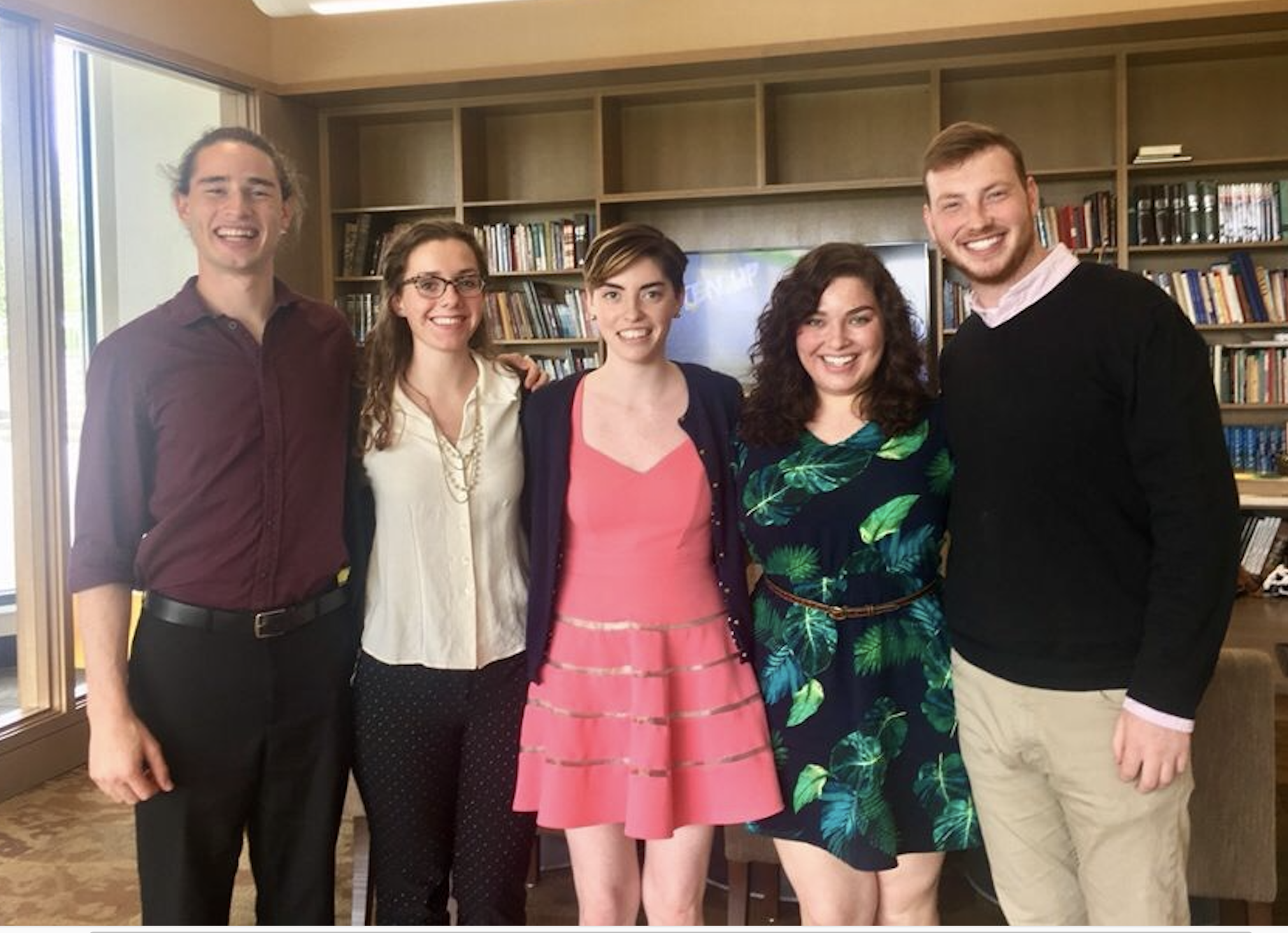
We took this photo before we even got to Indy but it’s actually the only one with everyone in it!
My family has always found me to be creative, whether that meant eating hot dogs like corn-on-the-cob at a young age or creating marvelous stories in school through my writing. Even though I, too, find myself to be creative to some extent, I would have never imagined working for an arts organization.
Wait a minute- it’s not just an arts organization. It’s an art organization for everyone and anyone. You may be thinking, Felicia, of course, anyone can do art, or at least, they could try to… why is it so special? But that’s where you’re wrong, imaginary conversationalist. I would venture to say most people think that spaces (whether outside, in school, at work) are inclusive and welcoming to all people, that is, until you are the person excluded by happenstance or purposefully. And this is where ArtMix comes in.
ArtMix meets people with disabilities where they are at, which is something that is often preached and valued but not practiced. It provides arts programming for all people with its main mission of “transforming the lives of people with disabilities through the creation of art”.
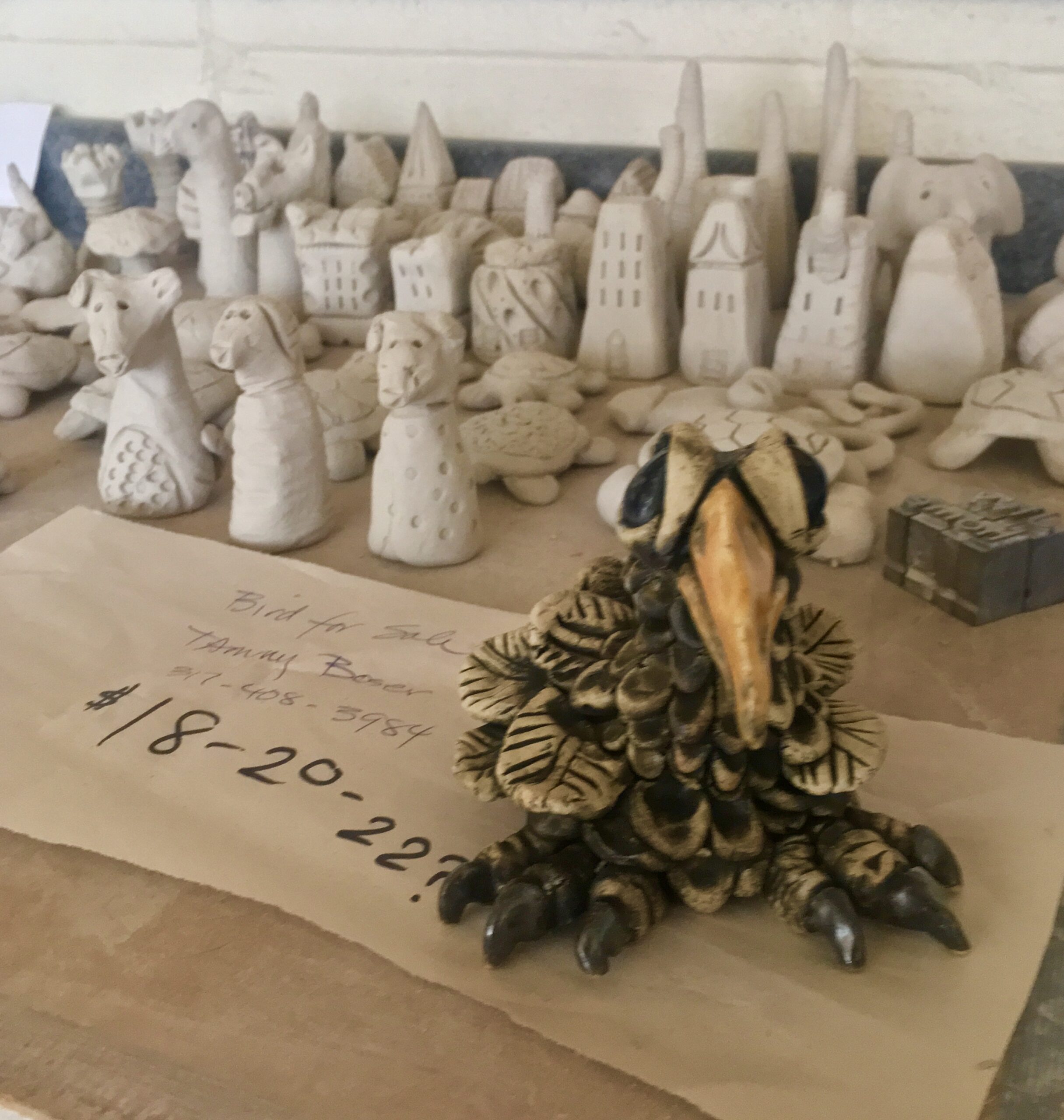
A clay bird that I’ve been eyeing, with a squid behind it that I have also been eyeing
One way that ArtMix has changed the way I think is that it makes me aware of accessibility issues. The first week I arrived in Indianapolis, other CAPS fellows and I walked around town to explore what the city has to offer. After walking a very long time, over twelve-thousand steps I believe, we sat down under the shade of the public library’s trees. It was then that I noticed how people in wheelchairs would have a hard time maneuvering the streets since there is constant construction. My friends and I were able to jump and navigate around construction, but a person in a wheelchair would not be able to do that. I struggle to write this because I know that people with disabilities have agency, yet there are barriers that go unnoticed that make life harder for them to live.
Even though some would say that people with disabilities are handicapped, they are even more handicap-able. I don’t know where I first heard the term, but I try to switch my terminology because I believe it is important to give people more agency than not (thank you, Ed professors). We cannot use our differences, and in this context, the differences of actual and perceived ability, to forge a social (and therefore a mental and emotional) barrier; rather, we must celebrate differences and bond over similarities as best as possible.
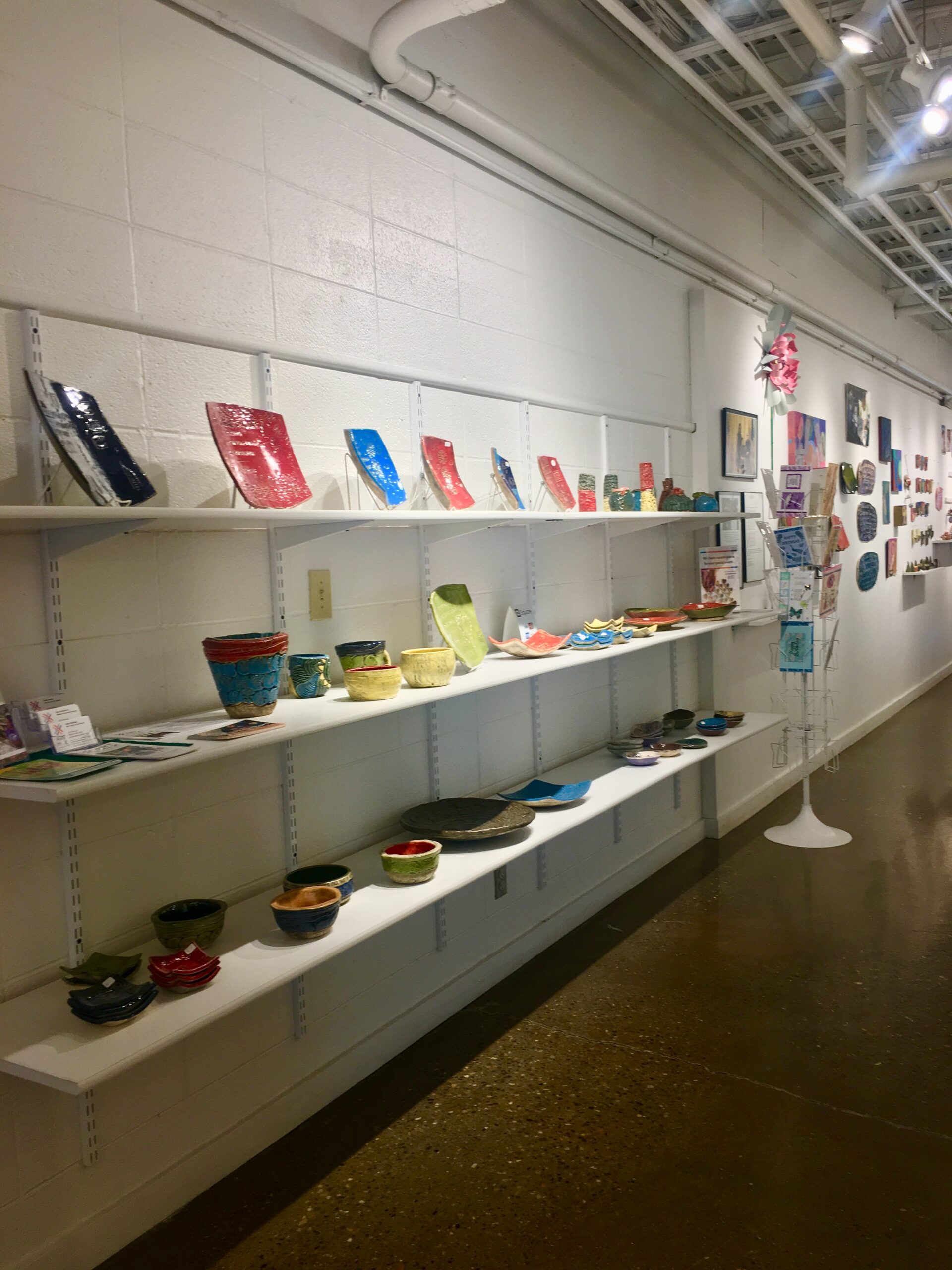
The ArtMix Gallery, displaying the artwork of our Urban Artisans
Even though I have worked at ArtMix for nearly one month, the nonprofit world is still a foreign one to me; I can say that I am slowly getting the hang of it, but there is still a lot that I have to learn. Sure, I have volunteered for a nonprofit before (shout-out to the Lake Erie Nature and Science Center), but I have never truly been behind the scenes. Now that I am in the hustle and bustle of a nonprofit organization, I can say that though I knew it demanded a significant amount of work, it is much more detailed work than anything that I assumed. Under the umbrella of development, the ArtMix team created, planned, and implemented our events Here’s the Scoop and ArtMix Home Tours with the help of staff and volunteers. We did everything from advertising, alphabetizing, analyzing- and that’s just the “A’s”. Needless to say, we were booked every day making sure each event would go swimmingly. Programming, communications, development, and CEO leadership are all one-stop shops when in regard to staff members; this still astounds me and reminds me of the passion people have for this cause.
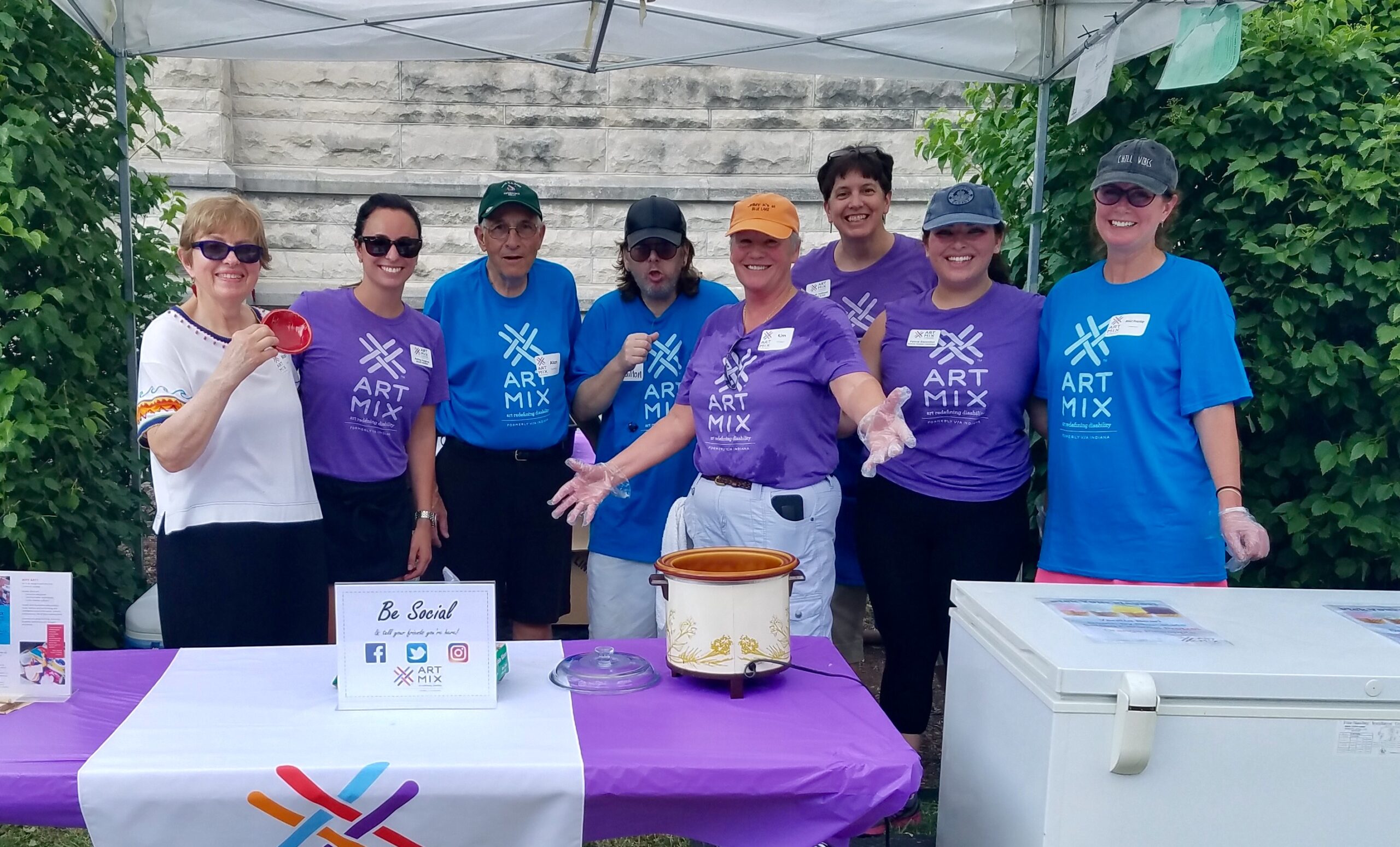
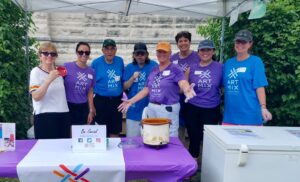
Volunteers and staff at our Here’s the Scoop event
Something I have noticed is that ArtMix has a difficult barrier to overcome, for it is on the unfavored side of both the social scene and the arts scene. ArtMix is “low art”, which to my understanding is more down-to-earth and less prestigious. And socially, ArtMix works with a community that is considered “The Other”. This combination is unique, which makes the organization incredibly personal, in my opinion. But this organization- and other ones that reach out to minorities -is pivotal and essential for the people it serves. And that is one of many reasons why I want to be a teacher and pursue the field of education: I aim to build relationships and develop students to a better version of themselves. And furthermore, my passion still remains to make education more equitable. These silent heroes, the people who work for the betterment of others, are the company I plan on keeping.
Outside of work, CAPS has truly blessed me with an opportunity to be independent with other like-minded college students- sometimes it’s fascinating how similar we are. Every evening, we make dinner for one another every night, which I should say is kind of funny, considering we consist of two vegetarians and one person who is lactose-intolerant (so, yes, we are basically vegan for dinner). I really enjoy this, partly because it is routine, and partly because it is a time to catch up and talk about whatever we want to. Sometimes the discourse is silly and lighthearted, but other times, we find ourselves dissecting, and I mean this in all my “millennial” seriousness, the problems of the world and how we find our futures to intersect with them. It is at these points that I like to engage as well as sit back and watch while the people around me exchange thoughtfully eager remarks. Early on, we learned that, for the most part, we have learned that our future careers and our current placements are seemingly thankless yet significant jobs, which I assume most jobs with a foundation on human interaction are. We will be those silent heroes, I’m sure. We’re simply in training right now.
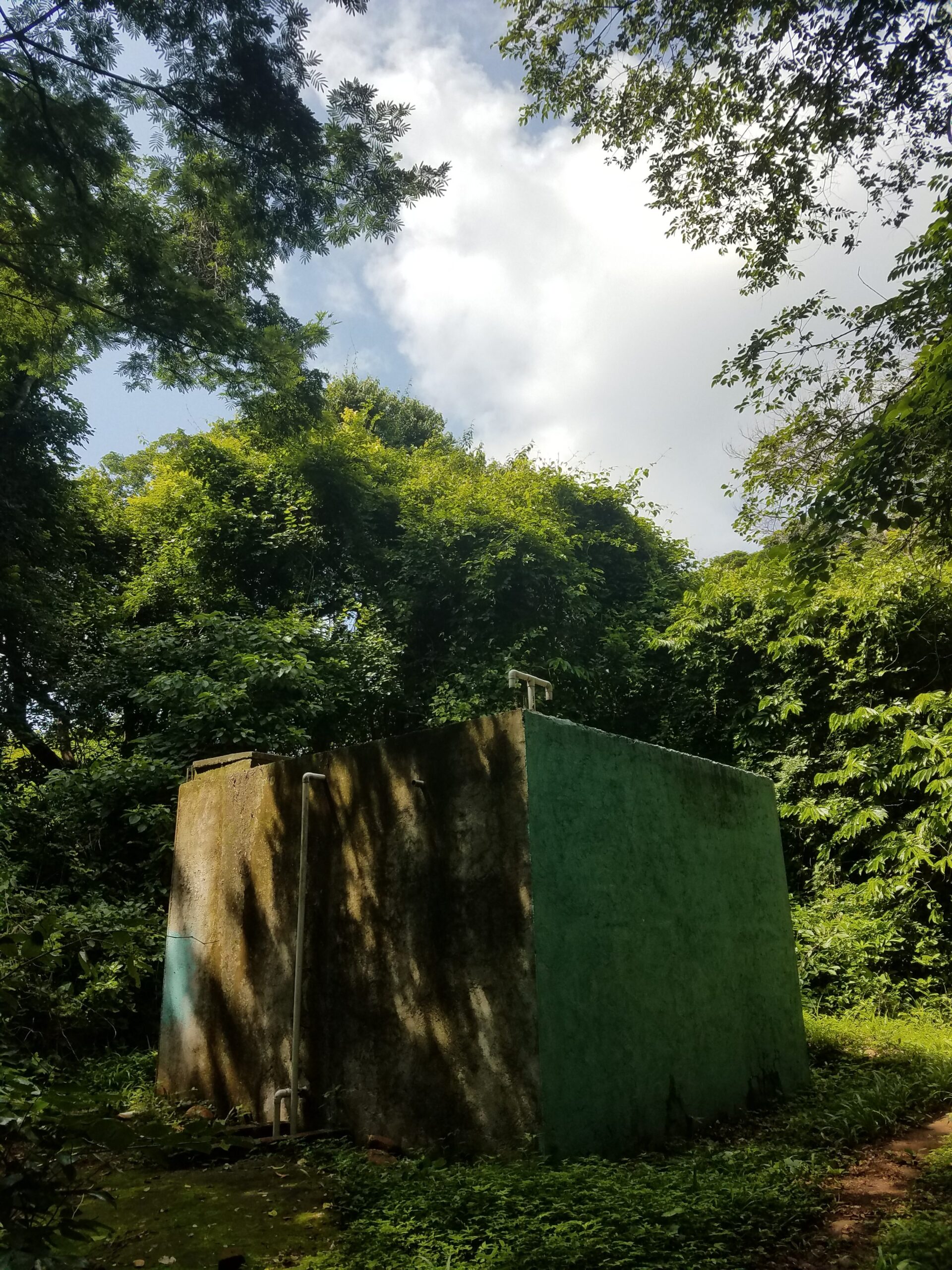 Companion Community Development Alternatives (CoCoDA) is a small organization with far reaching effects. CoCoDA partners with local organizations and communities in El Salvador and Nicaragua to accomplish community building projects. To do this, communities dictate which projects to work on and CoCoDA facilitates the project process and provides resources for the project’s completion. They occasionally plan trips with external organizations (many of these being universities) to help in the implementation.
The organization originally peaked my interest because of it’s thoughtful approach to volunteering in a world where international volunteering has been somewhat sensationalized in the form of short term volunteer trips. I wanted to learn more about the effects of crossing cultural boundaries with good intentions, and how to minimize any possible negative effects. Spending two weeks in El Salvador with CoCoDA showed me that CoCoDA is among the unfortunately small ranks of organizations that realize that good intentions are not necessarily enough in international volunteer situations.
Judith Lasker, professor of sociology and anthropology at Lehigh University conducted a study researching short term medical volunteer trips (detailed in the book Hoping to Help). In doing so, she creates a list of nine separate criteria that, if met, will lead to the most positive experience for the host community. These nine, while derived specifically for medical trips can be generalized for broader short volunteer trips, like the ones that CoCoDA organizes. The nine criteria are:
· Foster mutuality between sponsor organizations and host-country partners at every stage
· Maintain continuity of programming
· Conduct substantive needs assessment, with host-community involvement
· Evaluate process and outcomes and incorporate the results into improvements
· Focus on prevention (medical trip specific)
· Integrate diverse types of health services (medical trip specific)
· Build local capacity
· Strengthen volunteer preparation
· Have volunteers stay longer
CoCoDA has taken these criteria and thought very carefully about the application of their delegations in host countries. In everything that they do, CoCoDA strives to remain culturally sensitive and provide long-term solutions rather short-term ones, solutions that build capacity and trust between peoples. During my trip I was able to visit projects sites that had been completed, project sites that are currently under construction, and meet to discuss potential new projects. The projects that CoCoDA assists in implementing range from schools to water systems. They have been involved in constructing roads as well as setting up scholarship programs, each of these are projects dictated by the communities that they are benefitting. By giving the communities the autonomy to decide the nature of support, it promotes mutuality, builds capacity, and is usually more sustainable in the long run.
The first week of the trip focused on learning the history of El Salvador and ensuring that the delegation was aware of our responsibilities visiting as USA citizens. This meant visiting sites of massacres, assassinations, listening to the stories of people, and visiting museums. Much of what we learned centered around the Salvadoran civil war in which the USA played an integral role. Throughout the civil war, the people faced brutal oppression from the government, and due to communist ideals promoted among the guerrilla troops, the USA financed the Salvadoran government. This support, however, allowed the country’s government to continue its ironfisted suppression of the peasant class giving way to massacres and assassinations to anyone who spoke out against the government. As a United States citizen, it was sobering to realize that our money supported the Salvadoran government before and throughout the civil war, supporting these heinous acts. This illumination of Salvadoran history as well as United States history played an integral part in our preparation, humbling us as US citizens while we interacted with the people of El Salvador.
CoCoDA’s goal with short-term volunteer trips is to facilitate experiences that could lead to support from visitors later on. Ideally, delegates would come back from trips and champion the image of a more just relationship between US citizens and Central Americans, being more likely to take it upon themselves to contribute meaningfully to the betterment of others.
During our stay in a hostel in Suchitoto (a city located north of San Salvador), I connected with three young men around my age. They were from Nicaragua and patiently helped me through the very rough Spanish that I had accumulated through Duolingo. Hanging out and hearing them speak so fondly about their country’s beauty and hearing the anguish in their voice as they told me how they worry for their family’s safety throughout the current conflict was a powerful experience. It was clear to me that these people loved their roots, that they were proud of who they were, hoping for the best in their countries. In the States, the common stereotype assumes that Central Americans do not like their own countries and want to immigrate to the US, but these three men as well as many others that I met in El Salvador made it clear that this is not a stereotype that holds. Most Central Americans love their country and would only emigrate if their lives were in danger.
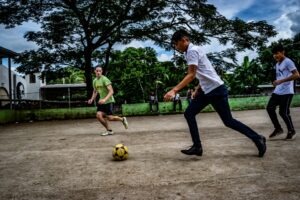
The experience I had traveling in El Salvador was a wonderful and focusing experience. I do not know where I will end up in my professional life, but this trip has helped strengthen in me my desire to work for and with organizations like CoCoDA.
I call Indiana home, but not by choice. My mom grew up in southern Indiana, and my dad thought the combination of her and the low cost of living was a great deal. I used to think the state was just boring, as expected of an eight-year-old surrounded by constant road work, potholes, and soy. Ignorance was bliss, because I didn’t start to notice the greater flaws until I started to question and explore my identity. My domineering feminist phase revealed that the “Midwest charm” includes casual misogyny and a severe lack of women in leadership roles. The feminist phase evolved into love that I had been taught by society not to accept. I know other kids have it a lot worse, but it is less than ideal being gay in Indiana. I thought it was just a regional thing at first, then I went to college and not much changed as far as attitude towards and education about LGBT issues. I sought out CAPS primarily for the opportunity to achieve my lifelong dream of getting out of the Crossroads of America, and I’ve landed a whopping two hours from my house.
This isn’t an entirely sour narrative, I just really want to exaggerate how low my expectations are for any part of Indiana, including Indianapolis. I was excited for the next level of independence: my first internship and living on my own with people I enjoy. To say Indy surprised me is an understatement, I think “shocked” is more appropriate. I’ve established myself in a safe living and working environment, and there’s so much individual, community, and city support for some LGBT needs. I’ve met wonderful allies and community members, all of who have directed me to helpful resources, gay friendly spots, and background on what the LGBT scene looks like in Indianapolis. Companies are in on it, too, and although it’s likely to make a profit it’s still refreshing to see. The support helps me thrive, and I can easily say this is one of the best summer’s I’ve ever experiences; however, I learned very quickly that the same energy and support does not extend beyond Indianapolis.
It’s like living in a mostly accepting bubble, and if you’re in the bubble why should you worry about what’s going on outside of it? I’ve lived outside the bubble for 20 years, and I know how rough it is without accessible resources or the communal willingness to learn. I’m grateful to have both an inside perspective, but I know I’ll never be fully comfortable living here and knowing what others face just beyond city limits. I always thought I’d want to live in a city, but my observation of Indy makes me wonder if I’ve been disillusioned by other cities before. A lot of gay kids dream about moving to a larger city because they’re generally more progressive and accepting, but the desire for change falls flat the city’s end. The mentality encourages people to come to places that range from okay to wonderful rather than use the resources available to change the areas that LGBT youth are running from. I want to know how I can do my part without forcing myself to live somewhere where I don’t feel welcomed, but I don’t want the coziness of the bubble to deafen me from those that can’t just pack their bags and go. I grow queasy thinking about those who’ve been in the bubble all their lives, knowing that what they have going on for them is unique, beneficial, and necessary for personal growth. I doubt it’s intentional, but there’s a lack of education here just as there is outside of big, progressive cities. I wonder what would happen if the bubble popped.
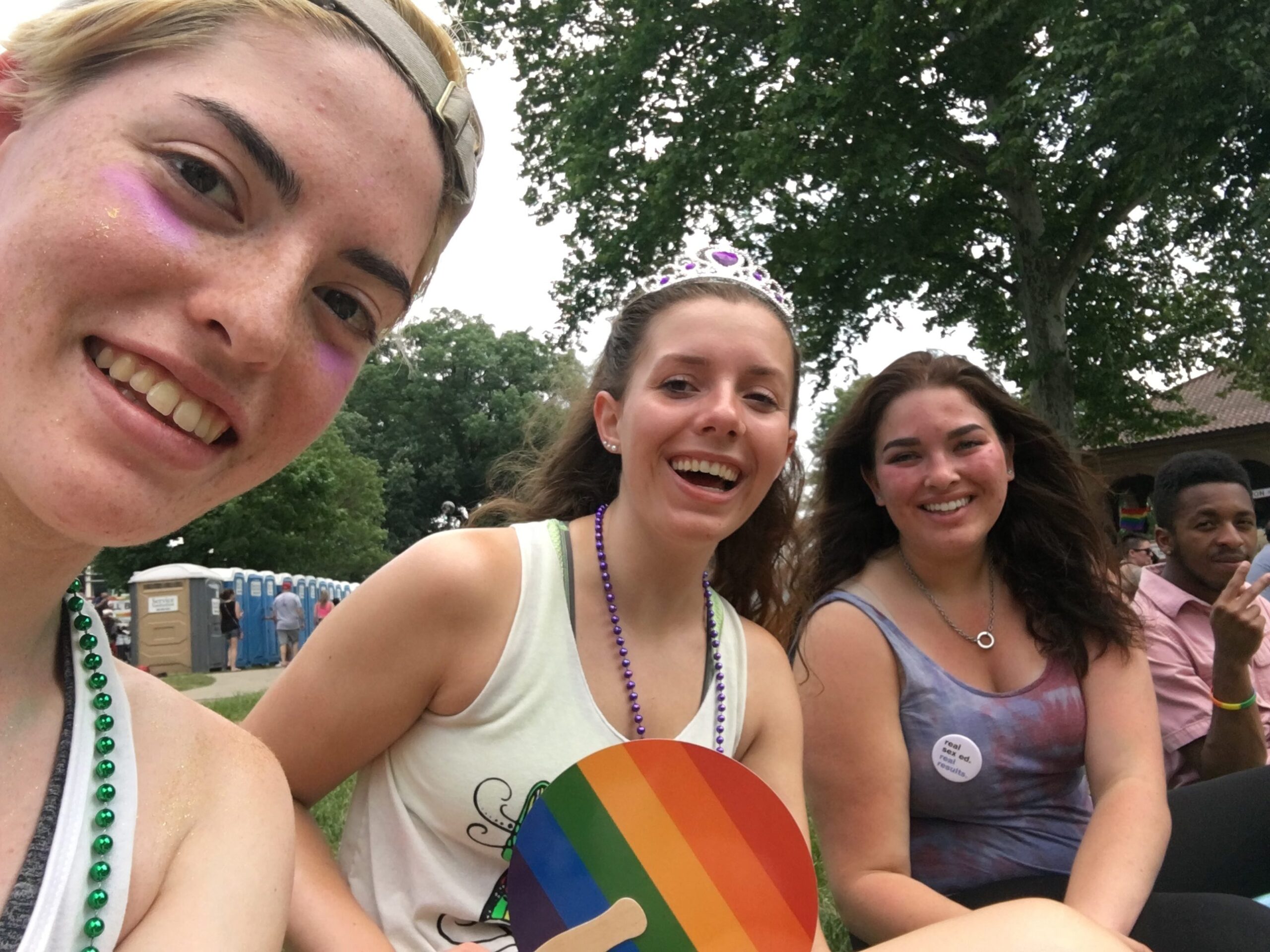
When applying to be a CAPS Fellow, I had a limited understanding of what that meant. I knew from former Fellows that it meant interning at “real” job, travelling to that “real” job, and spending my summer gaining some experience. But, just what exactly was that job? Where would I be going? Staying? Doing? To be honest, those questions are hard to answer. The best way to understand it is to experience it.
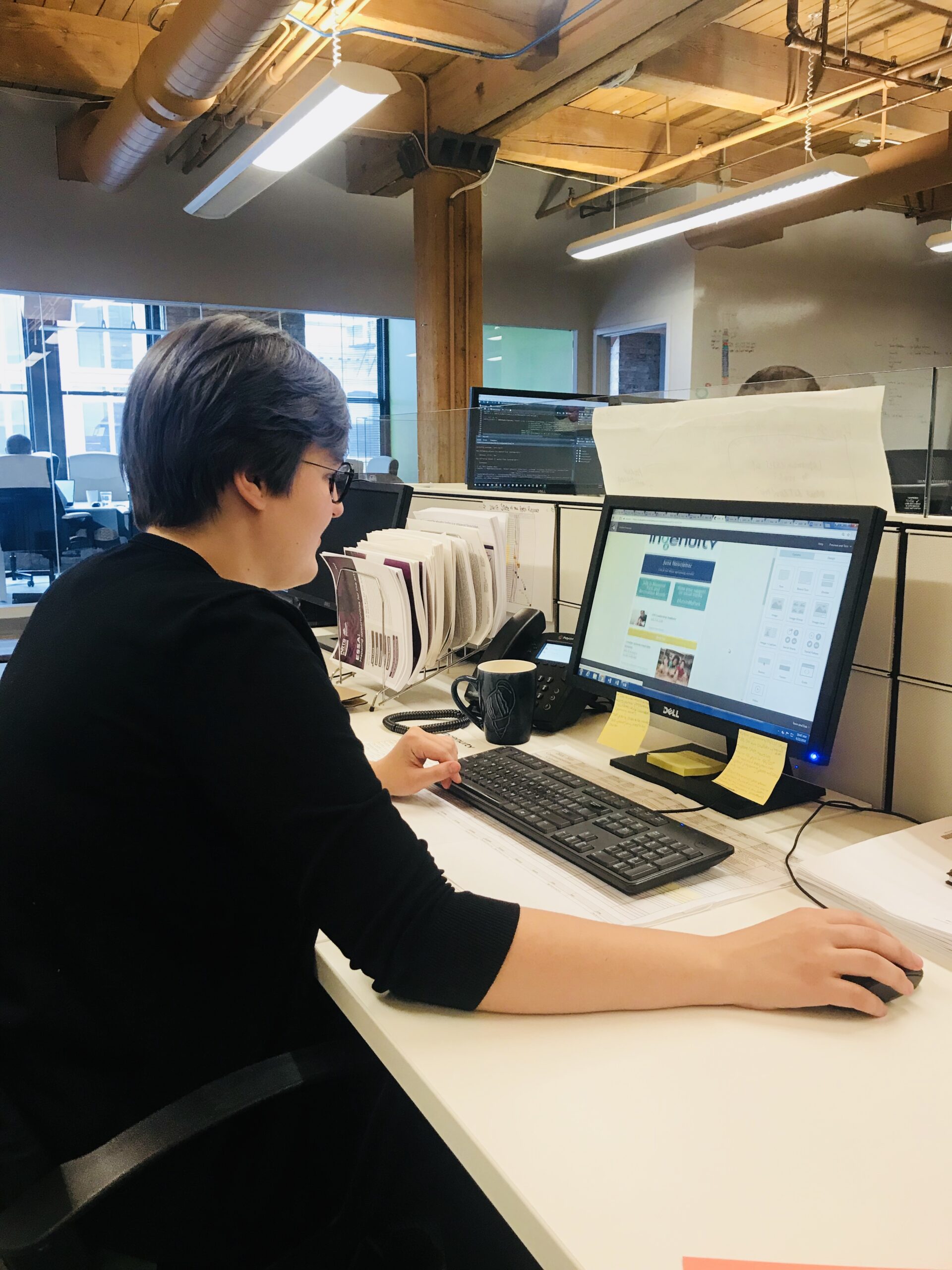
The first day I started at Ingenuity was the first day that I really understood what that non-profit does, and, really, I don’t think anyone could have explained it to me beforehand. There’s a process, I’ve learned, that comes with entering a new space (a new workplace). It’s a whole new environment, and, to do the job right, you need a lot of context for why your colleagues do the work they do and why. Before arriving, I browsed their website and googled the work they did in the past, but I began to understand more just by being there.
What do I mean by that? I mean: you learn most about your CAPS Fellows placement just by listening in on meetings, listening to your colleagues chat about the work, and having your colleagues explain to you how their work contributes to the larger trajectory of the organization.
And, please, ask questions!! It’s really easy to let yourself feel like you’re not qualified or as experienced as your colleagues, and that might make you feel like you should remain quiet so as to not disrupt the work going on, but don’t! In my experience, folks are so happy to bring you into the conversation. They want your input! So, if there’s clarification that you need in order to make meaningful contributions to the conversation, by all means ask for it!
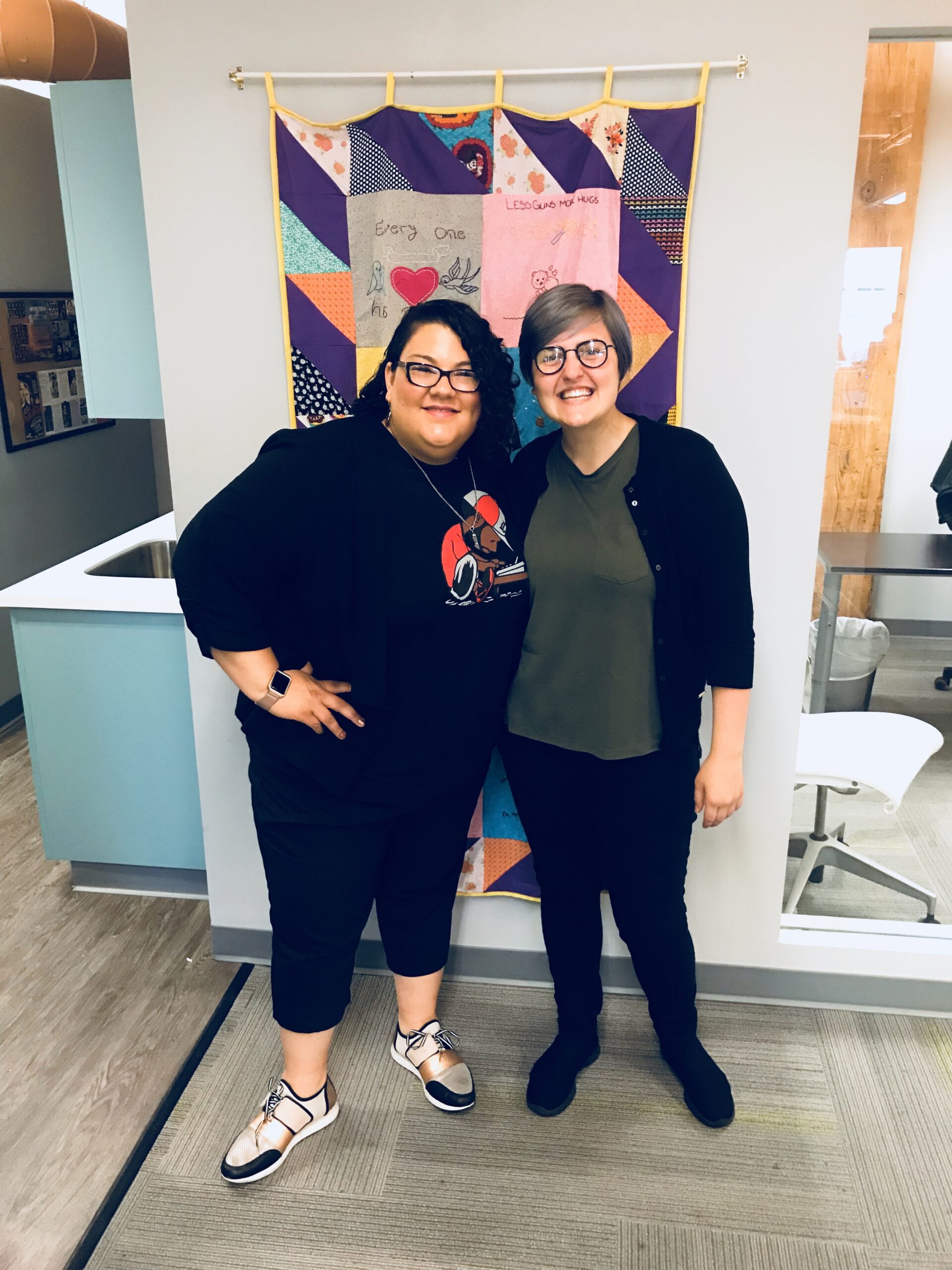
At Ingenuity, I’ve learned (through asking questions) that the organization’s goal is to bring arts education to every Chicago Public Schools student. One of the questions I asked: “How does Ingenuity do that?” Once I learned that Ingenuity is the Chicago ‘hub’ that tracks arts partners (organizations like: museums, galleries, creative working studios or any places that provide access to arts education) and teaching artists (in the classroom) at every school, I could then ask questions like, “What resources does Ingenuity provide that connects arts partners and teaching artists?” Their response is: Ingenuity provides several training sessions available to both partners and teachers throughout the year in order to inform them how they can use Ingenuity’s resources to their benefit (like arts grants), advocate for the continuance and addition of arts ed in schools, and much more. After learning the basics, through asking questions, I was able to not only understand the work that was going on but also where I could contribute to the conversation. It was because I asked questions that I got myself assigned to developing one of the training sessions I was most interested in (storytelling as an advocacy tool!).
So, just relax, believe in your own ideas, and trust that people want you to succeed, and then you’ll have an amazing time at your CAPS placement, meeting tons of wonderful people!
Living in a new place can be an exhausting process of navigating the unfamiliar. The first few days are usually filled with trying to get comfortable in a new space. For me this included finding where to buy groceries every week, the route I would take to my internship every day, and a good, nearby coffee shop. These small forms of comfort and routine help create the space for an unfamiliar place to become a community.
On the morning of the first full day at my internship, the crowded processing room was full of applause, as everyone celebrated accomplishments and got motivated for the day. During the morning meeting we discuss the theme of week, which for my first week was “community”. As a result, I spent time that week reflecting on community and what it meant to me in the context of my recent, unfamiliar surroundings. In new places, community is something I think might feel absent at first but can quickly emerge and come together.
Before explaining more about my notion of community in a new place, it might be useful to explain more about where I am interning. My CAPS placement is quite different from many of the other CAPS placements and from most internship experiences in general. I am interning at Growing Home, Chicago’s first and only high-production, USDA certified, organic urban farm. Yes, that’s right, I’m interning at a farm. In the city of Chicago.
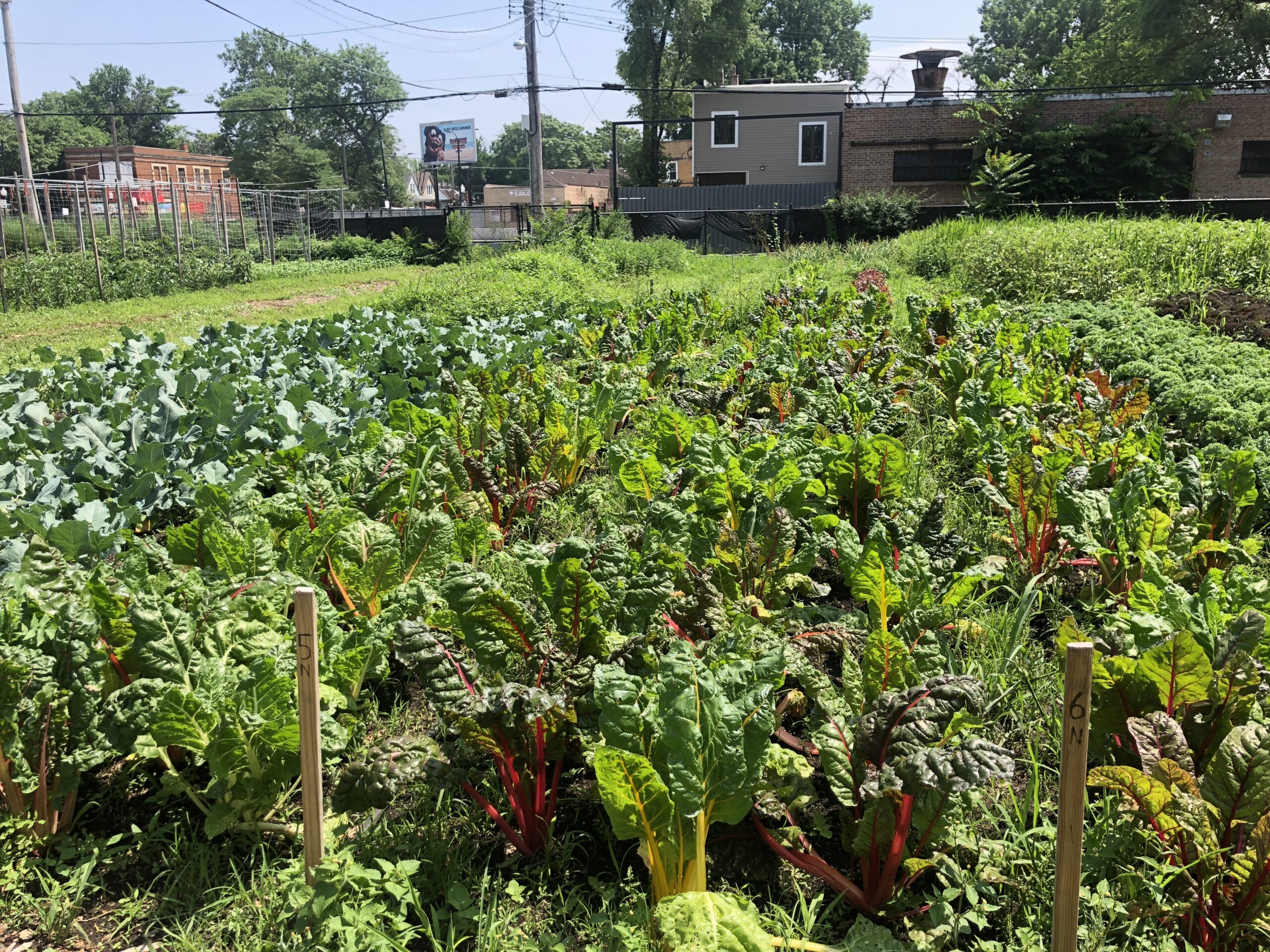
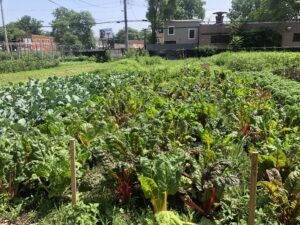
A view of the field on Honore Street, one of Growing Home’s two lots. Look closely to see the delicious and colorful swiss chard.
Upon telling people my placement, most did not know urban farms existed, or they assumed the farm was just a glorified garden. However, let me assure you, a garden will not produce 30,000 pounds of produce annually. At Growing Home, I work within the Community Engagement department which seeks to make the farm a space that is open and accessible for the surrounding, Greater Englewood community and other nearby neighborhoods, various organizations, schools and universities, and larger communities interested in urban agriculture within the city of Chicago and across the U.S. As the Community Engagement intern, I assist with our events and activities which include tours of the farm, weekly cooking demos, our annual block party, and tending to our learning garden which gives people an opportunity to interact with the plants and occasionally harvest a few vegetables to take home and try. Through these events as well as produce and seedling donations, the Community Engagement department helps improve food access in nearby communities where fresh and affordable produce is less accessible.
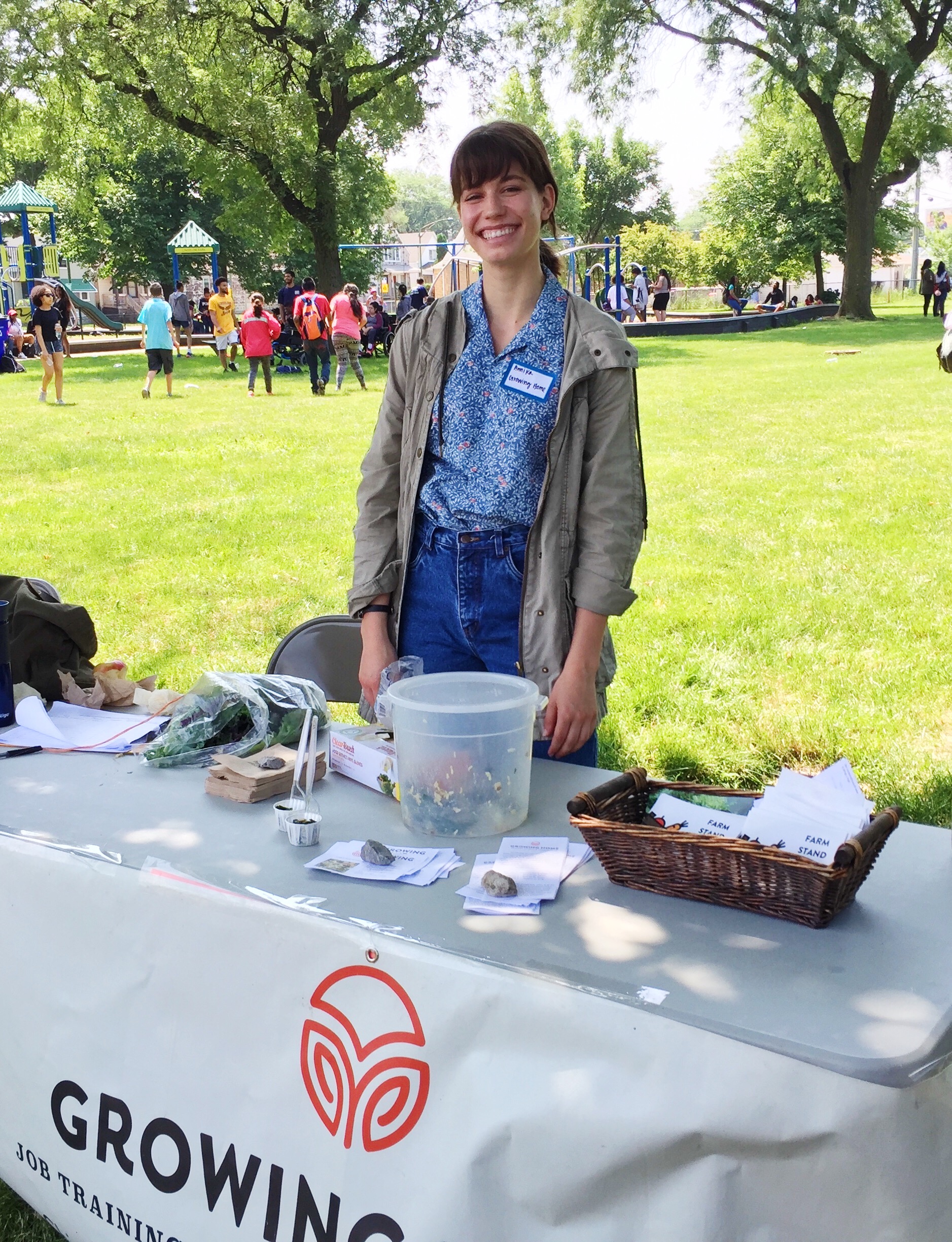
Tabling at a community event organized by a local high school where we served samples of a rice dish with kale from the farm.
Outside of Community Engagement, Growing Home runs a 14-week employment training program for adults who experience barriers to employment. During this program, participants work as Production Assistants on the farm and work through a job-readiness curriculum in the classroom.
Although I have only been in Chicago for three weeks, it amazes me how quickly I’ve begun to find a sense of community. Whether it’s among the Growing Home staff who have made me feel so welcome, and who are always willing to share their favorite ways to prepare the vegetables we grow on the farm, or the CAPS Chicago cohort who I hope to share many more adventures with in the coming weeks (especially more $1 Taco Tuesdays). So far, my time in Chicago and at Growing Home has taught me the importance of finding and creating community with those around you, and even though the time I will spend in these new communities is limited, I know the lessons I will learn and the relationships that form will extend far beyond my CAPS experience.